

Radiator with Aluminum Fin and U-Shaped Tube (CHT)
Price: $8
The present problem simulates the performance of a radiator using ANSYS Fluent software.
Radiator with Aluminum Fin and U-Shaped Tube (CHT)
Price: $8
The present problem simulates the performance of a radiator using ANSYS Fluent software.
Radiator with Aluminum Fin and U-Shaped Tube, ANSYS Fluent CFD Simulation Training
The present problem simulates the performance of a radiator using ANSYS Fluent software. In this modeling, a two-way pipe made of aluminum is designed; So that the water flows inside a U-shaped tube and moves in a two-way direction in the radiator. Water flow with a velocity of 1.4 m.s-1 and a temperature of 343.15 K enters the U-shaped tube and exits at a pressure equal to atmospheric pressure. The radiator's outer body and aluminum fins have convection heat transfer with their surroundings. The ambient temperature equals 290 K, and the heat transfer coefficient equals 10 W.m-2.K-1. Therefore, the radiator uses the water flow heat inside the U tube to transfer heat to the low-temperature environment by conduction and convection.
Geometry & Mesh
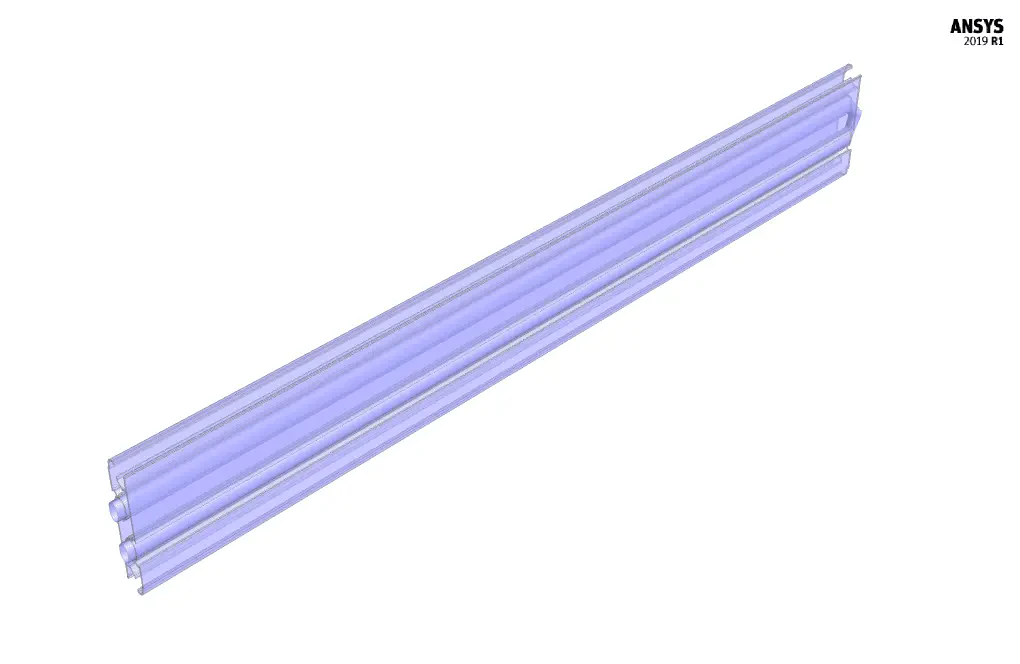
The present model is designed in three dimensions using Design Modeler software. This model is related to a radiator, so a reciprocating U-shaped tube is placed inside the aluminum fins of the radiator.
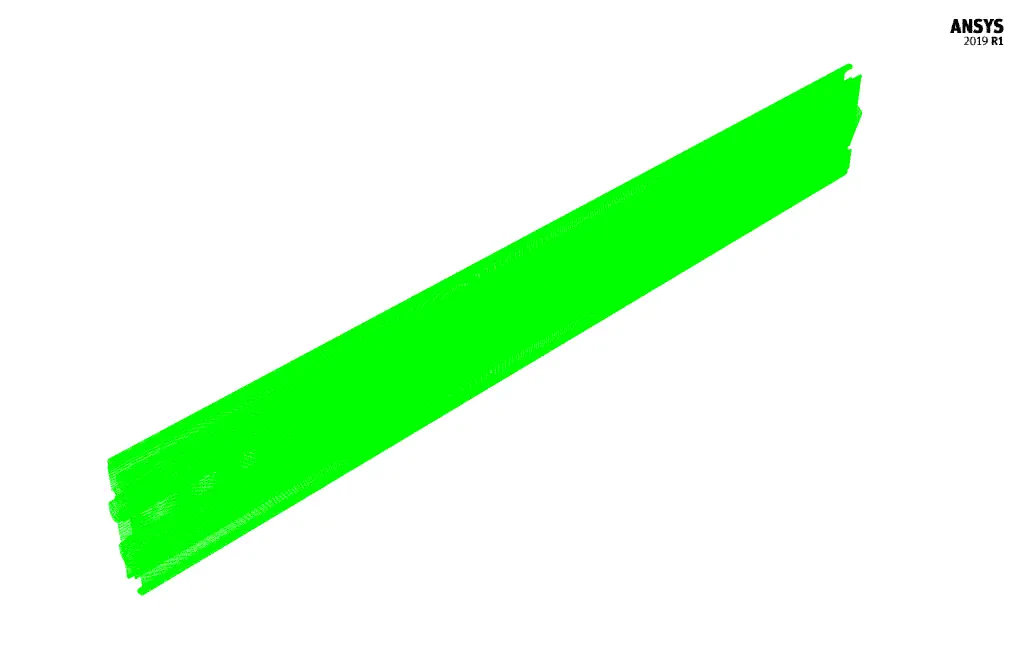
We carry out the model's meshing using ANSYS Meshing software. The mesh type is structured. The element number is 759660. The following figure shows the mesh.
CFD Simulation
We consider several assumptions to simulate the present model:
- We perform a pressure-based solver.
- The simulation is steady.
- The gravity effect on the fluid is ignored.
The following table represents a summary of the defining steps of the problem and its solution:
| Models (Radiator) | ||
| Viscous | k-epsilon | |
| k-epsilon model | standard | |
| near wall treatment | standard wall function | |
| Energy | On | |
| Boundary conditions (Radiator) | ||
| Inlet | Velocity Inlet | |
| velocity magnitude | 1.4 m.s-1 | |
| temperature | 343.15 K | |
| Outlet | Pressure Outlet | |
| gauge pressure | 0 pascal | |
| Inner Wall | Wall | |
| wall motion | stationary wall | |
| thermal condition | coupled | |
| Outer Wall | Wall | |
| wall motion | stationary wall | |
| thermal condition | convection | |
| heat transfer coefficient | 10 W.m-2.K-1 | |
| free stream temperature | 290 K | |
| Methods (Radiator) | ||
| Pressure-Velocity Coupling | SIMPLE | |
| pressure | second order | |
| momentum | second order upwind | |
| turbulent kinetic energy | first order upwind | |
| turbulent dissipation rate | first order upwind | |
| energy | second order upwind | |
| Initialization (Radiator) | ||
| Initialization methods | Standard | |
| gauge pressure | 0 pascal | |
| velocity (x,y,z) | 0 m.s-1 | |
| temperature | 300 | |
Radiator with Aluminum Fin and U-Shaped Tube Results & Discussion
After the solution process, two-dimensional and three-dimensional contours related to pressure, velocity, and temperature are obtained, and temperature and heat flux contours on the outer surface of the radiator U-shaped tube. The contours show that the high temperature of the water flowing inside the pipe causes heat transfer with the cold aluminum fins, and the temperature of the fins increases due to the conduction heat transfer, and then the hot fins transfer heat to the cold environment by convection.