

Radiator considering Internal Flow CFD Simulation
Price: $6
In this project, a radiator with an internal flow has been simulated and the results of this simulation have been investigated.
Radiator considering Internal Flow CFD Simulation
Price: $6
In this project, a radiator with an internal flow has been simulated and the results of this simulation have been investigated.
Radiator considering Internal Flow, Ansys Fluent CFD Simulation Training
In this case, we simulated an internal flow radiator is simulated by Ansys Fluent software. In this modeling, the hot oil is cooled with cold water so that a spiral tube in which the oil flows into a rectangular cubic chamber that Water is flowing inside it. The oil inlet velocity is 0.05 m / s with a temperature of 400 K. The water inlet velocity is 0.01 m / s with a temperature of 273 K. Both fluids are discharged to an environment at atmospheric pressure.
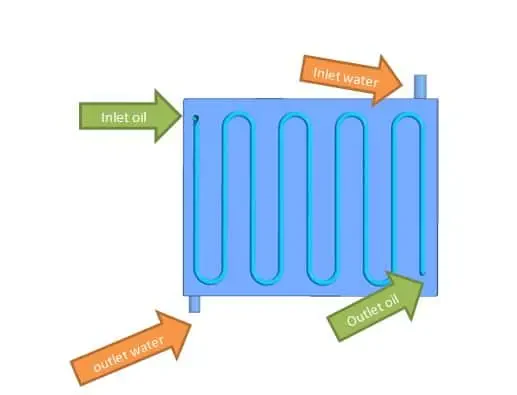
Geometry & Mesh
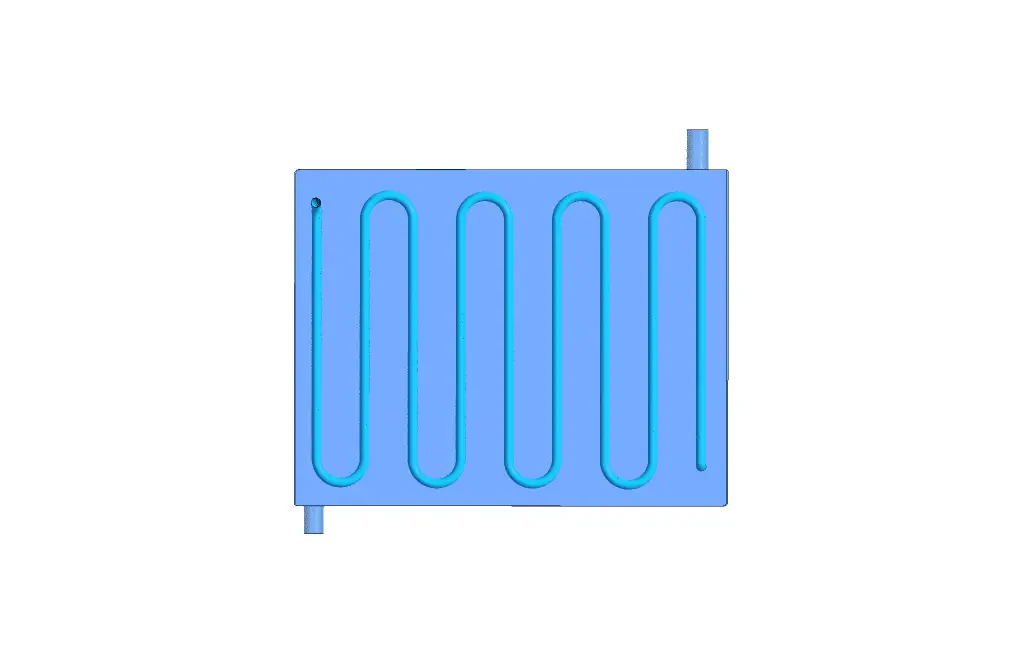
The geometry of this modeling is three-dimensional and is designed with Spaceclaim software, which consists of two parts: a spiral tube and a rectangular cubic chamber.
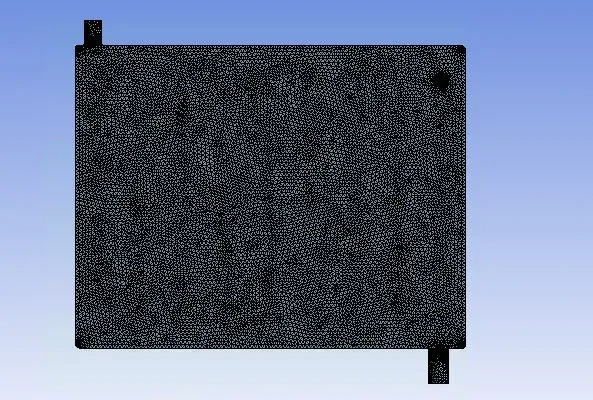
The meshing of this modeling has been done with Ansys Meshing software, and the total number of cells is 1615429, which can be seen in the picture below.
CFD Simulation
We consider several assumptions to simulate the present model:
- We perform a pressure-based solver.
- The simulation is steady.
- The gravity effect on the fluid is ignored.
The following table represents a summary of the defining steps of the problem and its solution:
| Models (Radiator) | ||
| Viscous | k-epsilon | |
| k-epsilon model | realizable | |
| near-wall treatment | Menter-lechner | |
| Energy | On | |
| Boundary conditions (Radiator) | ||
| Inlet water | Velocity Inlet | |
| velocity magnitude | 0.01 m.s-1 | |
| temperature | 273 K | |
| Inlet oil | Velocity Inlet | |
| velocity magnitude | 0.05 m.s-1 | |
| temperature | 400 K | |
| Outlet water | Pressure Outlet | |
| gauge pressure | 0 pascal | |
| Outlet oil | Pressure Outlet | |
| gauge pressure | 0 pascal | |
| Inner Wall | Wall | |
| wall motion | stationary wall | |
| thermal condition | coupled | |
| Outer Wall | Wall | |
| wall motion | stationary wall | |
| thermal condition | convection | |
| heat transfer coefficient | 10 W.m-2.K-1 | |
| free stream temperature | 290 K | |
| Methods (Radiator) | ||
| Pressure-Velocity Coupling | SIMPLE | |
| pressure | second-order | |
| momentum | second-order upwind | |
| turbulent kinetic energy | first-order upwind | |
| turbulent dissipation rate | first-order upwind | |
| energy | second-order upwind | |
| Initialization (Radiator) | ||
| Initialization methods | hybrid | |
Radiator considering Internal Flow Results
After simulating that temperature, speed, and pressure contours can be drawn, it is clear that this radiator has been able to do its job well and has decreased the oil temperature from 400 K to 363 K. The temperature of the water itself has increased by 20 during this process. The inlet speed of water and oil greatly affects heat transfer, and naturally, the outlet temperatures of water and oil can be changed.