Grain Drying Device CFD Simulation, 2-way DPM Model
Price: $80
In this project, a Rice drying device using two-way DPM has been simulated and the results of this simulation have been investigated.
Grain Drying Device CFD Simulation, 2-way DPM Model
Price: $80
In this project, a Rice drying device using two-way DPM has been simulated and the results of this simulation have been investigated.

Grain Drying Device CFD Simulation Using Two-way DPM Model, Ansys Fluent Training
In this project, we studied a Grain Drying Device CFD Simulation using the Two-way Discrete Phase Model(DPM) & Species Model in Ansys Fluent software, and then the results were investigated. Hot air enters the drying device, and then 120000 rice grains with 10% moisture are injected randomly for 6 seconds. The evaporation process continues for 9 seconds after the complete injection. Furthermore, the hot surfaces are in contact with the hot exhaust smoke of the engine, which provides an efficient condition for the drying device.
When rice is harvested, it contains 20-30% moisture which can corrupt the grains in the shortest time. Therefore, drying the grains after harvesting is important before storage and sending them to the rice mill. The rice drying device provides a mechanical method to put rice grains in the exposure of ambient hot air to increase moisture evaporation.
Geometry & Mesh
The 3D geometry was generated in Design Modeler software. A 3m*1m channel box contains four triangular passages of 20cm in length.
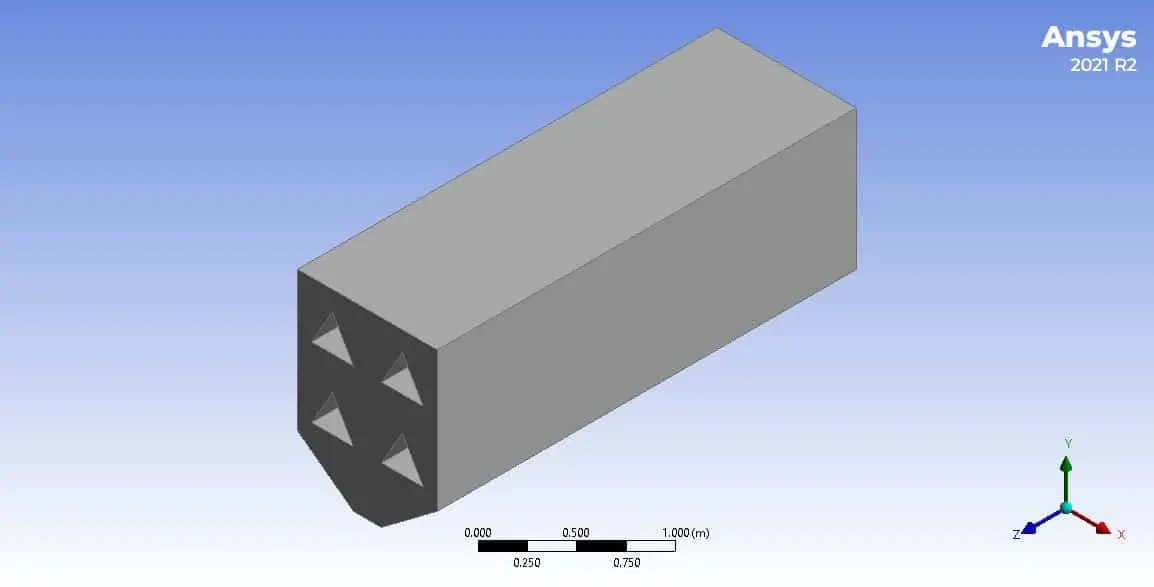
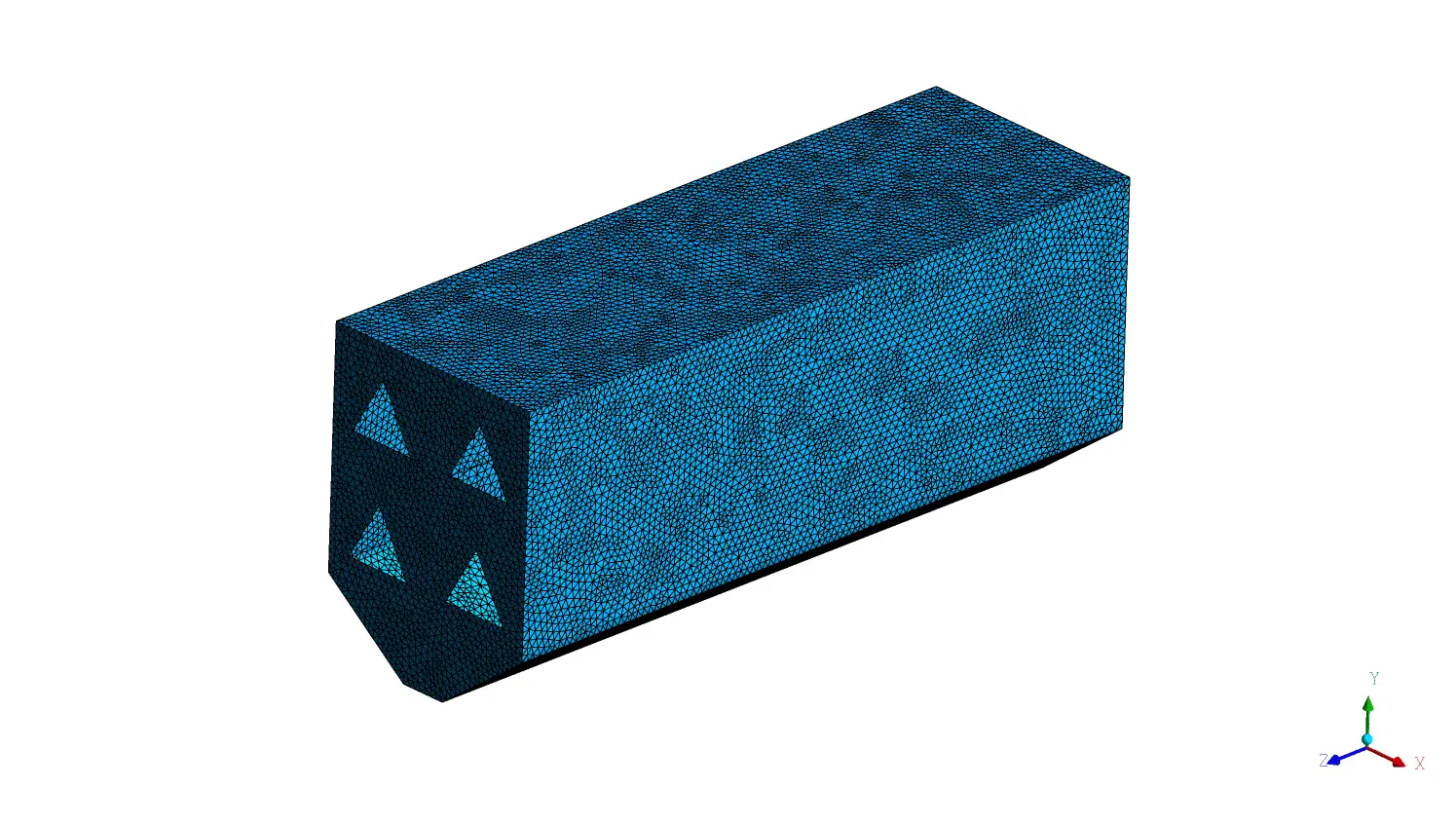
In addition, an unstructured mesh grid was carried out using Ansys meshing software, and overall, 556145 elements were generated.
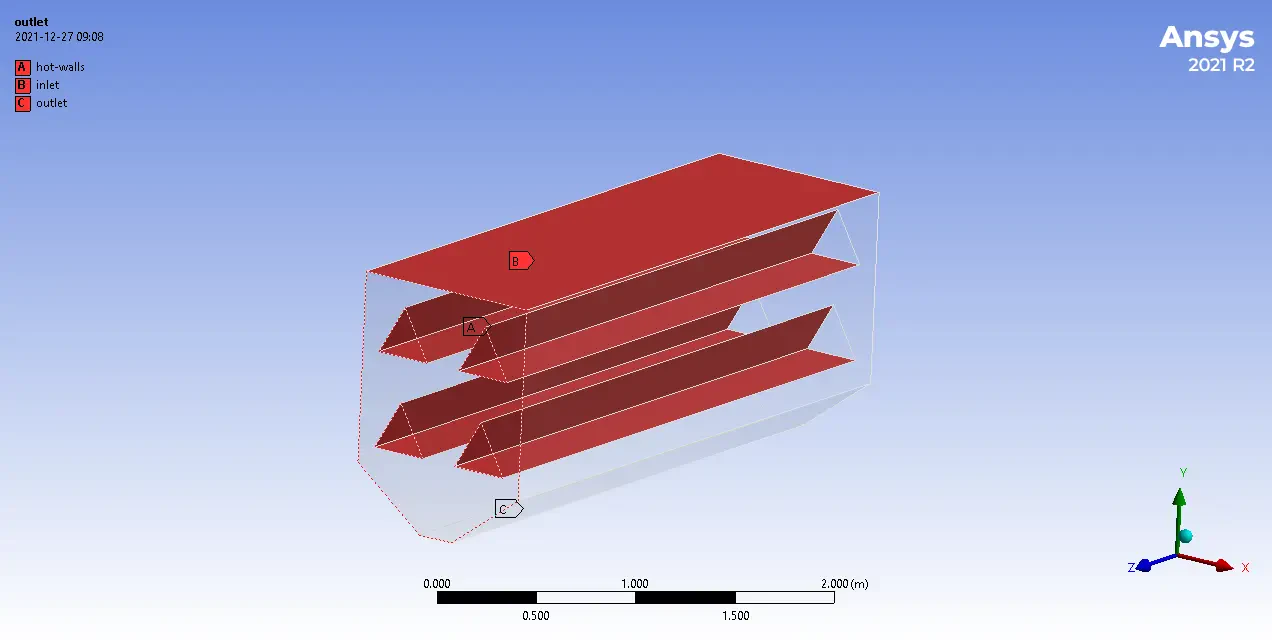
The figure below depicts the boundaries that were defined in this simulation.
Grain Drying Device CFD Simulation
Several assumptions have been considered to simulate Rice Drying Device, including:
- The simulation is Transient(unsteady) to capture the behavior of fluid and particles over time.
- The pressure-based solver type was used due to the incompressibility of the working fluid.
- The Two-way Discrete Phase Model(DPM) was utilized, so the grains of rice particles were injected with our desired condition into the fluid domain.
- Gravitational acceleration effects were considered -9.81m/s^2 in the y-direction.
The following table represents a summary of the solution:
| Models(Viscous) | |||||||
| Energy | On | ||||||
| Viscous | k-epsilon Realizable | Standard Wall Function | |||||
| Species | Species Transport | Mixture-template | |||||
| Discrete Phase Model | |||||||
| Interaction with continuous phase Unsteady particle tracking | On On | ||||||
| Injections | |||||||
| Injection Type Number of streams | Surface – inlet 10000 | ||||||
| Particle Type | Droplet | ||||||
| Material Evaporating species Diameter distribution | Water-liquid H2o Uniform | ||||||
| Diameter | 0.005m | Stop Time | 6s | ||||
| Temperature | 363.15K | Velocity Magnitude | 0m/s | ||||
| Start Time | 0s | Total Flow Rate | 0.5kg/s | ||||
| Materials | |||||||
| Mixture-template | Definition method | Fluent database | |||||
| Material name | Air | ||||||
| Droplet Particle | Definition method | Fluent database | |||||
| Material name | Water-liquid Volatile component fraction = 10% | ||||||
| Cell zone condition | |||||||
| Material name | Mixture-template | ||||||
| Boundary condition | |||||||
| Inlet | Type | Velocity inlet | |||||
| Velocity magnitude | 1m/s | ||||||
| Turbulent intensity | 5% | ||||||
| Turbulent viscosity ratio | 10 | ||||||
| Temperature | 363.15K | ||||||
| DPM BC Type | escape | ||||||
| Outlet | Type | Wall | |||||
| DPM BC Type | reflect | ||||||
| Hot walls | Type | Wall | |||||
| Temperature | 773.15K | ||||||
| DPM BC Type | reflect | ||||||
| Solver configuration | |||||||
| Pressure-velocity coupling | Scheme | SIMPLE | |||||
| Spatial Discretization | Gradient | Least squares cell-based | |||||
| Pressure | Second-order | ||||||
| Momentum | Second-order upwind | ||||||
| Turbulent kinetic energy | First-order upwind | ||||||
| Turbulent dissipation rate | First-order upwind | ||||||
| H2o | Second-order upwind | ||||||
| Energy | Second-order upwind | ||||||
| Initialization | Initialization methods | Standard Initialization | |||||
| Run calculation | Time step size | 0.05 | |||||
| Number of time steps | 300 | ||||||
| Max iterations per time step | 40 | ||||||
Results
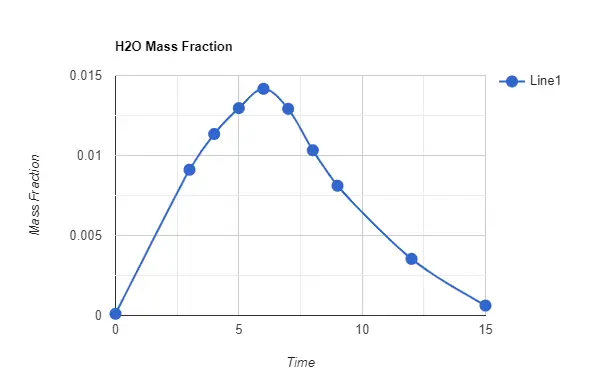
The particle injection into the rice drying device starts with 10000 rice grains. The injection process lasts for 6 seconds. Evaporation is happening by the first second but ignoring that as an assumption for simplification, we can get to the H2o mass fraction graph showing the desired variable over time. The moisture(H2o) reaches its highest value at the end of injection, nearly 0.015 and then, it takes approximately 9 seconds to fall to 0 due to evaporation.