

Rotary Cooling of an object with a Constant Heat Flux, ANSYS Fluent training
Price: $10
The present problem simulates the heat transfer and rotary cooling of a wall under a constant heat flux of a model with a semi cylinder shape, using ANSYS Fluent software.
Rotary Cooling of an object with a Constant Heat Flux, ANSYS Fluent training
Price: $10
The present problem simulates the heat transfer and rotary cooling of a wall under a constant heat flux of a model with a semi cylinder shape, using ANSYS Fluent software.
Rotary Cooling Project Description
The present problem simulates the heat transfer and cooling of a wall from a model with a semi-cylinder shape, using ANSYS Fluent software. The model rotates around a particular axis (model z-axis) at a speed equivalent to 400 rpm. Therefore, to define this rotational motion in the model, the frame motion technique with a rotational speed of 400 rpm has been used. The exterior sectional wall of the model under constant heat flux is equal to 1000 W.m-2, and on the outer surface of this sectional wall, there are five ducts for airflow.
Cooling airflow with a velocity of 29.215 ms-1 (assuming Reynolds 10000 for the inlet airflow to the model) and a temperature of 300 K enter the model through five inlet ducts the outlet section located at the top of the model at equivalent pressure Atmospheric pressure is released.
Geometry & Mesh
The present model is designed in three dimensions using Design Modeler software. The model consists of an semi-cylinder with a diameter of 50 mm and a height of 200 mm, on the lateral surface of which are five air inlets for a diameter of 5 mm.
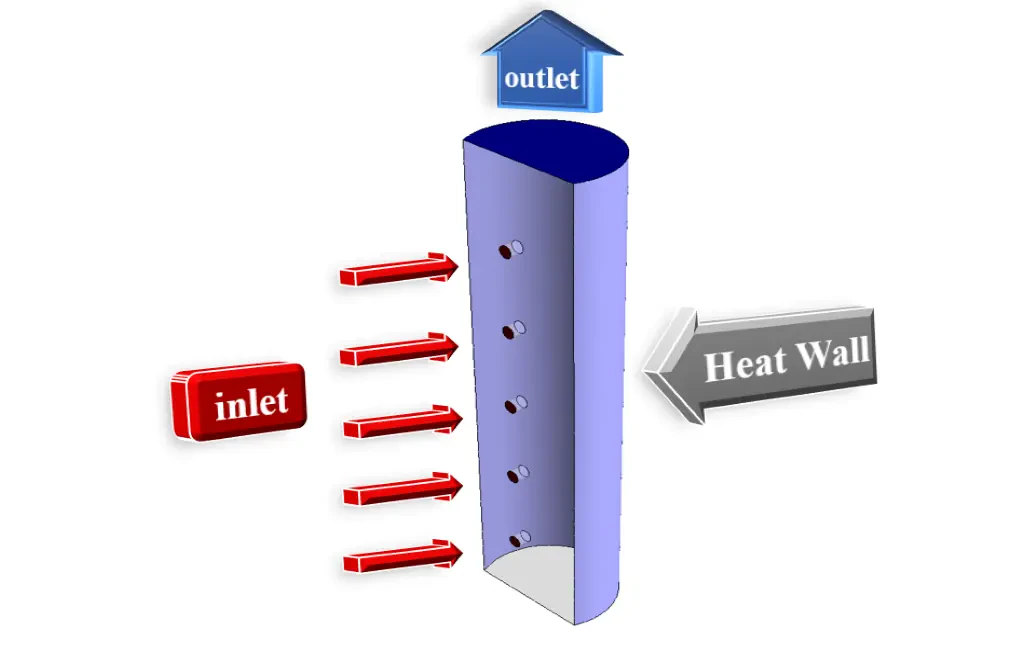
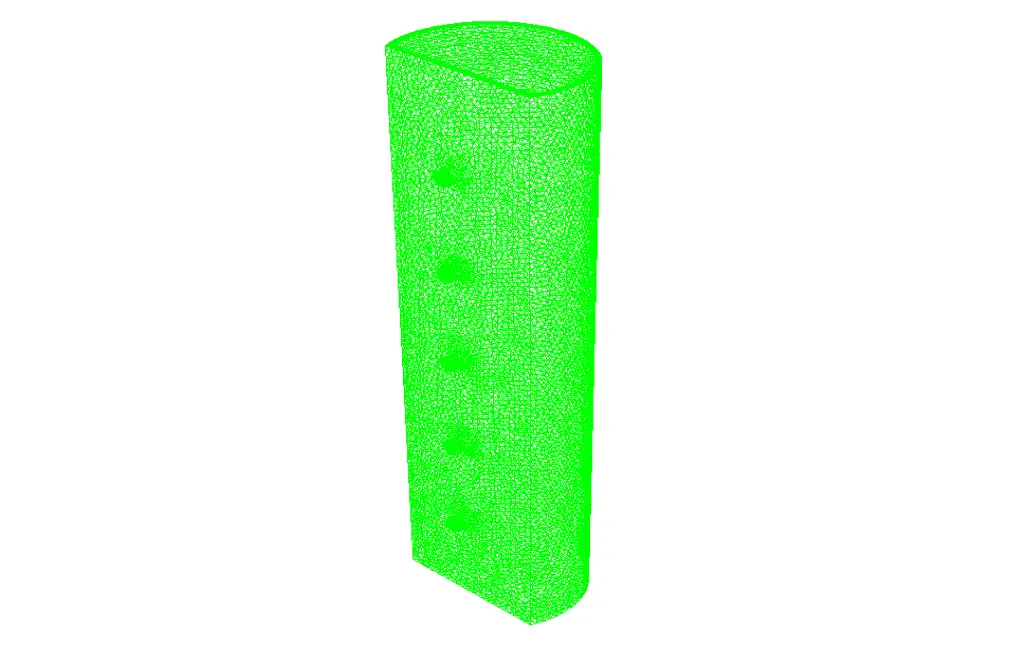
We carry out the meshing of the model using ANSYS Meshing software, and the mesh type is unstructured. The element number is 679558. The following figure shows the mesh.
Rotary Cooling CFD Simulation
We consider several assumptions to simulate the present model:
- We perform a pressure-based solver.
- The simulation is steady.
- The gravity effect on the fluid is Ignored.
The following table represents a summary of the defining steps of the problem and its solution:
| Models | ||
| Viscous | k-omega | |
| k-omega model | SST | |
| Energy | On | |
| Boundary conditions | ||
| Inlet | Velocity Inlet | |
| velocity magnitude | 29.215 m.s-1 | |
| temperature | 300 K | |
| Outlet | Pressure Outlet | |
| gauge pressure | 0 pascal | |
| Heat Wall | Wall | |
| wall motion | stationary wall | |
| heat flux | 1000 W.m-2 | |
| Wall | Wall | |
| wall motion | stationary wall | |
| heat flux | 0 W.m-2 | |
| Methods | ||
| Pressure-Velocity Coupling | SIMPLE | |
| pressure | second order | |
| momentum | second order upwind | |
| turbulent kinetic energy | first order upwind | |
| specific dissipation rate | first order upwind | |
| energy | second order upwind | |
| Initialization | ||
| Initialization methods | Standard | |
| gauge pressure | 0 pascal | |
| x-velocity & y-velocity | 0 m.s-1 | |
| z-velocity | -29.215 m.s-1 | |
| temperature | 300 K | |
Results & Discussions
At the end of the solution process, two-dimensional and three-dimensional contours related to pressure, speed, and temperature are obtained. Also, two-dimensional velocity vectors and two-dimensional flow lines have been obtained in different sections of the model. Two-dimensional sections are created on pages parallel to the X-Z plane of the model; So that they include the first (lowest), third (middle), and fifth (highest) inputs of the model. The contours show that the temperature is high near the heat flux wall, and when the airflow from the inlets hits this heat flux wall at high speed, it reduces the temperature.
The graph of changes in the amount of static pressure (relative pressure) on the model's heat flux wall at different cross-sections (including the first, third, and fifth inputs) is obtained. These figures show that the highest pressure is created in the central part of this wall because the airflow hits it directly at high speed.