

S2S Radiation Heat Transfer, CFD Simulation ANSYS Fluent Training
Price: $8
The present simulation is about S2S radiation heat transfer via ANSYS Fluent.
S2S Radiation Heat Transfer, CFD Simulation ANSYS Fluent Training
Price: $8
The present simulation is about S2S radiation heat transfer via ANSYS Fluent.
S2S Radiation Heat Transfer Description
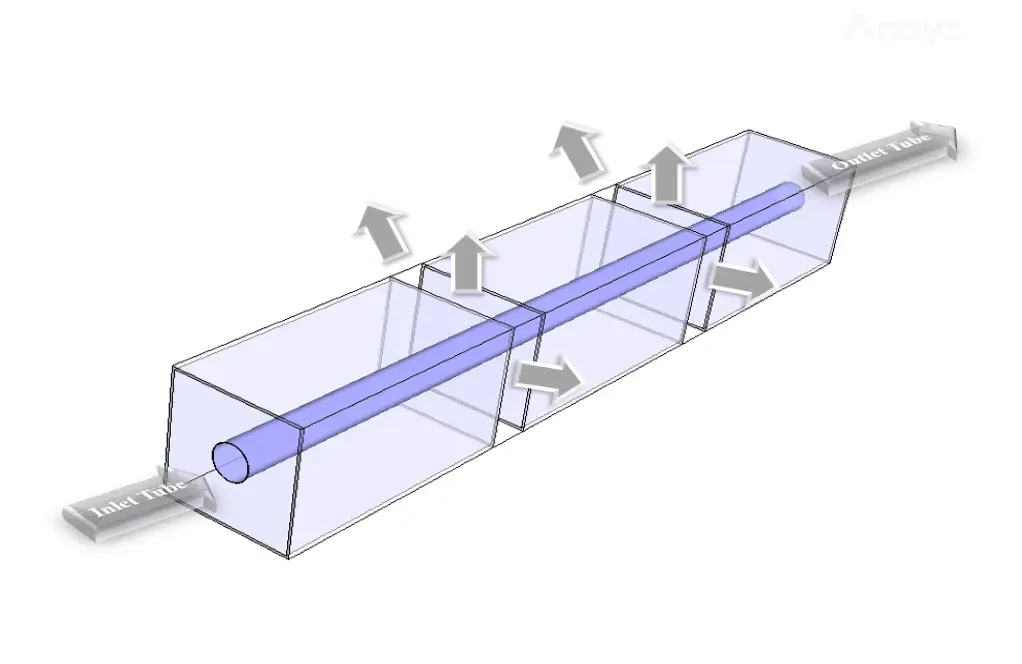
The present simulation is about S2S radiation heat transfer via ANSYS Fluent. In this project, plates model the three boxes, and inside these boxes, a tube is designed. The fluid flow inside the tube moves at a temperature of 283 K and a velocity of 20 m/s, and there is airflow inside the boxes around the tube.
It is assumed that these metal plates have a heat source of 1133333.33 W/m3. It is also assumed that radiation heat transfer occurs between the box plates and the surface of the tube. Therefore, the software has used the surface-to-surface (S2S) radiation model.
The surface-to-surface radiation model calculates the radiation exchange in an enclosure of gray-diffuse surfaces. The exchange between the two surfaces depends partly on their size, separation distance, and orientation. These parameters are calculated by a geometric function called a "view factor''. The main assumption of the S2S model is that any absorption, emission, or scattering of radiation can be ignored; Hence, only surface-to-surface radiation is considered for analysis.
The S2S model assumes that the pages should be gray and diffuse. The emissivity and absorptivity of a gray surface are independent of the wavelength, and according to Kirchhoff's law, the emissivity is equal to the absorptivity (ε = α). Also, the reflectivity is independent of the outgoing (or incoming) directions for a diffuse surface.
Geometry & Mesh
The present geometry is designed in a 3D model via Design Modeler The computational zone is related to the interior of three boxes created by several plates. An output boundary is considered between each of the boxes. A pipe is also passed through the interior of these boxes.
The mesh of the present model has been done via ANSYS Meshing. Mesh is structured, and the number of production cells is equal to 2101788.

Set-up & Solution
Assumptions used in this simulation:
- Pressure-based solver is used.
- The present simulation is steady.
- The effect of gravity on the model is ignored.
| Models | ||
| Viscous | k-epsilon | |
| k-epsilon model | standard | |
| near wall treatment | standard wall function | |
| Radiation | Surface to Surface (S2S) | |
| Boundary conditions | ||
| Inlet-tube | Velocity Inlet | |
| velocity magnitude | 20 m.s-1 | |
| temperature | 283 K | |
| internal emissivity | 1 | |
| Outlet-tube & Outlet-plates | Pressure Outlet | |
| gauge pressure | 0 Pascal | |
| internal emissivity | 1 | |
| Inner & Outer Plates’ Wall | Wall | |
| thermal condition | coupled | |
| Tube’s Wall | Wall | |
| heat flux | 0 W.m-2 | |
| Methods | ||
| Pressure-Velocity Coupling | Coupled | |
| pressure | Second-order | |
| momentum | Second-order upwind | |
| turbulent kinetic energy | First-order upwind | |
| turbulent dissipation rate | First-order upwind | |
| energy | Second-order upwind | |
| Initialization | ||
| Initialization methods | Hybrid | |
S2S Radiation Heat Transfer Results
After calculation, 2D and 3D contours related to temperature, temperature gradient, velocity, pressure, and density are obtained. The contours show that the heat generated by the plates is transferred through radiation between the surfaces in the space around the pipe. This radiation heat transfer between the surfaces leads to an increase in the air temperature of the tube.