

Short Wave in the Sea CFD Simulation, Ansys Fluent
Price: $24
In this project, a short wave in the sea has been simulated and the results of this simulation have been investigated.
Short Wave in the Sea CFD Simulation, Ansys Fluent
Price: $24
In this project, a short wave in the sea has been simulated and the results of this simulation have been investigated.
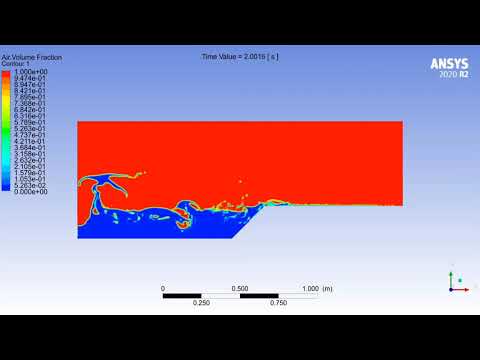
Short Wave in the Sea CFD Simulation, Ansys Fluent Tutorial
In this project, Short Wave in the Sea CFD Simulation has been done using Ansys Fluent software. The purpose of this project is to investigate the ability to simulate short waves with First-Order Airy theory in Fluent software and the VOF model with the open channel wave bc has been used.
Geometry & Mesh
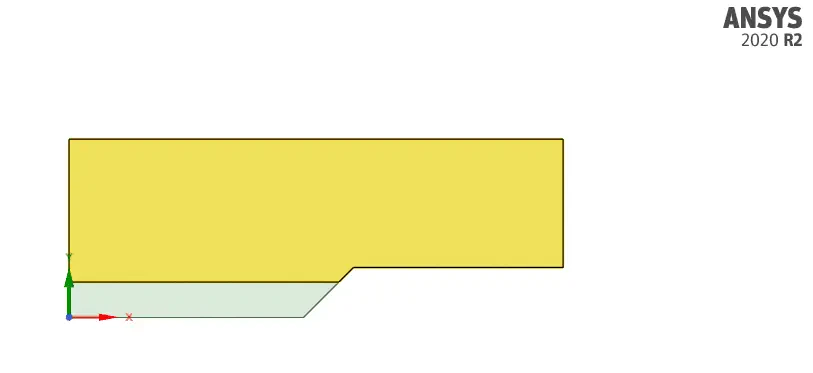
The two-dimensional geometry of this project has been produced with SpaceClaim software. The length of the computational area is 210 cm and its height is 76 cm.
The meshing of this present model has been generated by Ansys Meshing software. The mesh grid is unstructured and the total cell number is 55468.4
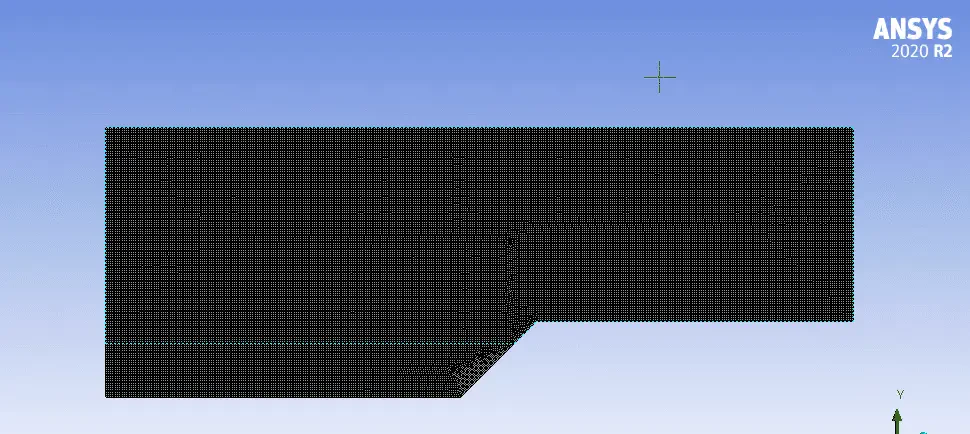
Short Wave CFD Simulation
To simulate the present model, several assumptions are considered, which are:
- The solver is pressure-based and transient.
- Simulation has only examined fluid behavior; in other words, heat transfer simulation has not been performed.
- The effect of gravity on the flow is considered to be 9.81 m.s-2 and along with the y-axis in the present model.
The Laminar viscous model has been used to solve the flow field equations, and the pressure-velocity coupling scheme is SIMPLE. The second-order upwind discretization method has been used for momentum and PRESTO! For pressure discretization.
The following is a summary of the steps for defining the problem and its solution.
| Models | ||
| Multiphase | ||
| Homogeneous model | Volume of fluid | |
| Number of Eulerian phases | 2(air& water) | |
| Interface modeling | Sharp Interfacial | |
| Formulation | explicit | |
| Body force formulation | Implicit body force | |
| Viscous | Laminar | |
| Material Properties | |
| Air | |
| Density | 1.225 |
| viscosity | 1.7894e-05 |
| water-liquid | |
| Density | 998.2 |
| viscosity | 0.001003 |
| Methods | ||
| Pressure-Velocity Coupling | SIMPLE | |
| Pressure | PRESTO! | |
| Momentum | Second-order upwind | |
| Volume fraction | Compressive | |
| Initialization | ||
| Initialization methods | Standard | |
| Patch | Phase | Phase2 |
| Variable | Volume Fraction | |
| Registers to patch | Region_0 | |
| Value | 1 | |
| Run calculation | ||
| Time advancement | Type | adaptive |
| Parameters | ||
| Initial time step size | 0.001 | |
| Settings | Minimum time step size | 0.0001 |
| Maximum time step size | 0.0001 | |
| Time step size | 20000 | |
Results
In Fluent software, it is possible to send waves from the input boundary condition into the domain. According to the speed counters, it is clear that when the waves move at sea level, vortices are created in the surrounding air and it can be said that the intensity of air turbulence is proportional. It is the height of the waves, which is why we see strong winds when we stand by the sea of waves.