Side Entry Mixing Tank in 3 Different rotational speeds, Ansys Fluent CFD Simulation Training
Price: $72
In this project, Side Entry Mixing Tank in Different RPM has been simulated and the results of this simulation have been investigated.
Side Entry Mixing Tank in 3 Different rotational speeds, Ansys Fluent CFD Simulation Training
Price: $72
In this project, Side Entry Mixing Tank in Different RPM has been simulated and the results of this simulation have been investigated.

Project Description
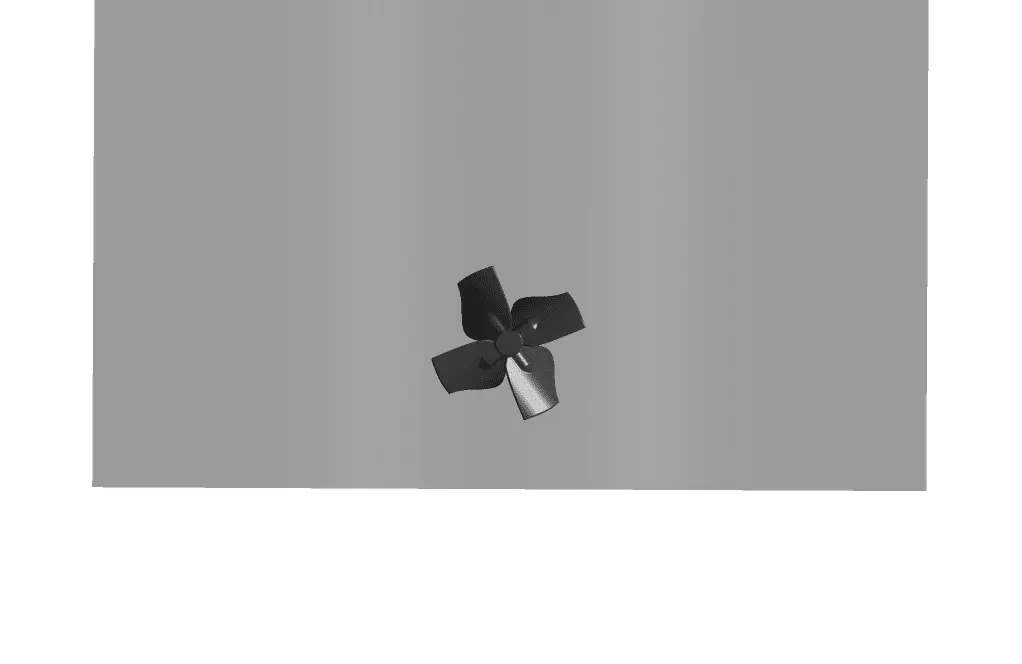
In this project, Side Entry Mixing Tank in Different RPM has been simulated by Ansys Fluent Software. which has been done by the CFD numerical simulation method by Ansys Fluent software, a mixing tank has been simulated. The mixing process is essential in many industries; for example, in the oil and gas industry, water deposition causes much damage to storage tanks, which causes corrosion, leakage, and perforation of the source. Side mixing blades are used to prevent these events because in most positions, due to space limitations, the blade can not enter the tank from above. This simulation is performed at different rotational speeds of 400 and 900 and 1400 rpm with the mesh motion method.
Geometry & Mesh
The three-dimensional geometry of this project is designed with Spaceclaim software. The length of the computational area is 400 cm, the width is 400 cm, and the height is 375 cm.
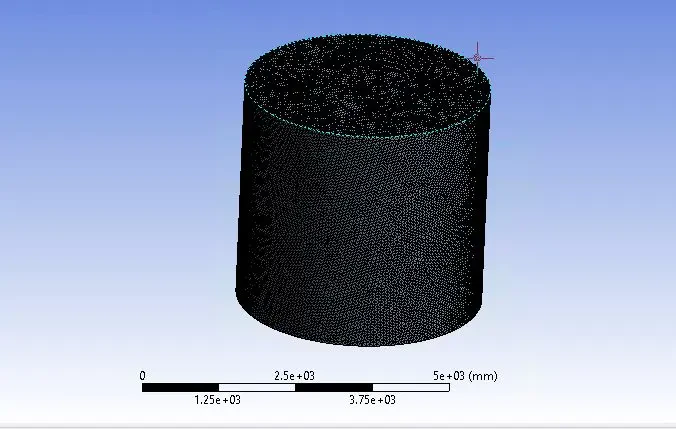
ANSYS Meshing produces the grid of the computational area, and the number of elements is 933102, which is made of relatively small grid elements.
Side Entry Mixing Tank CFD Simulation
To simulate this acoustic project, several assumptions are considered:
- We perform a pressure-based solver.
- The simulation is unsteady (Transient)
- We consider the gravity (-9.81 m^2/s) in the z-direction.
The following table represents a summary of the defining steps of the problem and its solution:
| Viscous | k-epsilon | |
| k-epsilon model | standard | |
| near-wall treatment | standard wall functions | |
| Multiphase | VOF | |
| Phase 1 | air | |
| Phase 2 | oil | |
| Phase 3 | water | |
| Boundary conditions | ||
| Wall | Wall Motion | Stationary wall |
| Frame motion | On | |
| Fluid | Rotational velocity | Case1: 400 rpm & Case2: 900 rpm & Case 3: 1400 rpm |
| Methods | ||
| Pressure-Velocity Coupling | simple | |
| Pressure | PRESTO | |
| momentum | second-order upwind | |
| turbulent kinetic energy | first-order upwind | |
| turbulent dissipation rate | first-order upwind | |
| Initialization | ||
| Initialization methods | Standard | |
Side Entry Mixing Tank Results
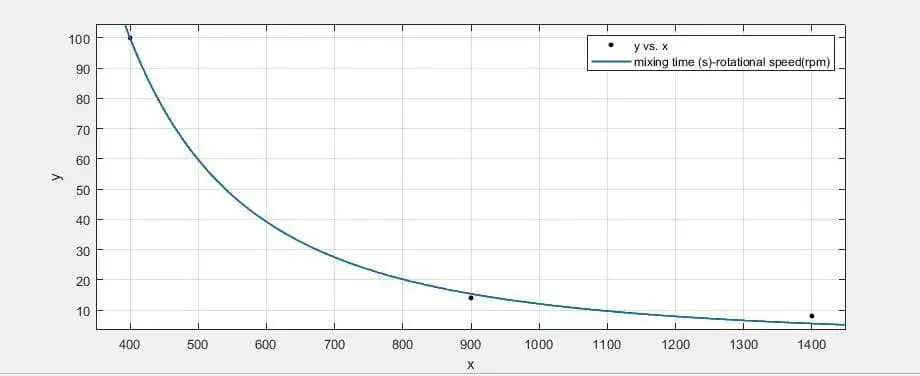
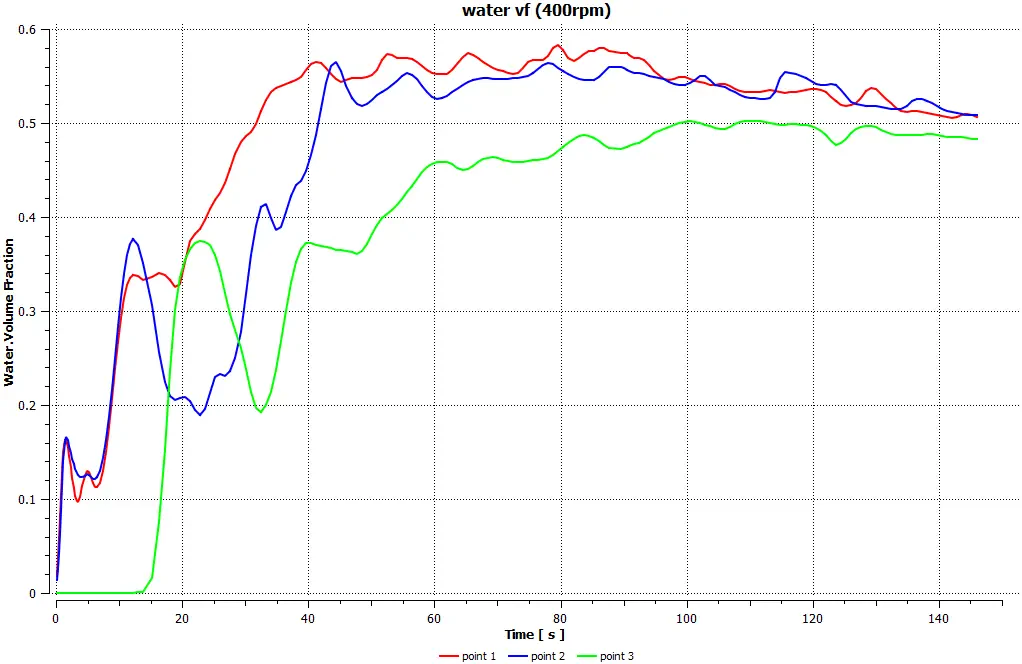
In this simulation, the mixing tank contains water and oil, in which water settles to the bottom of the tank due to its higher density. We mixed the tank's contents using a side mixer that rotates at 1400, 900, and 400 rpm. We want to get the perfect mixing time for each item. We checked the complete mixing criterion using three sensors placed in different positions of the tank and plotting the volume fraction of oil and water for all three points overtime on the chart. According to these charts, the mixing time is 100 seconds for 400 rpm, 14 seconds for 900 rpm, and 8 seconds for 1400 rpm
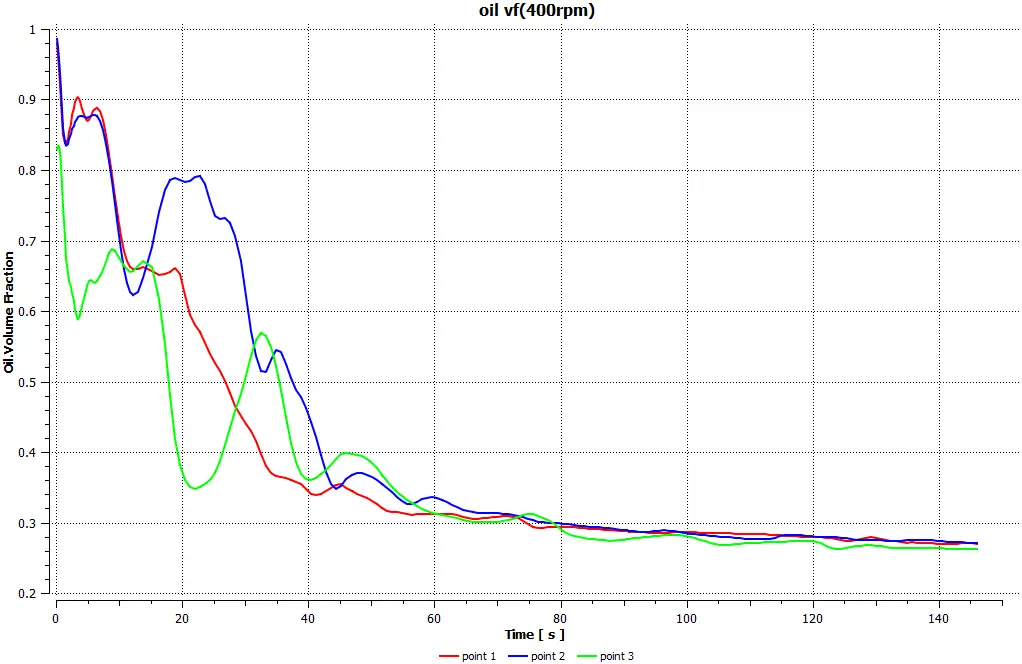
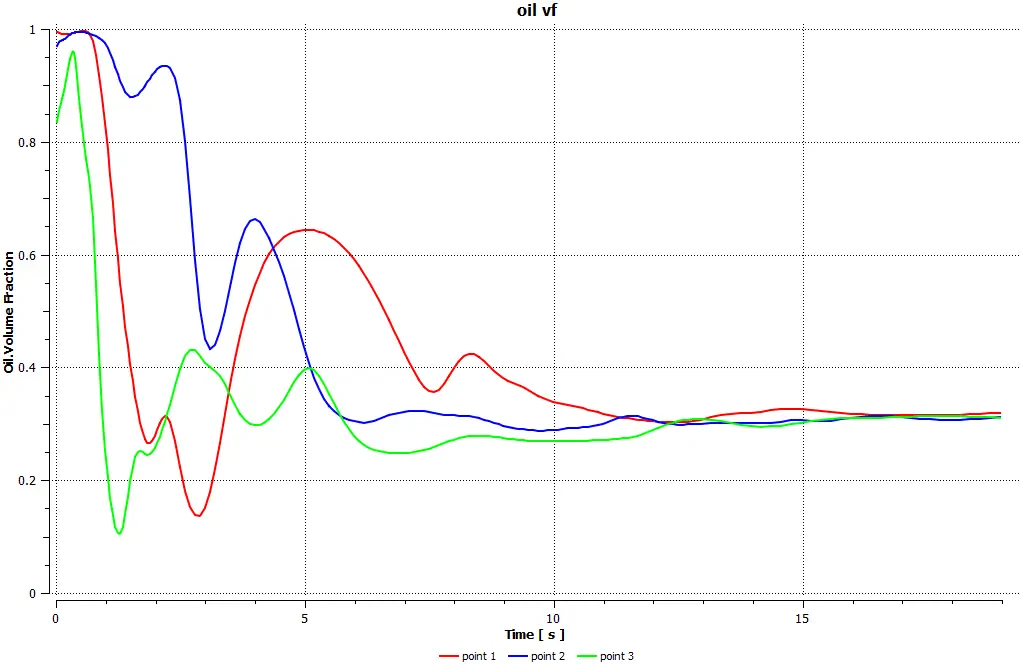
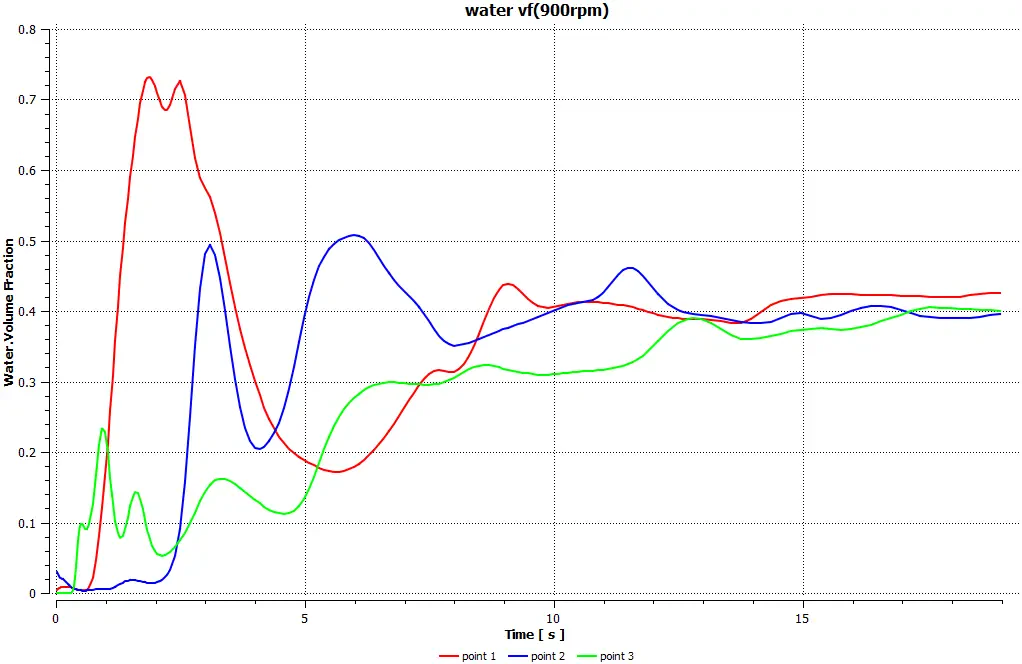
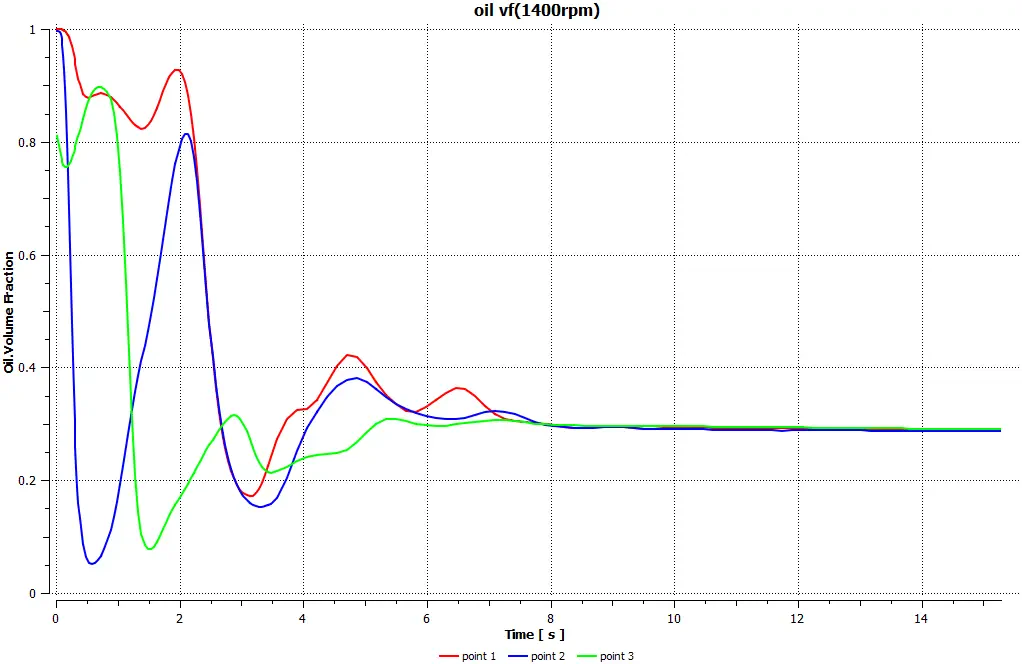
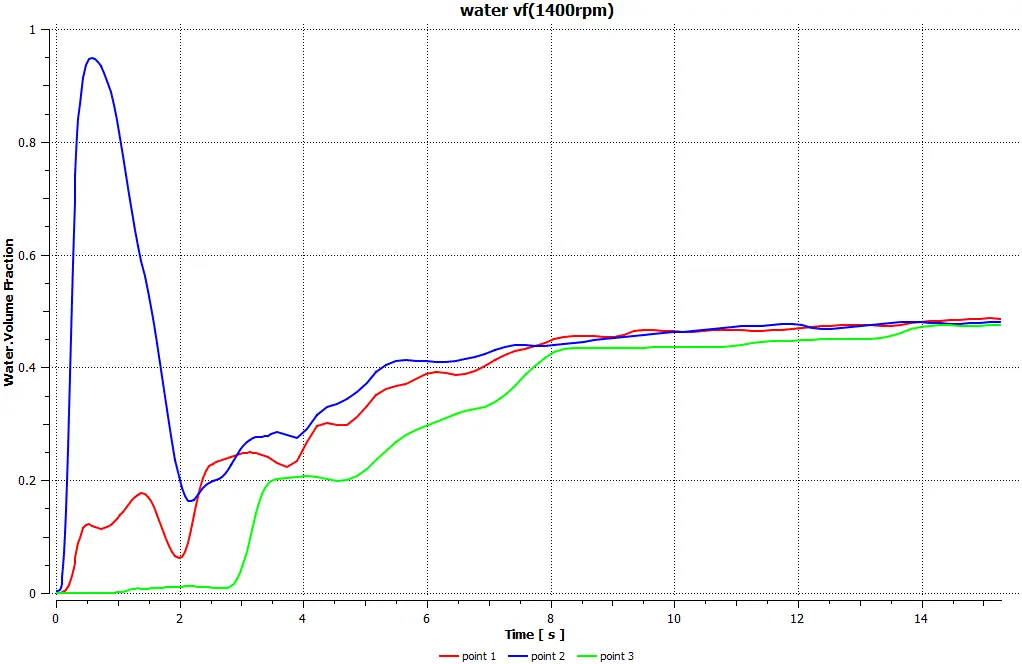
Given this trend, it is clear that increasing the rotational speed to a certain extent (here 900 rpm) is very useful for us and reduces the mixing time considerably, but increasing it too much has little effect on the mixing time And we can ignore it and naturally our cost of choosing an engine will be reduced