

Single Sided Ventilation in a Room Considering a Heater, ANSYS Fluent Training
Price: $16
- The problem numerically simulates natural convection heat transfer in a Single Sided Ventilation Inside a Room Considering a Heater, using ANSYS Fluent software.
- We perform this simulation in steady state conditions with the realizable k-epsilon turbulence model and standard wall functions.
- The thermal boundary conditions include isothermal hot and cold vertical walls creating a 127.8 K temperature difference that drives buoyancy-induced circulation.
- The geometry is created in ANSYS Design Modeler and meshed in ANSYS Meshing with an unstructured grid to capture thermal and velocity boundary layers.
Single Sided Ventilation in Room Considering a Heater
Problem description
This research examines natural convection heat transfer in a Single Sided Ventilation inside a room. The cavity is a confined air-filled enclosure in which the left vertical wall is kept at a cold temperature of 288 K (15°C) and the right vertical wall is heated to 415.8 K (142.7°C), generating a horizontal temperature gradient of about 128 K across the cavity. The horizontal walls are considered adiabatic, disallowing heat transfer in the vertical direction and ensuring that heat transfer is mainly between the two vertical boundaries.
Geometry & Mesh
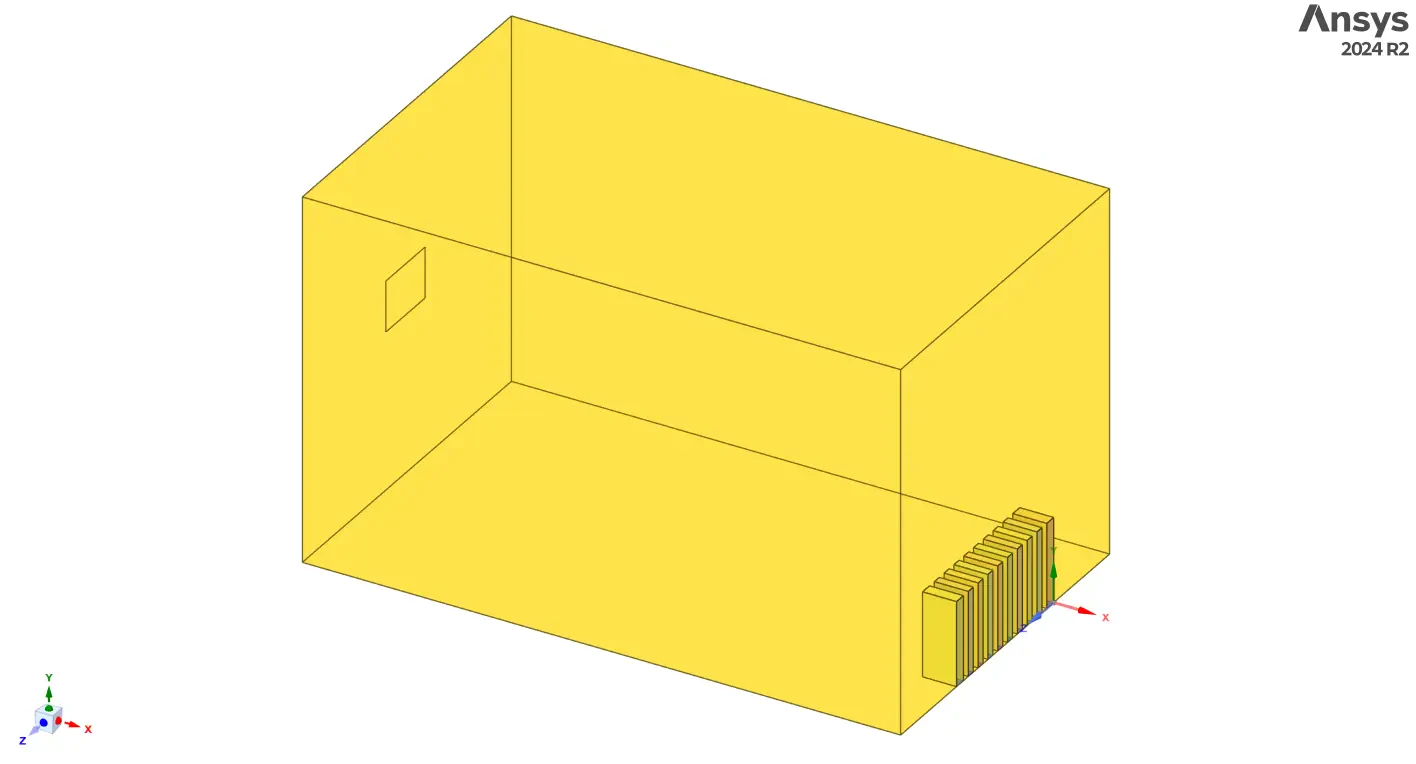
The 3-D geometry of the Single Sided Ventilation in the room is designed using Ansys SpaceClaim software. The model consists of a room measuring 2.13 m ⨯ 2.15 m ⨯ 3.32 m, with a rectangular cube heater at the bottom of one of its sidewalls. The following figure shows the geometry.
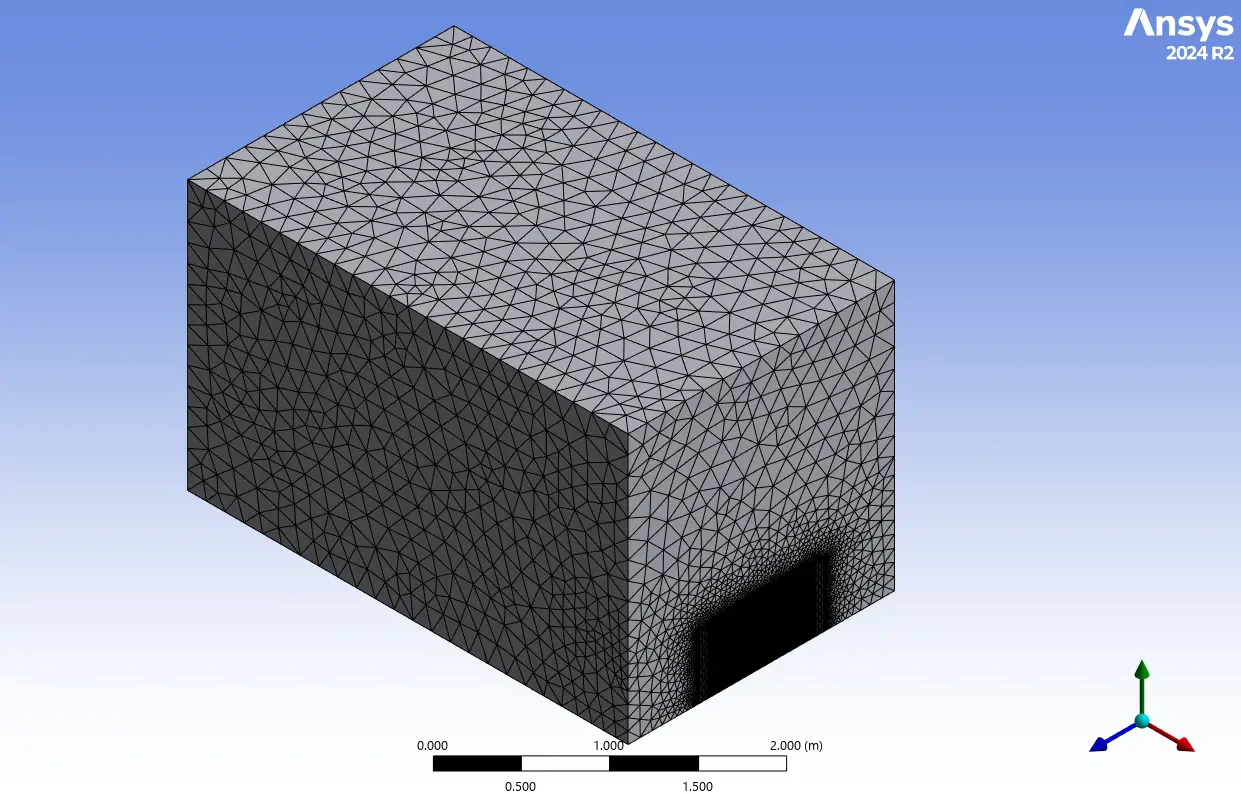
The meshing of the present model has been done by ANSYS Meshing software. The mesh type is unstructured and the element number is 1187415. The following figure shows a view of the mesh.
Single-Sided Ventilation CFD Simulation
To simulate the present model, several assumptions are considered, which are:
- The Pressure-Based solver has been performed.
- Simulation has been performed in both fluid and heat transfer modes.
- The present model is steady-state.
- The effect of gravity is 9.81 m.s-2 on the fluid.
Here is the summary of the steps for defining a problem and its solution in the table:
Simulation Settings
This setup uses a realizable k-ε turbulence model with standard near-wall treatment, pressure-outlet boundary conditions and stationary walls with no wall heat flux. The solver uses SIMPLE coupling and mostly second-order discretization schemes for accuracy (with a lower-order scheme for the dissipation rate). The case is initialized with standard conditions (atmospheric pressure, zero velocity and a typical temperature).
Single-Sided Result
The CFD simulation is successful in demonstrating natural convection in the differentially heated cavity for a temperature difference of 127.8 K (288 K to 415.8 K) between the vertical walls.
Key Findings:
- Flow Pattern: A steady single-cell clockwise circulation develops, with maximum velocities of 0.8 m/s in the boundary layers near the vertical walls
- Heat Transfer: Effective convective heat transfer occurs with hot fluid rising on the right wall and cold fluid descending on the left wall
- Thermal Field: There are smooth temperature gradients across the cavity with well-developed thermal boundary layers on both the heated and cooled surfaces
- Pressure Variation: The pressure field exhibits the expected hydrostatic variation, decreasing from bottom to top of the cavity due to buoyancy effects and density variations caused by temperature differences in the natural convection process.
Streamline patterns affirm orderly, steady-state flow without instabilities, demonstrating successful convergence of the k-epsilon turbulence model. The findings accurately capture the underlying physics of natural convection heat transfer in enclosed cavities, yielding useful information for thermal management applications.