

Sloshing of a Tanker Truck CFD Simulation, Ansys Fluent Training
Price: $20
In this project, the sloshing of a tanker truck has been simulated, and the results have been investigated.
Sloshing of a Tanker Truck CFD Simulation, Ansys Fluent Training
Price: $20
In this project, the sloshing of a tanker truck has been simulated, and the results have been investigated.

Sloshing of a Tanker Project Description
In this project, Ansys Fluent software has been used to simulate the sloshing of a tanker truck. The Volume of Fluid (VOF) model has been used to simulate and solve the two-phase flow field equations. The primary phase is air and, the secondary phase is water. The truck brakes at the speed of 15 m/s, and after 3 seconds, it stops. This means that in addition to gravity acceleration, the water inside the tanker feels the brake deceleration.
Geometry & Mesh
The geometry of the present model is generated using SpaceClaim software. The tanker dimension is 12300* 1900.1867 mm.
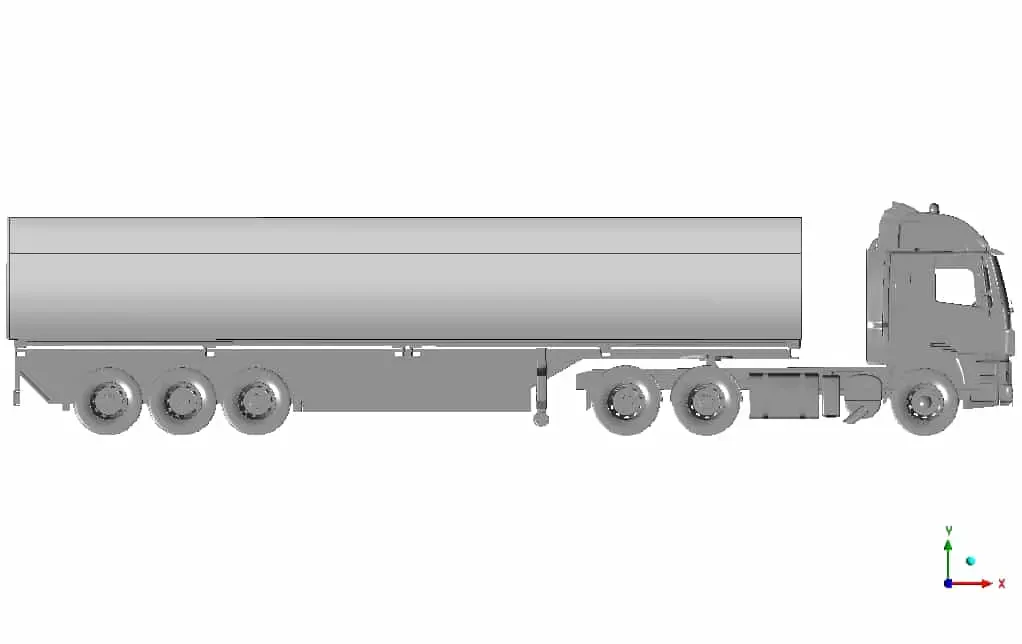
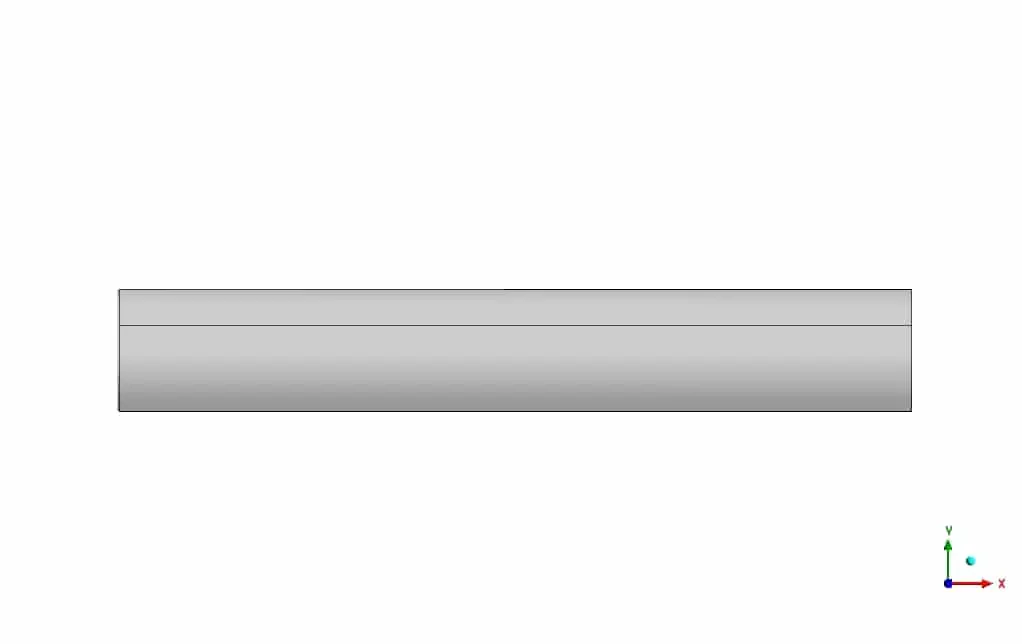
The meshing of the present model has been done using Ansys Meshing software. The mesh type is structured in all of the computational domains, and the cell number is equal to 233,700.
Sloshing of a Tanker CFD Simulation Settings:
We consider several assumptions to simulate the present model:
- Due to the incompressibility of the flow, the pressure-based solver method has been selected.
- The simulation is transient.
- The gravity effect is considered equal to -9.81 m.s-2 on Y-axis
- The brake deceleration is considered at the first 3 seconds equal to 5 m.s-2 on X-axis
The K-epsilon Realizable viscous model with Scalable wall function has been used to solve the turbulent flow equations. The pressure-velocity coupling scheme is SIMPLE. The second-order upwind discretization method has been used for Momentum, Turbulent kinetic energy, and Turbulent dissipation rate.
The following table represents a summary of the defining steps of the problem in this project and its solution:
| General | ||
| Solver | Type | Pressure-based |
| Time | Transient | |
| Gravity | X | IF(t<=3[s],5[m/s^2],0[m/s^2]) |
| Y | -9.81 [m/s^2] | |
| Z | 0 | |
| Models | ||
| Multiphase | ||
| Model | Volume of Fluid | |
| Number of Eulerian phases | 2(air & water) | |
| Interface modeling | Sharp | |
| Formulation | Explicit | |
| Primary phase | air | |
| Secondary phase | water | |
| Phase interaction | ||
| Surface Tension coefficient[N/m] | Constant = 0.072 | |
| Viscous | ||
| k-epsilon | Realizable | |
| Near wall treatment | Scalable wall functions | |
| Material Properties | ||
| Air | ||
| Density | 1.225 | |
| viscosity | 1.7894e-05 | |
| water-liquid | ||
| Density | 998.2 | |
| viscosity | 0.001003 | |
| Methods | ||
| Pressure-Velocity Coupling | SIMPLE | |
| Pressure | PRESTO | |
| Momentum | Second-order upwind | |
| Turbulent kinetic energy | Second-order upwind | |
| Turbulent dissipation rate | Second-order upwind | |
| Volume fraction | Compressive | |
| Initialization | ||
| Initialization methods | Standard | |
| Patch | Phase | water |
| Variable | Volume Fraction | |
| Zones to patch | Water_mesh_ | |
| Value | 1 | |
| Run calculation | ||
| Time step size | 0.002 | |
| Max iterations/time step | 20 | |
| Number of time steps | 5000 | |
Sloshing of a Tanker Results
After the solution process is completed, contours of velocity, Pressure, Water volume fraction, Eddy viscosity, Streamline, and Turbulence intensity are extracted. As can be seen, under the influence of gravity and deceleration, the water inside the truck tanker moves and hits the front wall of the tanker. After 3 seconds, the truck stops, and, since that time, only gravity affects the water.