Solar Chimney Optimization: DOE Applying OSFD Method
Price: $180
- This product presents Solar Chimney Optimization using ANSYS software.
- We model with the Design Modeler software; we mesh with ANSYS Meshing software.
- We use the Design Exploration tool to perform the optimization process.
- We use the Optimal Space-Filling Design in the Design of Experiment (DOE).
- We use the Genetic Aggregation and the Response Surface Methodology (RSM).
Description
In this project, we present the optimization process of a solar chimney using the Design of Experiment (DOE) in ANSYS software.
A solar chimney consists of a tall tower attached at the center to a wide circular collector. The air inlet is at a gap between the ground and the collector's absorber plates, around the solar chimney; while the air outlet is at the top of the tower.
Solar irradiation on the absorber plate causes a heat transfer to the airflow below the collector. When air temperature increases, air density and pressure decrease. As a result, the buoyancy effect becomes dominant. Hence, the air moves upward at a considerable speed.
Methodology
We modeled a 3D solar chimney with a simple construction in Design Modeler software. Then, we meshed the model in ANSYS Meshing software.
We intend to optimize the design of a solar chimney. Therefore, we defined 3 input parameters (geometric factors), including tower height, collector radius, and the angle of the absorber plate. Then, we defined the airflow rate as the target output parameter.
We used the Design Exploration tool to perform the optimization process.
First, we start with the Design of Experiment (DOE). We generated the design points using the Optimal Space-Filling Design (OSPF). According to the maximum and minimum ranges for all three input parameters, 15 design points are generated.
Then, we continue with the Response Surface Methodology (RSM). We estimated the output parameter values based on the Genetic Aggregation type.
Conclusion
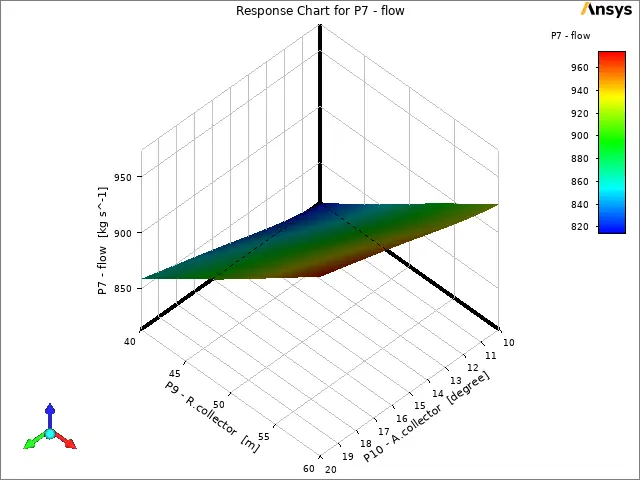
According to the RSM, we obtained 2D and 3D plots of mass flow rate to analyze the simultaneous effects of the three input parameters. The results show that increasing the tower height, collector radius, and absorber plate angle increases the mass flow rate.
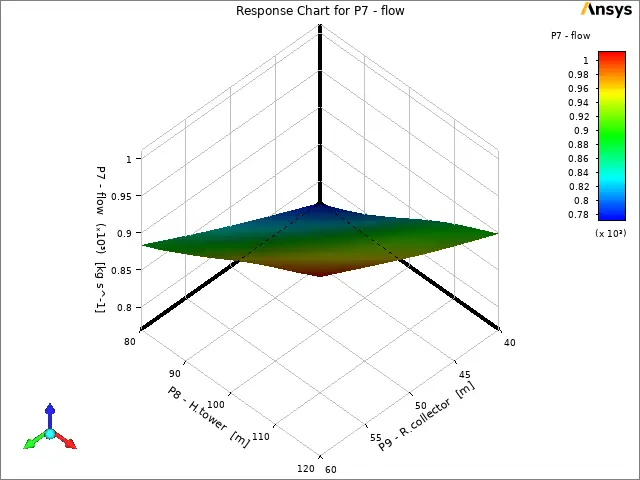
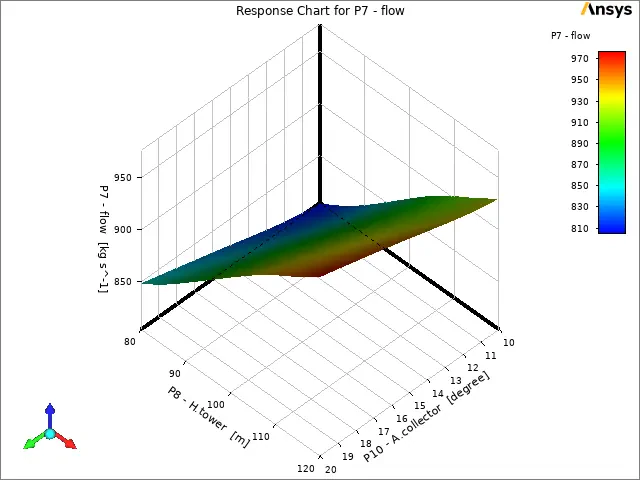
As the tower height increases, the pressure difference between the base and the top of the tower rises (ΔP = ρgh). The higher pressure difference increases the buoyancy force. Hence, the hot air moves upwards at a faster speed.
Increasing the collector radius and consequently, the collector area causes more solar absorption and, as a result, more heat transfer to the air below the collector. Increasing the temperature reduces the air density and enhances the buoyancy force.
Increasing the collector's slope causes a greater suction effect and the hot airflow is more easily moved towards the chimney.
Hence, the optimal design is obtained at the maximum height, radius, and angle. Then, we compared the base and the optimal cases by the velocity contour and vector.
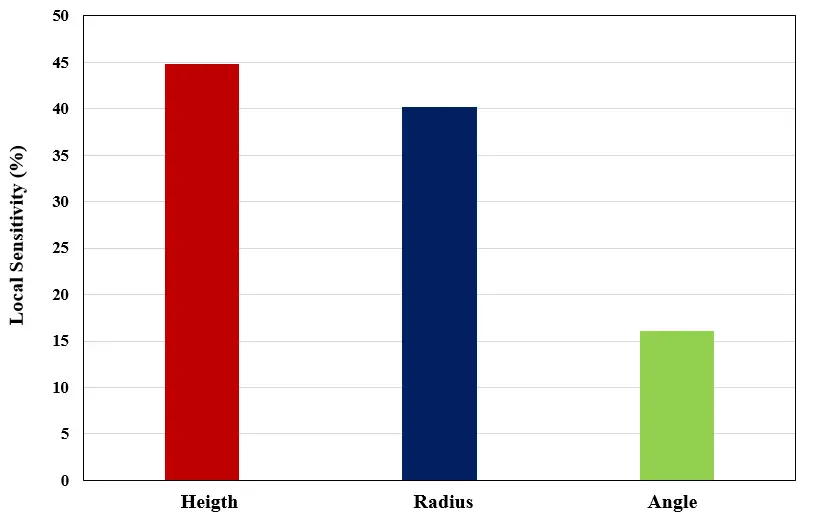
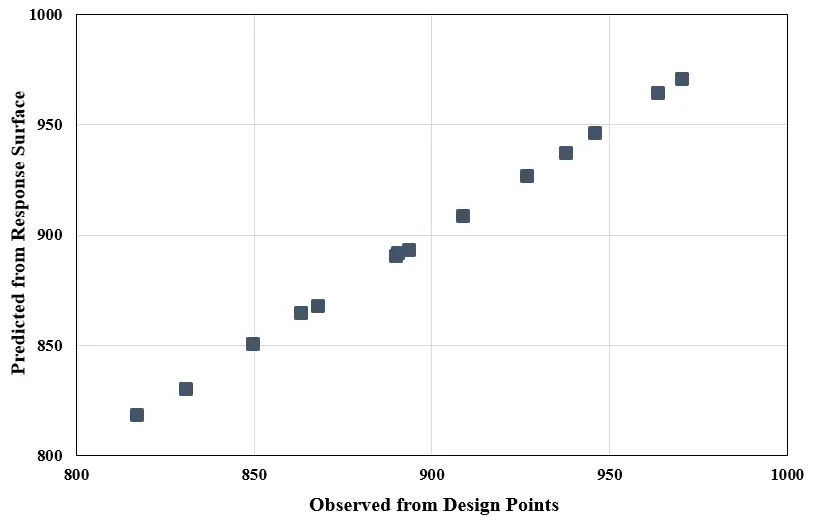
In addition, we obtained the plots of the local sensitivity and goodness of fit. The local sensitivity shows how much each input parameter affects the output parameter. The goodness of fit shows the accuracy of the results estimated by RSM compared to the results obtained at the design points.