Spoiler Effect on a Car Aerodynamics, ANSYS Fluent CFD Simulation Tutorial
Price: $100
- The present problem simulates a car in two modes with and without a spoiler using ANSYS Fluent.
- We design the 3-D model by the Design Modeler software.
- We mesh the model with ICEM software.
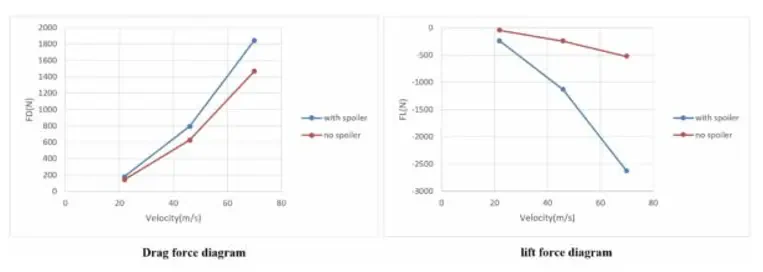
- We investigate drag and lift force in two modes: with spoiler and without spoiler.
Description
The present problem simulates a car in two modes with and without a spoiler in terms of aerodynamic coefficients, at 3 different speeds using ANSYS Fluent software. We perform this CFD project and investigate it by CFD analysis.
The present model is designed in three dimensions using Design Modeler software. The meshing of this project has been done with ICEM software.
Spoiler Methodology
In this project, the car’s geometry in two modes of with and without spoiler in terms of aerodynamic coefficients, in 3 different speeds with zero side angle, has been studied by ANSYS Fluent software.
The considered speeds are 22, 46, and 70 meters per second (m/s), and at the highest speed, the car's stability in the case in which a spoiler has been added is examined.
Moreover, the SST k-omega model is enabled to solve the turbulent fluid equations due to its advantage in predicting flow patterns near and from the walls accurately.
Spoiler Conclusion
At the end of the solution process, two-dimensional contours related to pressure and velocity are obtained. As seen in the pressure contour, the pressure increases at the stagnation point on the car's front section.
Also, the velocity contour clearly shows how the wake region is generated on the car's rear section. Furthermore, based on the data calculated in Fluent, the following tables show the aerodynamic forces in two directions for two modes of with and without spoiler. Speed is in meters per second, and forces are Newtons.
| no spoiler | ||
| Velocity | fx | fz |
| 22 | 145 | -47 |
| 46 | 629 | -250 |
| 70 | 1467 | -527 |
| with spoiler | ||
| velocity | fx | fz |
| 22 | 184 | -243 |
| 46 | 796 | -1135 |
| 70 | 1847 | -2633 |
We can see from the diagrams and tables above that the drag force increases for the mode with the spoiler. As expected, the lift force increases in the direction the body sticks to the ground, so the car’s stability increases, which causes control at high speeds of the car to get better.