

Talking Spread COVID-19 CFD Simulation, ANSYS Fluent Training
Price: $20
- The problem numerically simulates Talking Spread COVID-19 using ANSYS Fluent software.
- We design the 3-D model by the Design Modeler software.
- We Mesh the model by ANSYS Meshing software, and the element number equals 724076.
- We perform this simulation as unsteady (Transient).
- We use the discrete phase model (DPM) to define particle virus dispersion.
- We use a Profile to define virus particles' velocity and mass flow rate.
Talking Spread COVID-19 CFD Simulation, ANSYS Fluent Training
Price: $20
- The problem numerically simulates Talking Spread COVID-19 using ANSYS Fluent software.
- We design the 3-D model by the Design Modeler software.
- We Mesh the model by ANSYS Meshing software, and the element number equals 724076.
- We perform this simulation as unsteady (Transient).
- We use the discrete phase model (DPM) to define particle virus dispersion.
- We use a Profile to define virus particles' velocity and mass flow rate.

Description
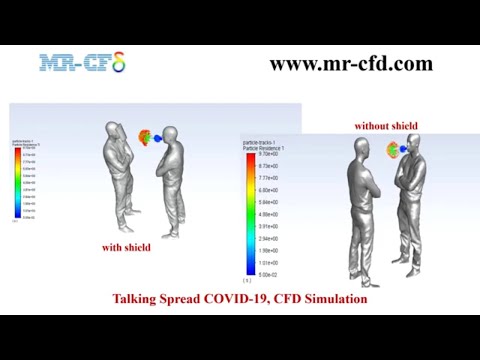
In this project, the ability of coronavirus particles to propagate at a distance less than a social distance via talking has been simulated using ANSYS Fluent software. We perform this CFD project and investigate it by CFD analysis.
Therefore, it has been tried to simulate the release of virus particles from a Coronavirus patient’s mouth while talking and transmitting it to another person in a specific space (social distancing).
The present model is designed in three dimensions using Design Modeler software. The model’s geometry includes a computational space measuring 1.6 m * 2 m * 2.6 m in which two people are facing each other at a distance of 80 cm.
One of these two people is designed as a patient, so the patient’s mouth is defined as the source of the virus spread caused by talking.
The meshing of the model has been done using ANSYS Meshing software. The element number is 724076.
Also, a transient solver has been used due to the nature of the project (i.e., particle/virus dispersion).
Talking Methodology
This study aims to investigate the ability of virus particles to propagate and transmit at a distance less than a social distance. For the present simulation, the discrete phase model (DPM) is used; Because this model allows us to study a mass of particles discretely or bit by bit in a continuously fluid space.
Due to this model’s choice, the virus particles secreted from the patient’s mouth are considered a discrete phase. The open airflow in the computational area is regarded as a continuous phase.
The type of discrete phase behavior will be time-dependent and with a time step of 0.001 s (by activating the unsteady particle tracking mode). After activating the discrete phase model, the Injection process must be defined, determining the type and quality of discrete particles injected into the model.
In this model, the emitted particles are defined as the Inert type, and the injection type is surface and is done through the surface of the patient’s mouth.
These virus particles have a constant diameter of 0.000001 m and a temperature of 310 K, which are spread between 0 s and 20 s. A specific Profile has been used to define virus particles' velocity and mass flow rate.
This profile shows the velocity and flow rate of the emitted particles when speaking; Thus, these virus particles are removed from the patient’s mouth in a Transient manner.
The particle velocity profile is defined as a sinusoidal function with a maximum velocity of 0.33 m/s, and the particle flow rate is determined by a specific ratio to the particle velocity.
Also, the RNG k-epsilon model and energy equation are enabled to solve the turbulent fluid equations and to calculate the temperature distribution inside the domain, respectively.
Talking Conclusion
At the end of the dissolution process, we obtain the particle tracking of the virus particles at different time intervals of the simulation process. This particle sequence is based on the residence time and the velocity of the particles.
According to the simulation results, the virus particles were expelled from the patient’s mouth in the first 20 s. In the second 20 s, only the particles in the space between the patient and the healthy person continue their transitional movement.
According to the results, we conclude that by talking to the patient without a mask or shield for 20 s, these virus particles transmit to a healthy person after 40 s and expose him to receiving virus particles.