

Tank Filling CFD Simulation, 3-phase, ANSYS Fluent Training
Price: $80
In this project, Tank Filling with three phases (VOF) has been simulated and the results have been investigated.
Tank Filling CFD Simulation, 3-phase, ANSYS Fluent Training
Price: $80
In this project, Tank Filling with three phases (VOF) has been simulated and the results have been investigated.
Tank Filling Project Description
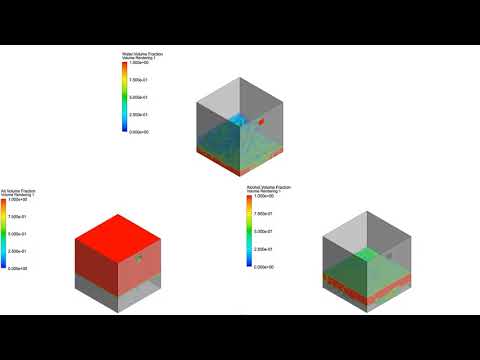
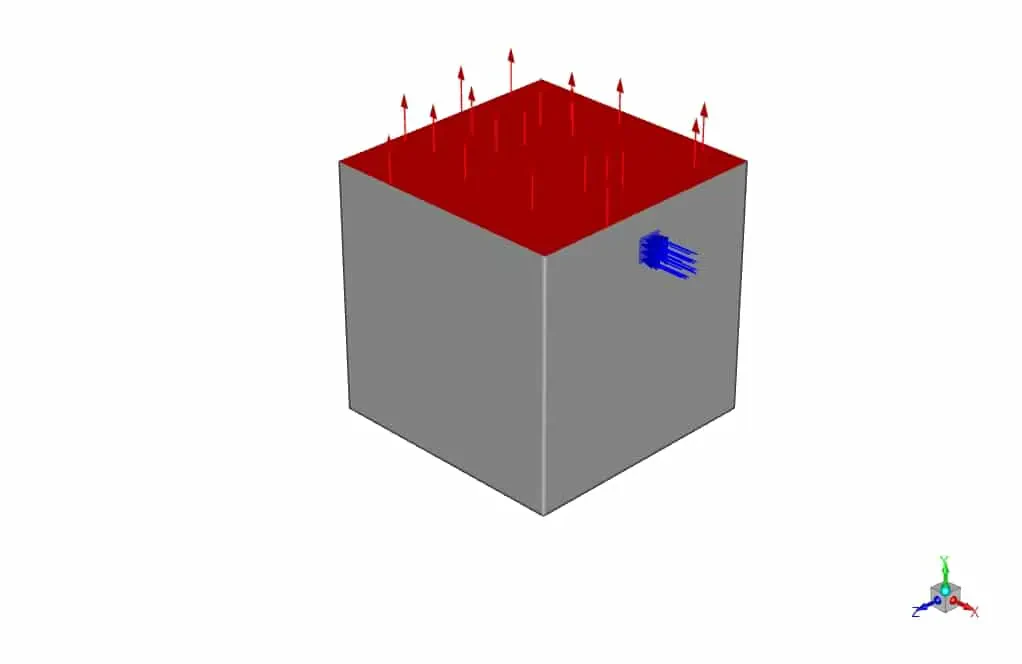
The current project simulates the tank filling by Ansys Fluent software. The goal of many operations in the chemical industry is to separate the components of a solution or mixture from each other or to obtain a pure substance from a combination of two or more components. In this Tank Filling simulation, using the VOF (volume of fluid) method, the interaction of three phases, including water, alcohol, and air was investigated. For this purpose, the effect of shear forces on the boundary between the phases was applied by applying surface stresses between the two phases. Water enters the domain through a 10 cm side valve at a speed of 1 m / s, and the interaction of the phases was investigated by comparing different contours.
Geometry & Mesh
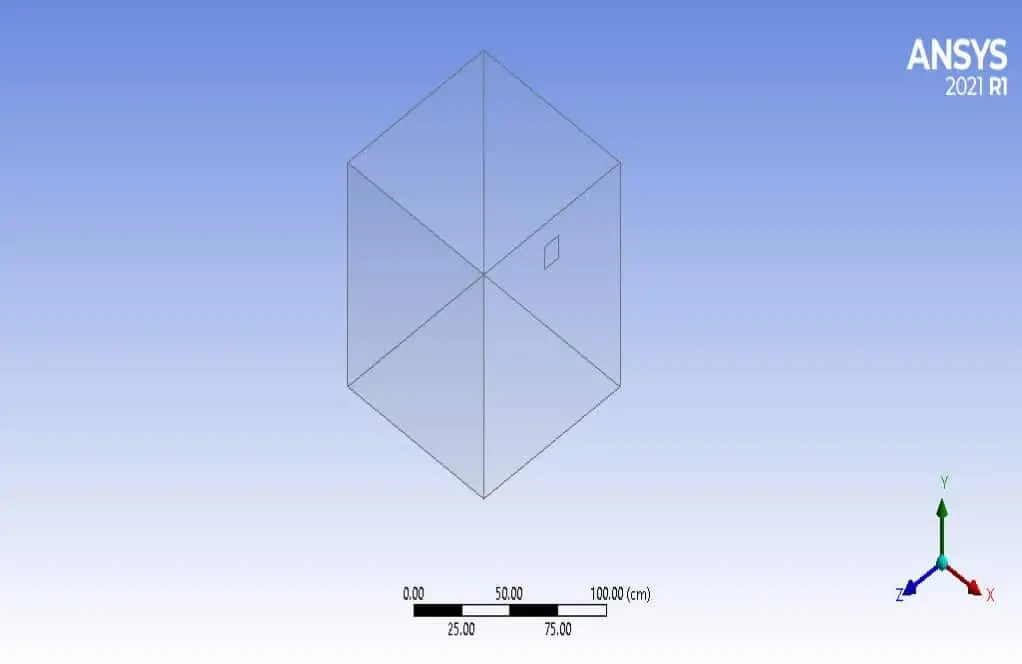
The computational domain was designed using Design Modeler software, and its dimensions were a cube with a side of 1 meter. A square valve with a side of 10 cm in the wall was designed to allow water to flow into the domain. In the beginning and before starting to solve the problem, there was 40 cm of alcohol in the bottom of the container
.
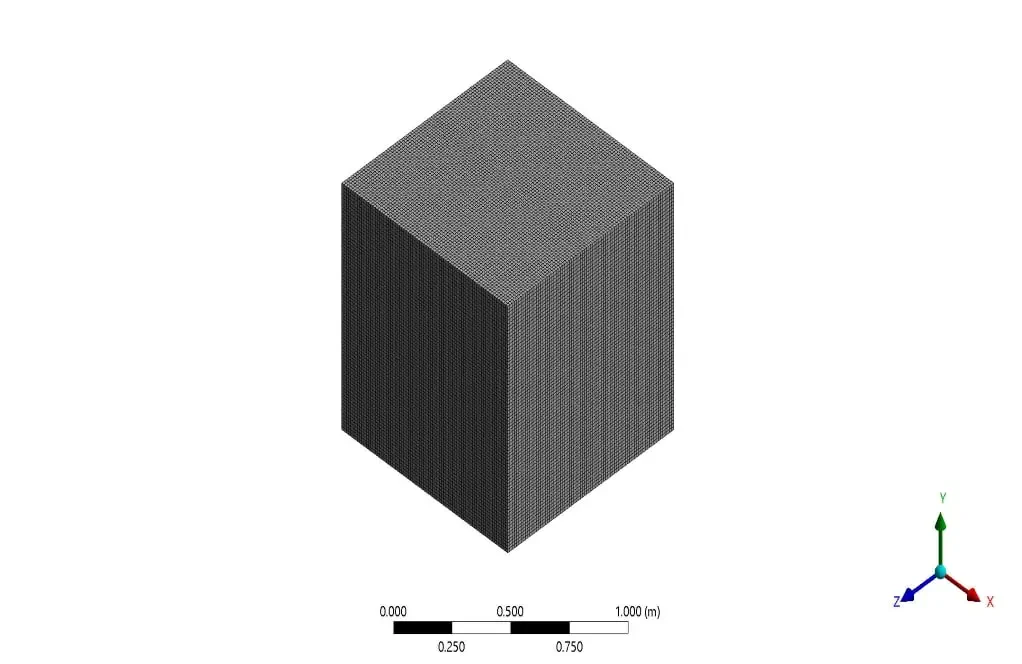
Ansys Meshing software was used for grid generation, and the type of problem elements was structured. Also, the total number of elements was about 421,000.
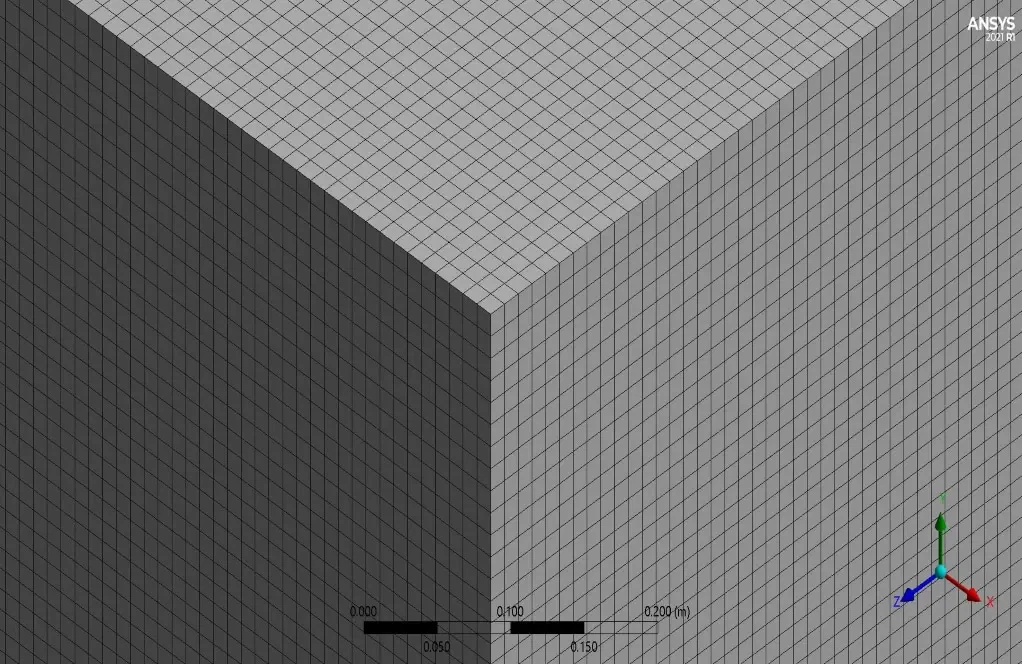
Tank Filling CFD Simulation
To simulate the present model, several assumptions are considered, which are:
- Due to the incompressibility of the flow, the pressure-based solver method has been selected.
- The simulation is transient.
- The gravity effect is considered equal to -9.81 m.s-2 on Y-axis
- All thermodynamic properties of fluids, including density, were assumed to be constant.
The VOF (Volume of Fluid) model is used to simulate non-mixing biphasic flows and is generally used to simulate the interface of two fluids. In other words, the VOF model will be highly efficient when the goal of the simulation is to study the interface between two fluids. In the software, the equations of each phase were solved discretely along with the RANS and turbulence equations.
The following is a summary of the steps for defining the problem and its solution:
| Material Properties | |||
| Water | |||
| Amount | Fluid properties | ||
| 998.2 | Density (kg/m3) | ||
| Alcohol | |||
| Amount | Fluid properties | ||
| 790 | Density (kg/m3) | ||
| Air | |||
| Amount | Fluid properties | ||
| 1.225 | Density (kg/m3) | ||
| Multiphase | |||
| Homogeneous model | VOF (volume of fluid) | ||
| Number of Eulerian phases | 3 (water-alcohol-air) | ||
| Interface modeling | sharp | ||
| Formulation | Explicit | ||
| Phase interaction | |||
| Fluid type | Surface tension coefficient (N/m) | ||
| Water-air | 0.072 | ||
| Alcohol-water | 0.043 | ||
| Air-alcohol | 0.022 | ||
| Boundary Condition | |||
| Type | Amount (units) | ||
| Velocity inlet | 1 m/s | ||
| pressure outlet (gauge pressure) | 0 pa | ||
| Cell zone condition | |||
| Fluid | mixture | ||
| Turbulence models | |||
| K-epsilon | viscous model | ||
| Realizable | K- model | ||
| Standard wall functions | Wall function | ||
| Solution methods | |||
| SIMPLE | pressure velocity coupling | ||
| PRESTO | pressure | spatial discretization | |
| Second-order upwind | momentum | ||
| First-order upwind | turbulent kinetic energy | ||
| First-order upwind | turbulent dissipation rate | ||
| Volume fraction | Geo-reconstruct | ||
Tank Filling Results
In this section, first, the velocity counters at 1 and 15 seconds after solving were given below. As can be seen in the attached animation, as the volume of water in the tank increases, the alcohol phase moves upwards, and due to the non-mixing of water and alcohol, the separation operation can be performed by placing a drain valve under the tank.