Taxi Drone FSI Analysis: CFD Simulation by Ansys Fluent
Price: $649
- The problem numerically simulates a Taxi Drone using ANSYS Fluent software.
- We design the 3-D model with the SpaceClaim software.
- We mesh the model with Ansys Meshing software. The element number equals 9,998,951 and their type is Tetrahedral.
- In this simulation, Dynamic Mesh is used for FSI modeling.
FSI Analysis: Taxi Drone CFD Simulation Training
Introduction
FSI simulation involves the interaction between the fluid and the structure. If we only want to consider the effects of the fluid on the structure, we use one-way method, and if we want to consider the effect of the structure on the fluid in addition to the effect of the fluid on the structure, we use two-way method. In this simulation, we have performed a two-way simulation. Previously, we could only run the two-way method in Workbench, but now Fluent software also has this capability. However, if our simulation involves large displacements, it is better to use Workbench because Fluent is not able to accurately analyze large displacements.
Taxi drones, or electric vertical takeoff and landing vehicles (eVTOLs), are a new class of commercial aircraft designed to provide fast passenger transportation in densely populated urban areas by utilizing autonomous technologies and electric propulsion. These aerial vehicles are considered an innovative alternative to traditional transportation systems, with the aim of reducing ground traffic and minimizing environmental pollution.
These aircraft generally use a multirotor configuration to enable vertical takeoff and landing without the need for a runway. By using electric propulsion systems and advanced lithium-ion batteries, these drones produce no carbon emissions and, due to the absence of internal combustion engines, generate much less noise than traditional helicopters.
The geometry of the present model is three-dimensional and has been designed using SpaceClaim software. We do the meshing of the present model with Ansys Meshing software. The mesh type is Tetrahedral, and the element number is 9,998,951.
Methodology
In this FSI study used a steady-state, pressure-based CFD simulation in ANSYS Fluent software to analyze the incompressible flow around a UAV and the fluid-structure interactions(FSI). The flow physics was modeled using the k-Ԑ Realizable turbulence model and a dynamic mesh was also used.
Results and Conclusion
According to the extracted contours, it is observed that, as expected, the greatest displacement occurs at the wing tips of the UAV and the greatest stress is at the wing-body connection.
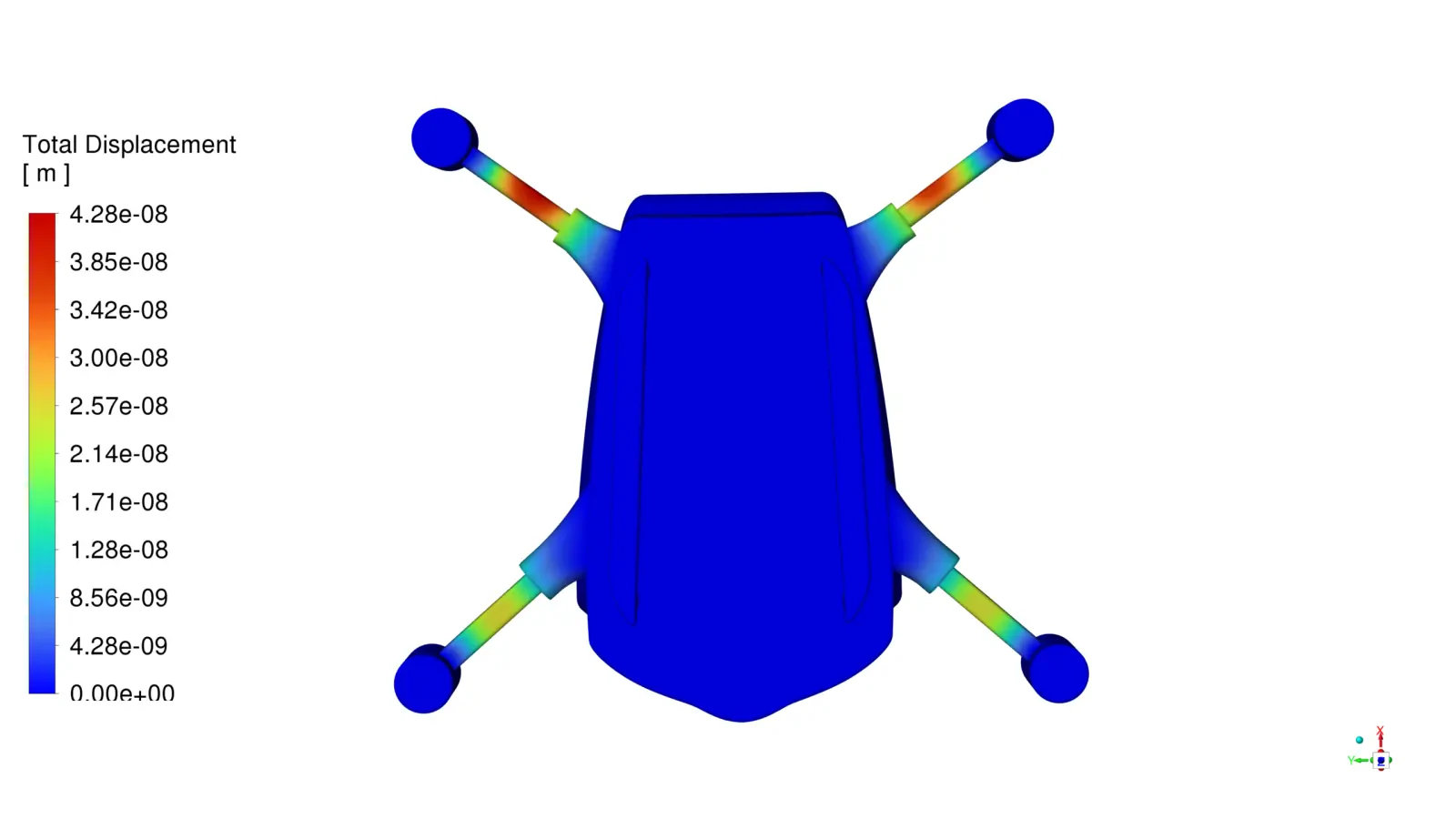
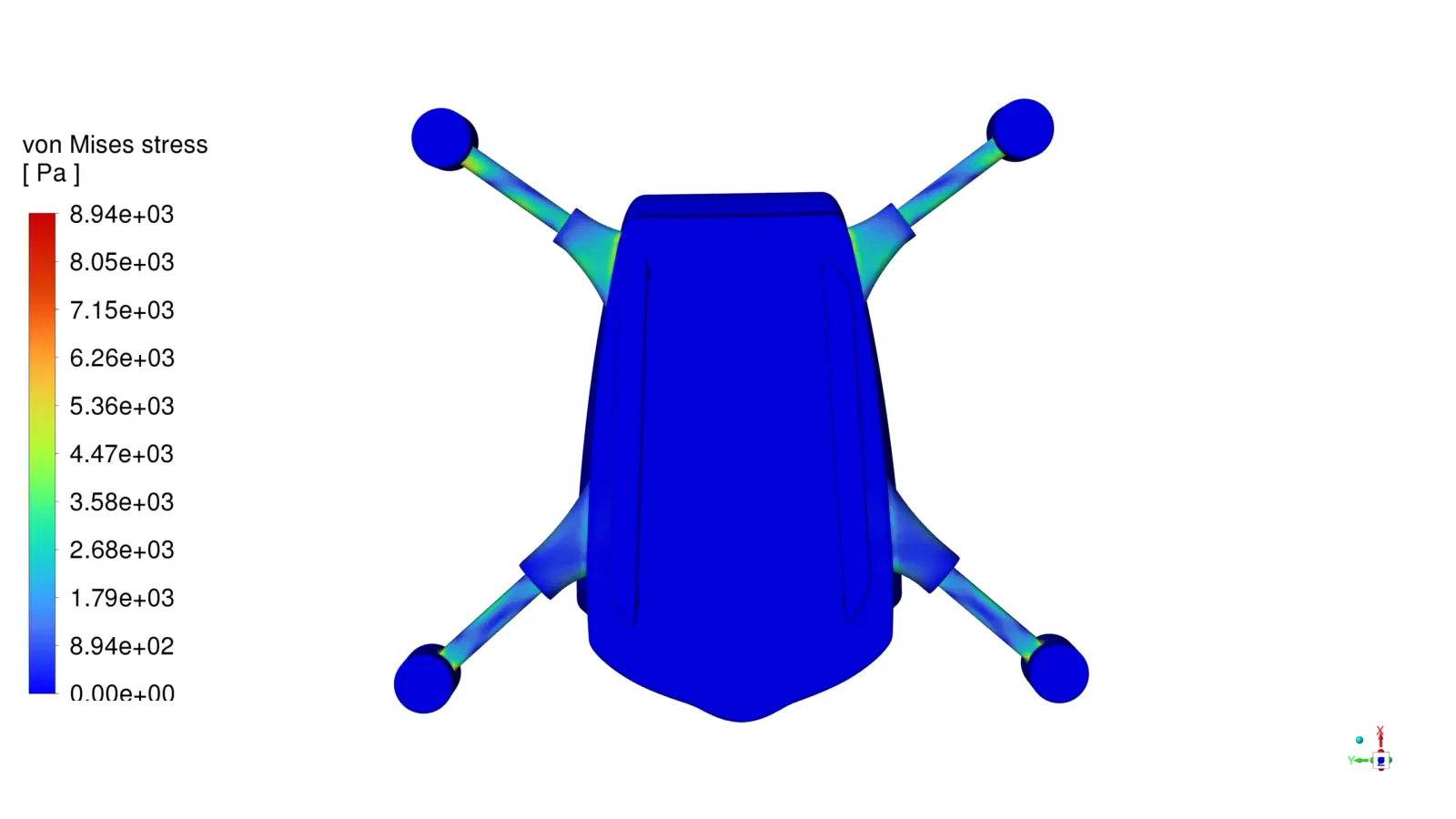
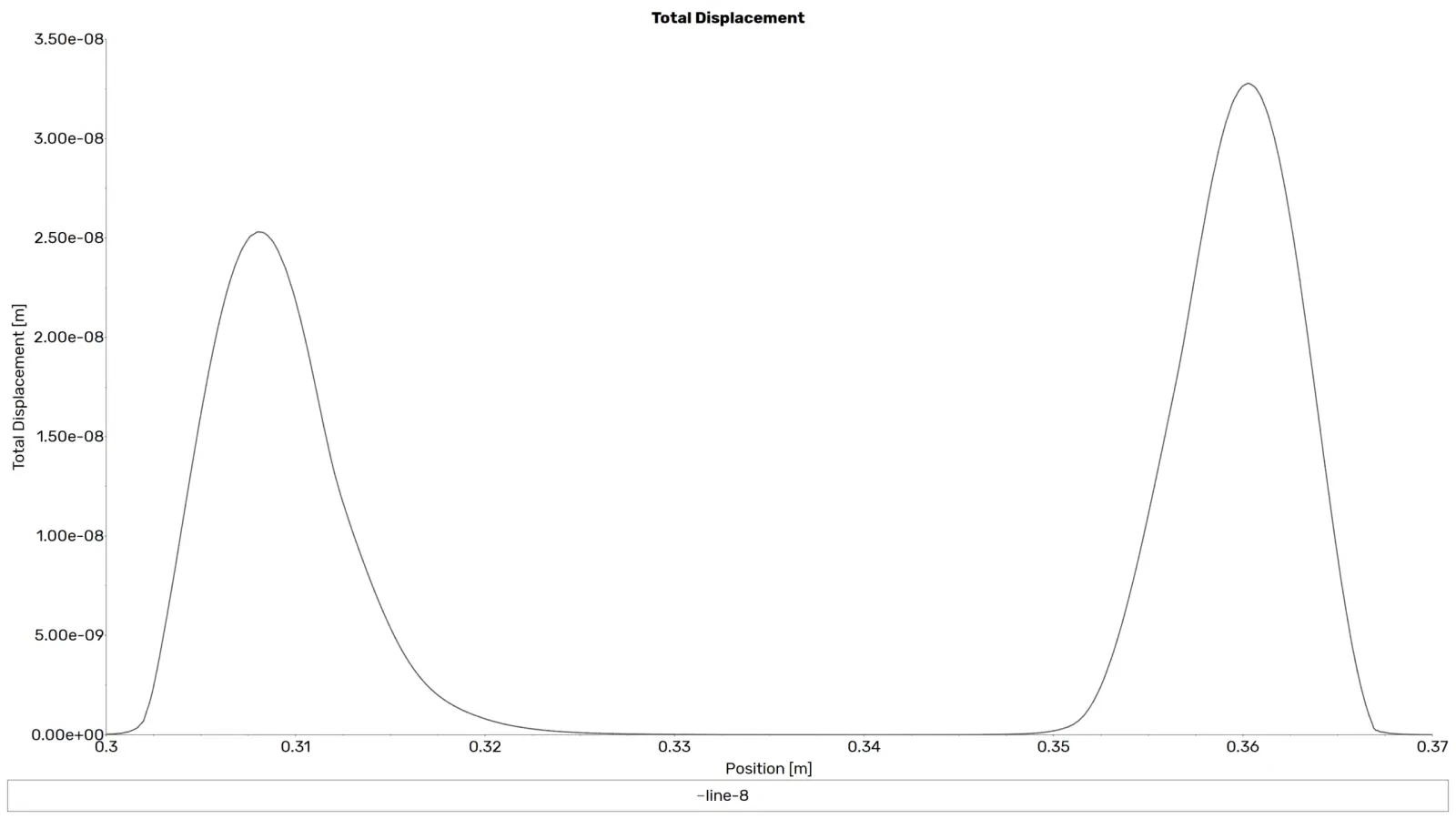
It is also seen in the diagrams that the amount of displacement decreases from the wingtips to the fuselage junction and reaches zero at the fuselage. Although the fuselage displacement may sometimes not be zero, its amount is very small and is usually ignored. The diagram below is for two taxi drone stands diagonally.