

Thermal Management of Battery Using Nano Fluid
Price: $949
In this project, Thermal Management of Battery (using Nano Fluid) has been simulated and the results of this simulation have been investigated.
Thermal Management of Battery Using Nano Fluid
Price: $949
In this project, Thermal Management of Battery (using Nano Fluid) has been simulated and the results of this simulation have been investigated.
Thermal Management of Battery (Using Nano Fluid), CFD Simulation Ansys Fluent Training
The present problem simulates the Thermal Management of Battery Using Nano Fluid (Two-Phase) by Ansys Fluent software. This simulation is related to a Dual-Potential MSMD (multiscale multidomain) battery model. Generally, a battery can store electrical energy in chemical energy. If the current is requested from the battery, the chemical energy is converted into electrical energy, and when the battery is charged, the electrical energy is converted into chemical energy. Also, heat can be generated from multiple sources, including internal losses of joule heating and local electrode overpotentials, the entropy of the cell reaction, the heat of mixing, and side reactions.
Previously a modular, efficient battery simulation model (MSMD model) was introduced to aid the scale-up of Li-ion material & electrode designs to complete cell and pack designs, capturing electrochemical interplay with 3-D electronic current pathways and thermal response. The expandable and flexible architecture connects the physics of battery charge/discharge processes, thermal control, safety, and reliability computationally efficiently.
The present simulation is performed with Mixture multiphase model, and the effect of nanofluid flow in heat transfer enhancement of the battery is investigated. This work aims to investigate the effectiveness of phase change materials in the cooling process of the battery. The nanofluid material is water as base fluid and aluminum as nanoparticles, and the velocity of the nanofluid at the inlet face is equal to 0.1 m/s. The volume fraction of nanoparticles is 0.05.
GK empirical model is set for E–Chemistry. The Specified C-rate of 0.5 and numerical cell capacity of 14.6 are chosen as Electrical parameters.
Geometry & Mesh
The Geometry of this model is designed in Design Modeler software three-dimensionally, and the scale of it is as follows:
Xmin: -0.007 m Xmax: 0.007 m
Ymin: -0.008 m Ymax: 0.0087 m
Zmin: -0.0008325 m Zmax: 0.002 m
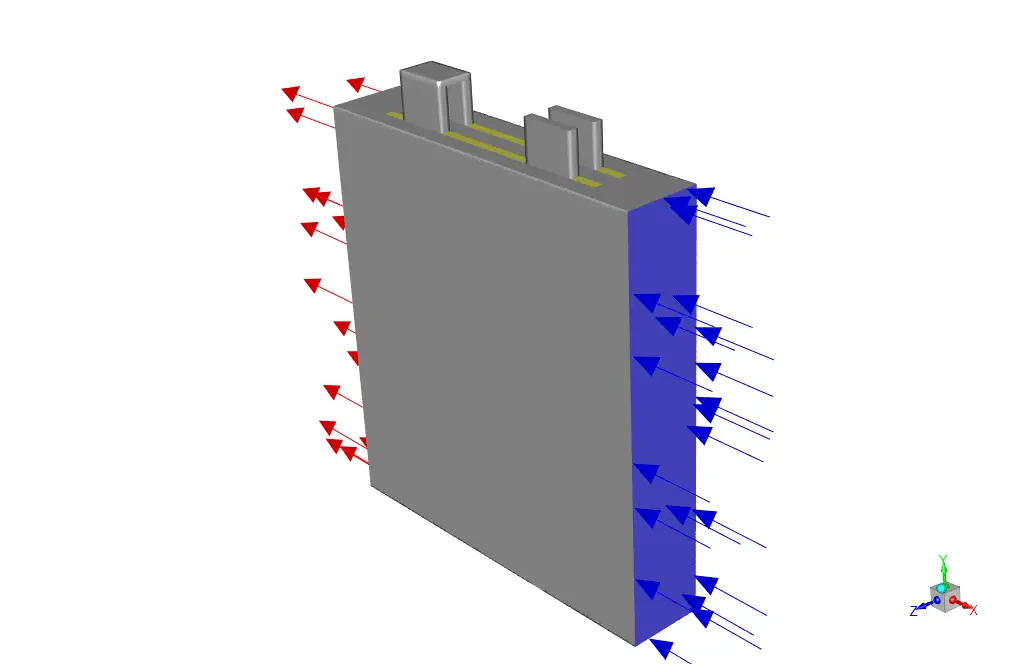
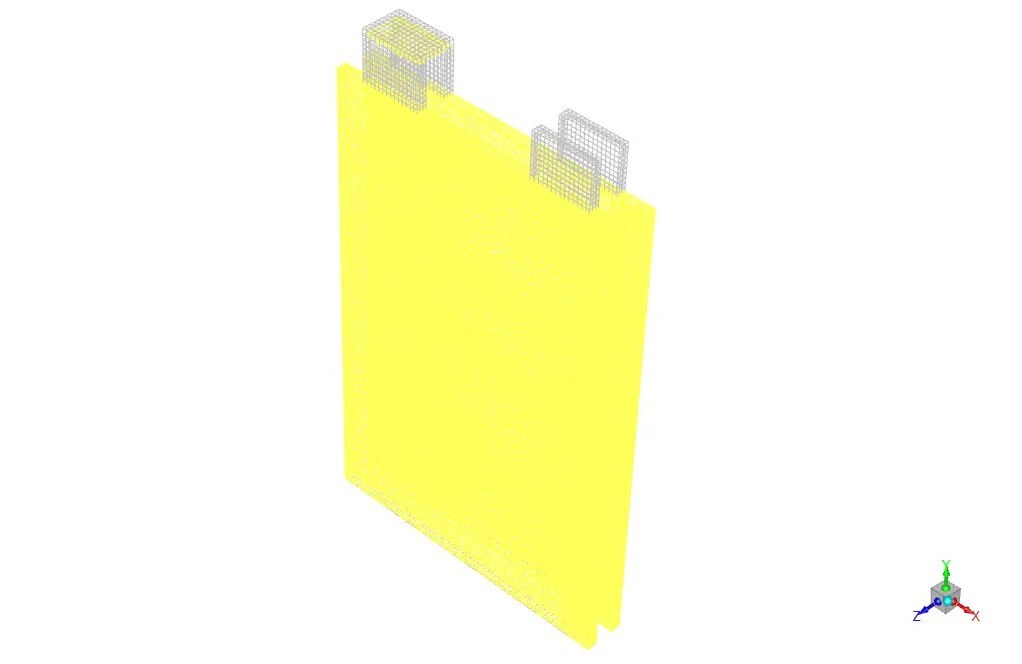
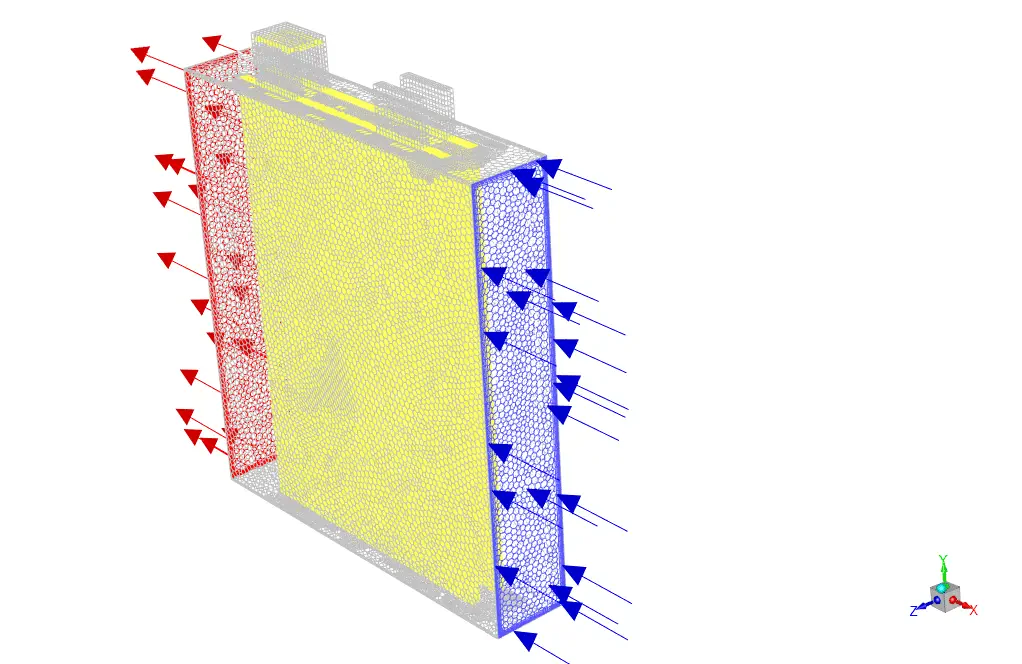
We carry out the model's meshing using ANSYS Meshing software. The mesh type is polyhedral, and the cell number is 362734. The following figure shows the mesh:
Battery CFD Simulation
We consider several assumptions to simulate the present model:
- Solver is pressure-based.
- The simulation is transient.
- The gravity effect is set at -9.81 in the Y direction.
The following table represents a summary of the defining steps of the problem and its solution:
| General | ||||||||
| ||||||||
| Models | ||||||||
| Viscous | Laminar | |||||||
| Energy | on | |||||||
| multiphase | Mixture Model | |||||||
| Interface Modeling | Dispersed | |||||||
| Formulation | Implicit | |||||||
| Granular | on | |||||||
| Particle Diameter | 1e-5 | |||||||
| Slip Velocity | On | |||||||
| Inlet | Velocity Inlet | |||||||
| velocity magnitude | 0.1 m.s-1 | |||||||
| Volume Fraction | 0.05 | |||||||
| Temperature | 298 k | |||||||
| Outlet | Pressure Outlet | |||||||
| gauge pressure | 0 pascal | |||||||
| Walls | Wall | |||||||
| wall motion | stationary wall | |||||||
| Battery Model | on | |||||||
| Solution Method | MSMD | |||||||
| E-Chemistry Model | NTGK Empirical Model | |||||||
| Solution Options | Specified C-Rate | |||||||
| C-Rate | 0.5 | |||||||
| Min. Stop Voltage | 3 | |||||||
| Max. Stop Voltage | 4.3 | |||||||
| Initial DoD | 0.2 | |||||||
| Methods | ||||||||
| Pressure-Velocity Coupling | SIMPLE | |||||||
| Pressure | PRESTO! | |||||||
| momentum | first-order upwind | |||||||
| Volume Fraction | first-order upwind | |||||||
| Energy | first-order upwind | |||||||
| Transient Formulation | First Order Implicit | |||||||
| Wrapped-Face Gradient Correction | on | |||||||
| Initialization | ||||||||
| Initialization methods | Standard | |||||||
| gauge pressure | 0 pascal | |||||||
| x-velocity | -0.1 m.s-1 | |||||||
| y-velocity | 0 m.s-1 | |||||||
| z-velocity | 0 m.s-1 | |||||||
| Temperature | 298 k | |||||||
| Phase-2 Granular Temperature | 0.0001 m2/s2 | |||||||
Thermal Management of Battery Using Nano Fluid Results
We obtained two-dimensional and three-dimensional pressure and temperature contours, respectively, at the end of the solution process. We presented this chart in 500 Seconds. The results show that applying a Nanofluid flow to the battery body will cool and reduce the temperature growth rate.