

Vertical shell and tube liquid sodium Heat Exchanger
Price: $8
In this project, a Vertical Heat Exchanger has been simulated, and the results of this simulation have been investigated.
Vertical shell and tube liquid sodium Heat Exchanger
Price: $8
In this project, a Vertical Heat Exchanger has been simulated, and the results of this simulation have been investigated.
Vertical shell and tube Heat Exchanger (liquid sodium), Ansys Fluent CFD Simulation Training
The present simulation is about heat transfer in a vertical heat exchanger via ANSYS Fluent. A Heat exchanger is an industrial equipment whose main task is to heat transfer between its hot and cold sides. In this project, a vertical shell and tube heat exchanger are modeled.
The fluid used in this heat exchanger is liquid sodium. Sodium flow with a temperature of 900 K and a velocity of 1.5 m / s inside the helical tubes moves from the top of the heat exchanger to the bottom.
Sodium flow with a temperature of 400 K and a velocity of 1.5 m / s inside the cylindrical shell of the heat exchanger moves from down to the top.
The thermophysical properties of liquid sodium are defined as a function of temperature. Thus, density, specific heat capacity, thermal conductivity, and viscosity change at different temperatures.
Geometry & Mesh
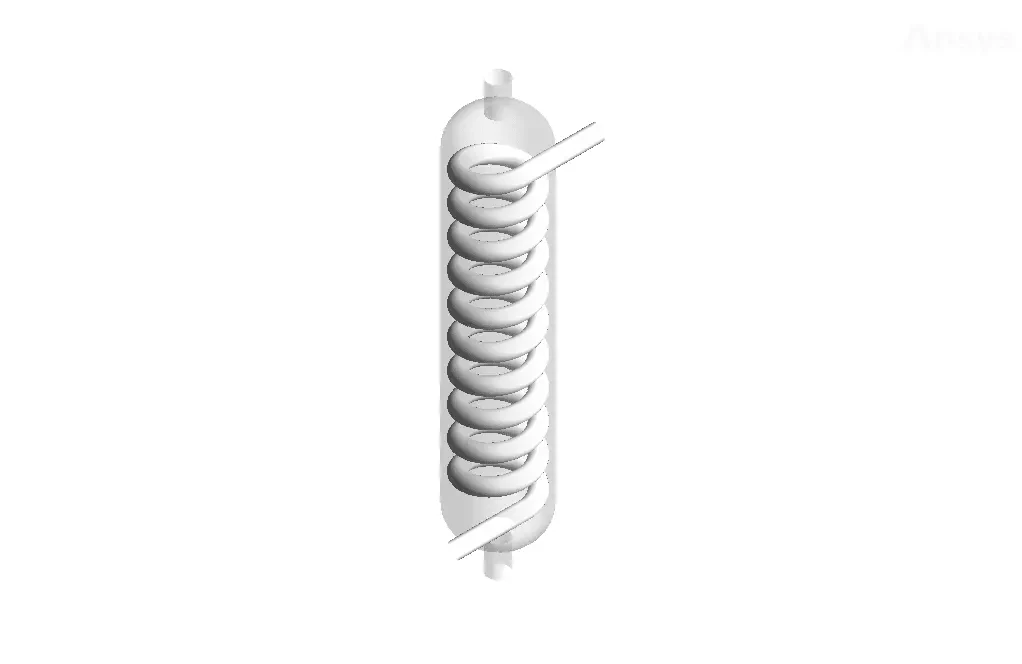
The present geometry is designed in a 3D model via Design Modeler. The computational zone is the interior space of a heat exchanger. This heat exchanger is shell and tube type; It consists of a vertical cylindrical shell with a spiral tube inside.
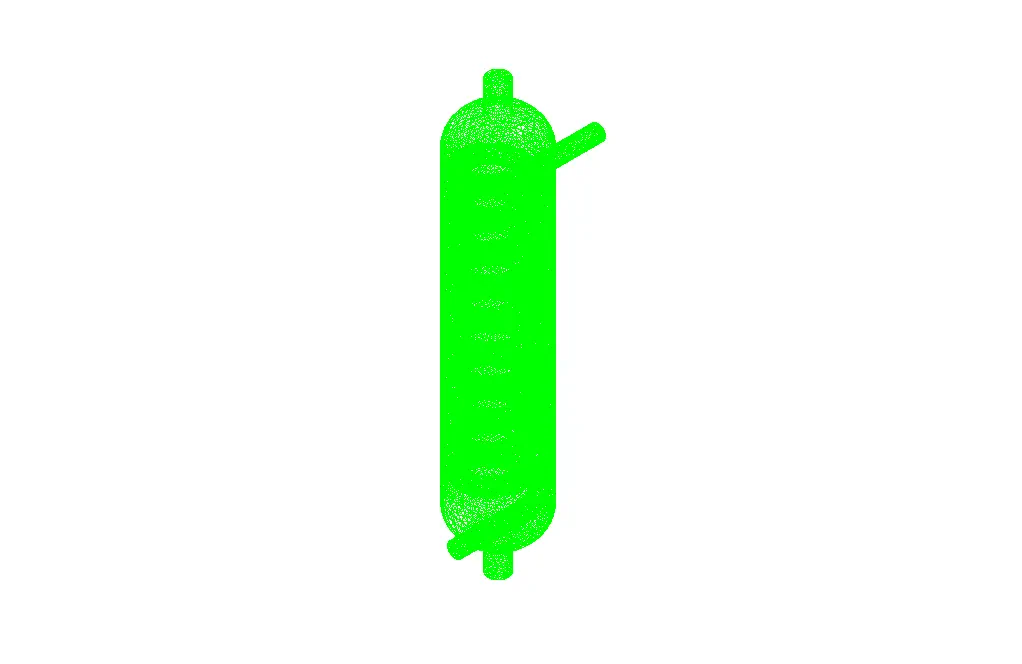
The mesh of the present model has been done via ANSYS Meshing. Mesh is done unstructured, and the number of production cells is equal to 640618.
Set-up & Solution
Assumptions used in this simulation :
- Pressure-based solver is used.
- The present simulation is steady.
- The effect of gravity is ignored.
| Models | ||
| Viscous | k-epsilon | |
| k-epsilon model | RNG | |
| Near-wall treatment | standard wall function | |
| Energy | On | |
| Boundary conditions | ||
| Inlet (shell) | Velocity Inlet | |
| velocity magnitude | 1.5 m.s-1 | |
| temperature | 400 K | |
| Inlet (tube) | Velocity Inlet | |
| velocity magnitude | 1.5 m.s-1 | |
| temperature | 900 C | |
| Walls (inner) | Wall | |
| wall motion | stationary wall | |
| thermal condition | coupled | |
| Walls (outer) | Wall | |
| wall motion | stationary wall | |
| heat flux | 0 W.m-2 | |
| Outlet (shell) | Pressure Outlet | |
| gauge pressure | 0 pascal | |
| Outlet (tube) | Pressure Outlet | |
| gauge pressure | 0 pascal | |
| Methods | ||
| Pressure-Velocity Coupling | coupled | |
| pressure | Second-order | |
| momentum | Second-order upwind | |
| energy | Second-order upwind | |
| turbulent kinetic energy | First-order upwind | |
| turbulent dissipation rate | First-order upwind | |
| Initialization | ||
| Initialization methods | hybrid | |
Vertical Heat Exchanger Results
After calculation, 2D and 3D contours related to temperature, pressure, and velocity are obtained. The contours show that heat transfer occurs between the shell (with lower temperature) and the tube (with higher temperature). In this way, the liquid sodium flow inside the tube is cooled, and the liquid sodium flow inside the shell is heated.