Wall Wavy Motion CFD Simulation, Dynamic Mesh
Price: $54
- The problem numerically simulates the Wall Wavy Motion using ANSYS Fluent software.
- We design the 2-D model with the Design Modeler software.
- We mesh the model with ANSYS Meshing software, and the element number equals 146,998.
- We perform this simulation as unsteady (Transient).
- We use the Dynamic Mesh Model to define deforming and moving zones.
- We use the user-defined function (UDF) to define the wavy motion.

Description
This project is related to the numerical simulation of the Wall with Wavy Motion using ANSYS Fluent software. We aim to consider the effect of a non-stationary wall on the water flow. We assumed that water flows in a two-dimensional channel. We considered that the bottom wall of the channel has wave motion.
This product is the sixth chapter of the Dynamic Mesh Training Course.
In this project, we simulated the water flow inside a channel with wave motion. We aim to model the wavy motion of the bottom wall of the channel. The wavy motion of the wall changes the behavior of the fluid in the channel. So, the mesh of the computing domain deforms over time.
We modeled the geometry of the project using Design Modeler software. The geometry is related to a channel with a non-stationary wall. The computational domain includes the internal space of the channel. Then we meshed the model with ANSYS Meshing software. The model mesh is unstructured, and the number of cells equals 146,998.
Wavy Motion Methodology
The Dynamic Mesh Model is used in this simulation. We generally use a dynamic mesh whenever we have a moving boundary or a deforming zone.
Here, a wall creates a wave motion. So this causes the mesh to deform over time. Therefore, we define a user-defined function (UDF) to define the wavy motion of the wall. To apply the wave motion to the wall, we must use the Grid Motion UDF.
According to the wavy motion of the wall, the mesh zone above the non-stationary wall is deformed. So, for this zone, we use the Deforming option.
Due to the nature of this modeling, fluid behavior is time-dependent. Hence, we use the unsteady (Transient) solver.
Conclusion
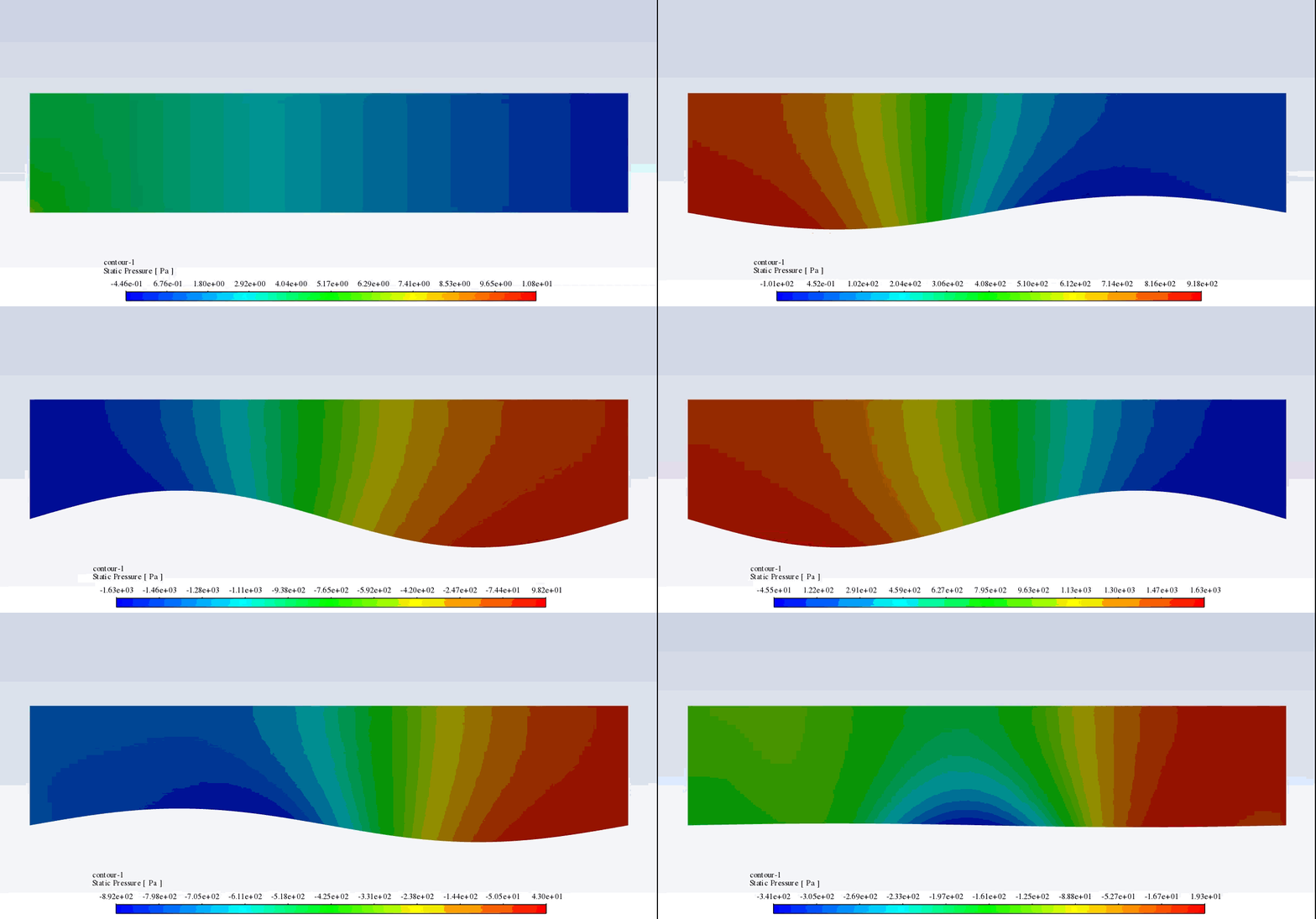
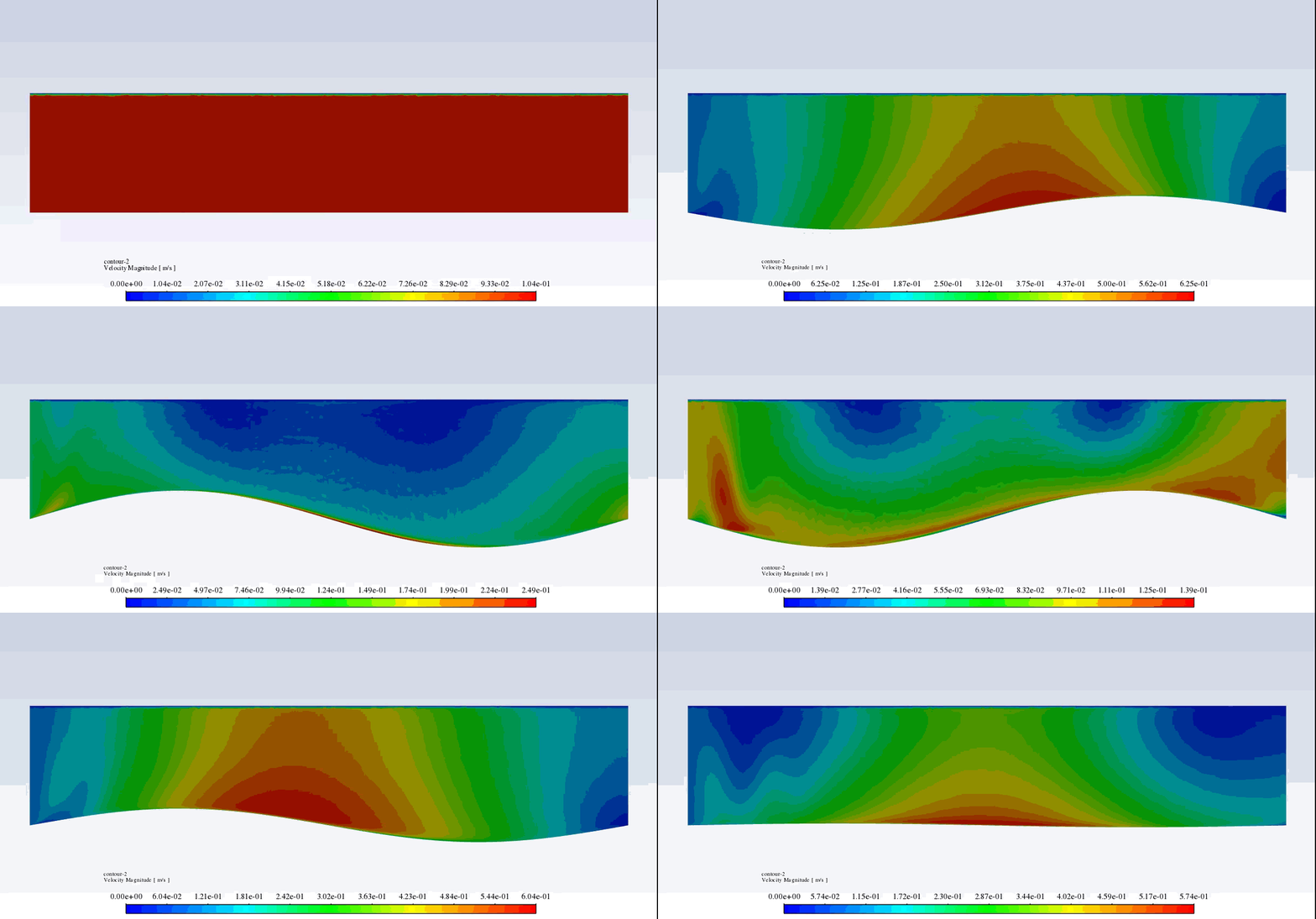
After the solution, we obtained pressure and velocity contours. Because the wall moves over time, we obtained the velocity and pressure contours animation.
The results show that the pressure and velocity are constantly changing under the influence of the wave motion of the channel wall. The wave motion causes the cross-section of the flow to change along the channel. As the cross-section decreases, the velocity increases, and the pressure decreases. If the cross-section increases, the velocity decreases, and the pressure increases.