

Abrasive Fluid Jet, CFD Simulation ANSYS Fluent Training
Price: $8
In this project, an abrasive fluid Jet has been simulated by ANSYS Fluent software.
Abrasive Fluid Jet, CFD Simulation ANSYS Fluent Training
Price: $8
In this project, an abrasive fluid Jet has been simulated by ANSYS Fluent software.
Abrasive Fluid Jet Description
The present simulation is about a fluid jet with abrasive particles via ANSYS Fluent. This process is used to cut hard materials such as metals, stones, composites, plastics, etc., and remove wire sheaths and pleats. The working mechanism of these systems is such that a beam of fluid moves at high speed towards the desired metal surfaces for cutting work.
Particles of an abrasive are injected into this path of the fluid to hit the surfaces with the fluid at high speed, and as a result, the cutting process takes place from the surfaces.
The most important advantage of this cutting method is that it does not need heating; because thermal cutting processes cause the desired material to melt or burn. In this project, a zone for fluid jet movement is designed; thus, the fluid jet with the abrasive material makes contact with a curved metal surface.
Oil has been used to create fluid jets, and sand particles have been used as abrasive particles. Oil enters the model as a continuous fluid at 23 m/s. The discrete phase model (DPM) is also used to define the motion of abrasive particles.
The discrete phase is used when discrete particles move in a continuous environment; in other words, the solution perspective changes from Eulerian to Lagrangian. Also, since abrasive particles cause abrasion on the desired surfaces, the erosion model must be activated.
Geometry & Mesh
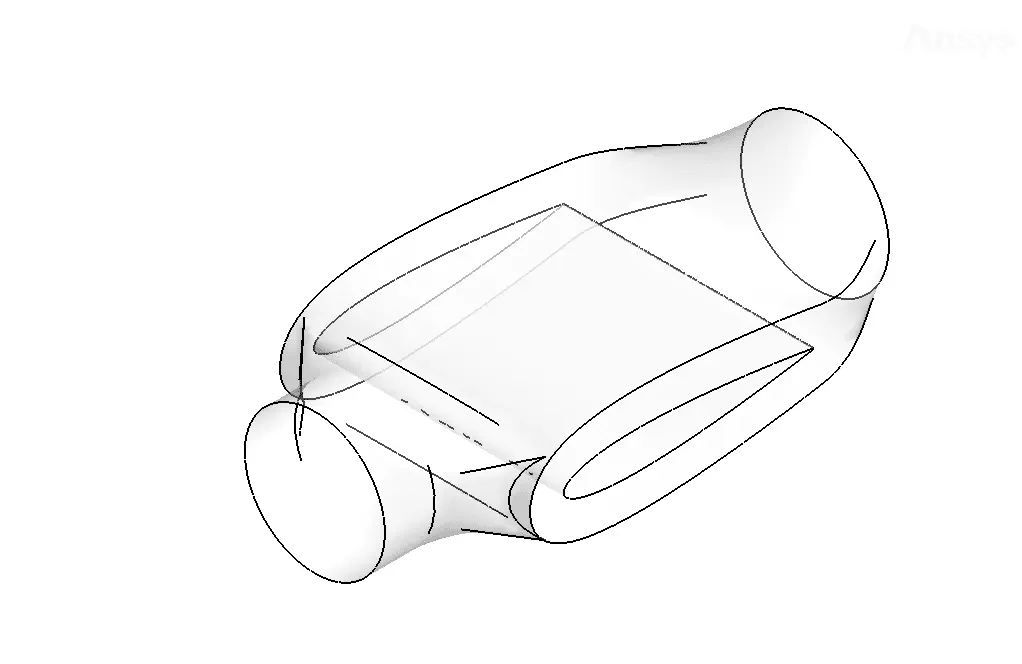
The present geometry is designed in a 3D model via Design Modeler. The computational zone is the space around a curved surface to which the fluid flows from a circular cross-section.
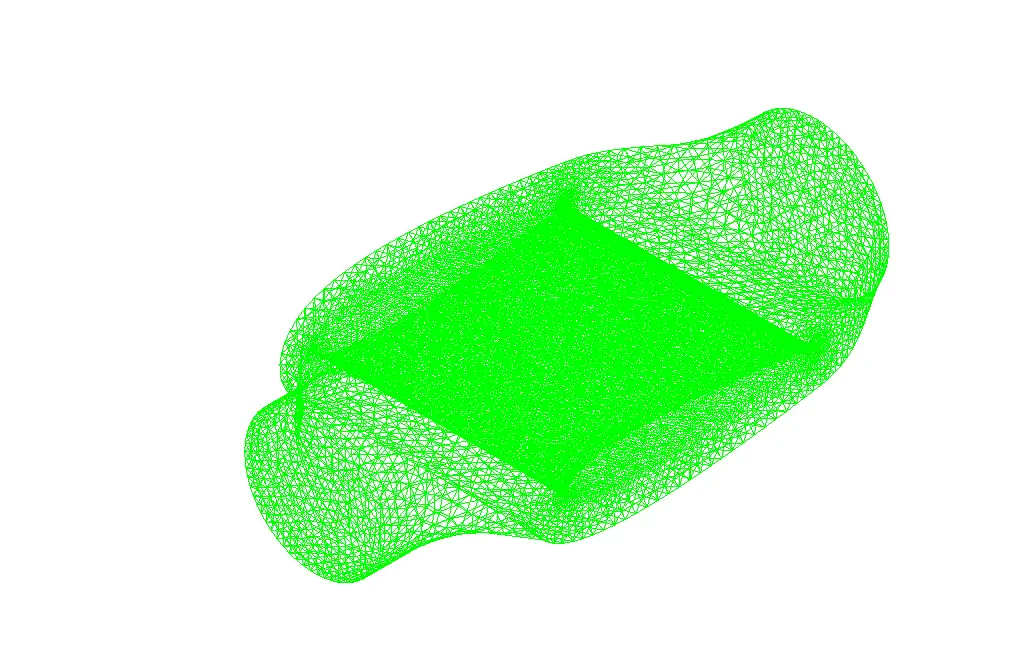
The mesh of the present model has been done via ANSYS Meshing. Mesh is done unstructured, and the number of production cells is equal to 924058.
Set-up & Solution
Assumptions used in this simulation:
- pressure-based solver is used.
- The present simulation is unsteady.
- The gravity is applied to the model, and the gravitational acceleration is defined as 9.81 m.s-2.
| Models | ||
| Viscous | k-epsilon | |
| k-epsilon model | realizable | |
| near-wall treatment | standard wall treatment | |
| Discrete Phase Model | On | |
| interaction with continuous phase | on | |
| physical model | erosion/accretion | |
| Injection | On | |
| injection type | surface | |
| injection surface | inlet | |
| diameter | 0.00015 | |
| mass flow rate | 0.046 kg.s-1 | |
| Boundary conditions | ||
| Inlet | Velocity Inlet | |
| velocity magnitude | 23 m.s-1 | |
| discrete phase BC type | escape | |
| Walls | Wall | |
| wall motion | stationary wall | |
| discrete phase model conditions | erosion/accretion | |
| erosion models | Generic, Finnie, Mclaury, Oka, DNV | |
| Outlet | Pressure Outlet | |
| gauge pressure | 0 pascal | |
| discrete phase BC type | escape | |
| Methods | ||
| Pressure-Velocity Coupling | SIMPLE | |
| pressure | second order | |
| momentum | second order upwind | |
| turbulent kinetic energy | second order upwind | |
| turbulent dissipation rate | second order upwind | |
| Initialization | ||
| Initialization methods | standard | |
| gauge pressure | 0 pascal | |
| velocity (x,y,z) | 23 m.s-1 | |
Abrasive Fluid Jet Results
After calculation, 2D and 3D contours related to pressure, velocity, and DPM density are obtained. The particle tracking based on residence time is also obtained. The results show that the fluid flow becomes a jet of fluid as the cross-sectional area decreases and then, along with discrete sand particles, strikes the curved surfaces at high speed and pressure, thus causing an erosion process on the surfaces.