

DPM Online Courses
Here's every CFD online course related to DPM category.
Price: $129
Advance your Discrete Phase Model (DPM) CFD skills with this 10-project ANSYS Fluent training package — covering industrial particle and erosion applications, combustion and spray particle tracking, respiratory virus dispersion, and field-coupled particle physics.
Price: $89
Build intermediate-level expertise in Discrete Phase Model (DPM) CFD with this 10-project ANSYS Fluent training package — covering spray and droplet devices, respiratory and virus particle dispersion, particle-laden flows, and particle-driven chemical reactions.
Price: $49
The final step in the series, this course covers the most demanding version of each project — high-speed and reacting flows, fluid-structure interaction, UDFs, and moving geometry — the kind of coupled, multi-physics problems most CFD engineers never get past. It's built for those who want to solve undefined, real-world problems and defend their results with confidence.

Build Real-World CFD Skills with ANSYS Fluent
Intermediate
Price: $29
Building on the fundamentals, this course tackles harder, more realistic versions of the same 16 engineering fields and flow models, introducing multi-phase interactions, transient behavior, and more demanding boundary conditions. You'll leave with the skills to handle real project complexity, not just tutorial-scale problems.
Price: $9
This course takes you from zero to your first working simulations in ANSYS Fluent, covering foundational projects across 16 engineering fields — aerospace, biomedical, chemical, HVAC, marine, renewable energy, and more — alongside core flow models and Fluent modules. By the end, you'll be comfortable setting up, running, and interpreting basic CFD simulations on your own.

DPM (Discrete Phase Model) GOLDEN Training Course
Beginner, Intermediate, Advanced
Price: $3,269
Particle (DPM) CFD Simulation GOLDEN Training Package by MR CFD is a complete learning bundle that turns students and engineers into expert users of particle-based CFD methods in ANSYS Fluent. With more than 155 step‑by‑step tutorials covering DPM, DDPM, and DEM applications from erosion and spray to virus dispersion and HVAC, it equips teams to handle real industrial particle analysis projects with confidence. Backed by 15 years of MR CFD consulting experience, the package includes practical case studies, full workflow training, one year of expert support, and temporary HPC access to fast‑track onboarding and reduce training costs for universities, institutes, and companies.
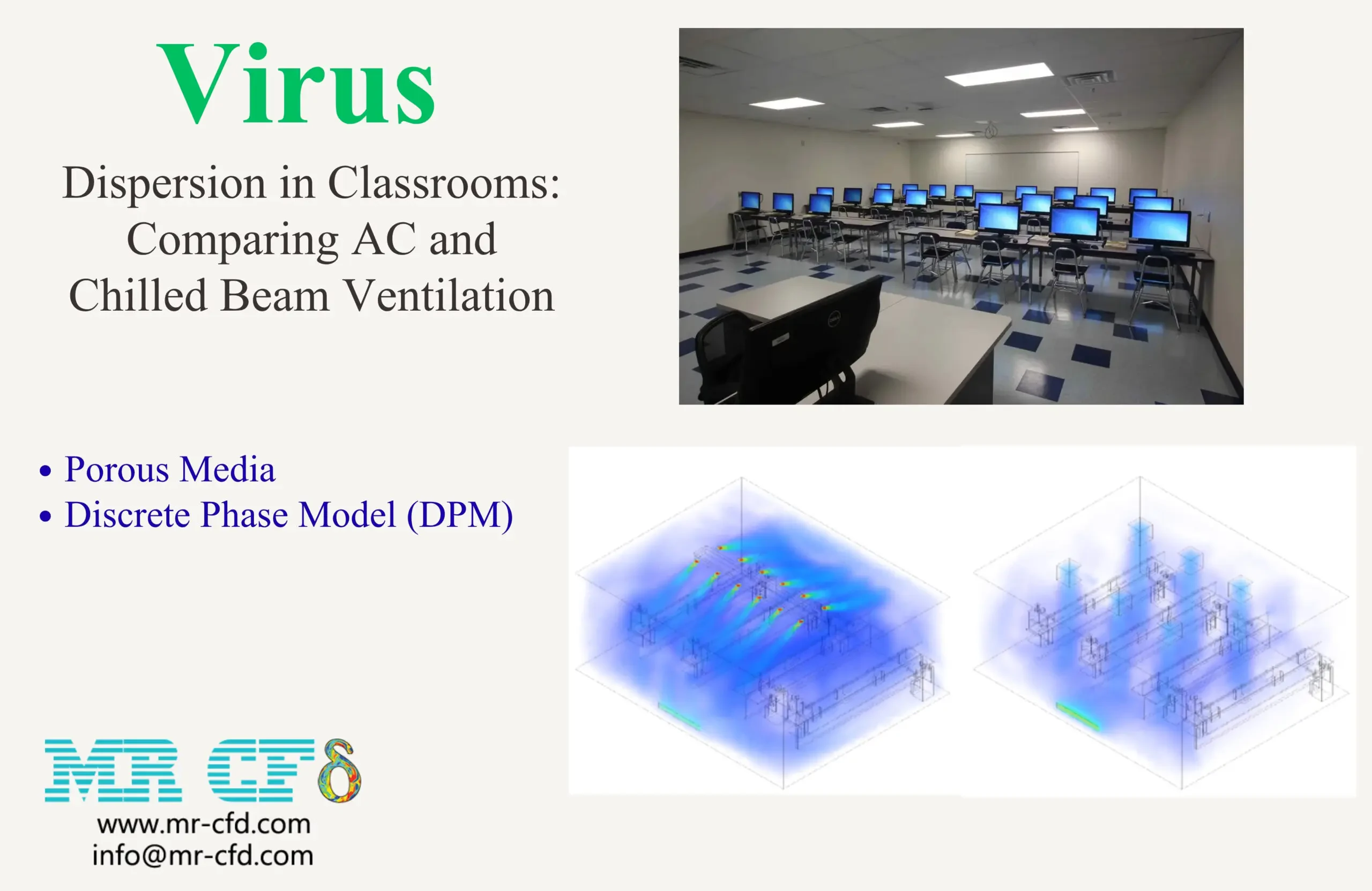
Virus dispersion in classrooms: CFD simulation comparing AC and chilled beam ventilation
Intermediate, Advanced
Price: $240
ANSYS CFD study of virus transport and comfort in a 10×8 m classroom comparing AC and chilled beam ventilation. Room with desks, eight occupants, AC louvers vs. chilled-beam inlets; unstructured mesh refined near jets, walls, and bodies. Steady pressure-based RANS (realizable k-ε), energy on with buoyancy; virus tracked via DPM; appropriate velocity-inlet and pressure-outlet BCs. AC removes particles faster but shows uneven temperatures, while chilled beams improve thermal uniformity with broader mixing that disperses particles more widely.
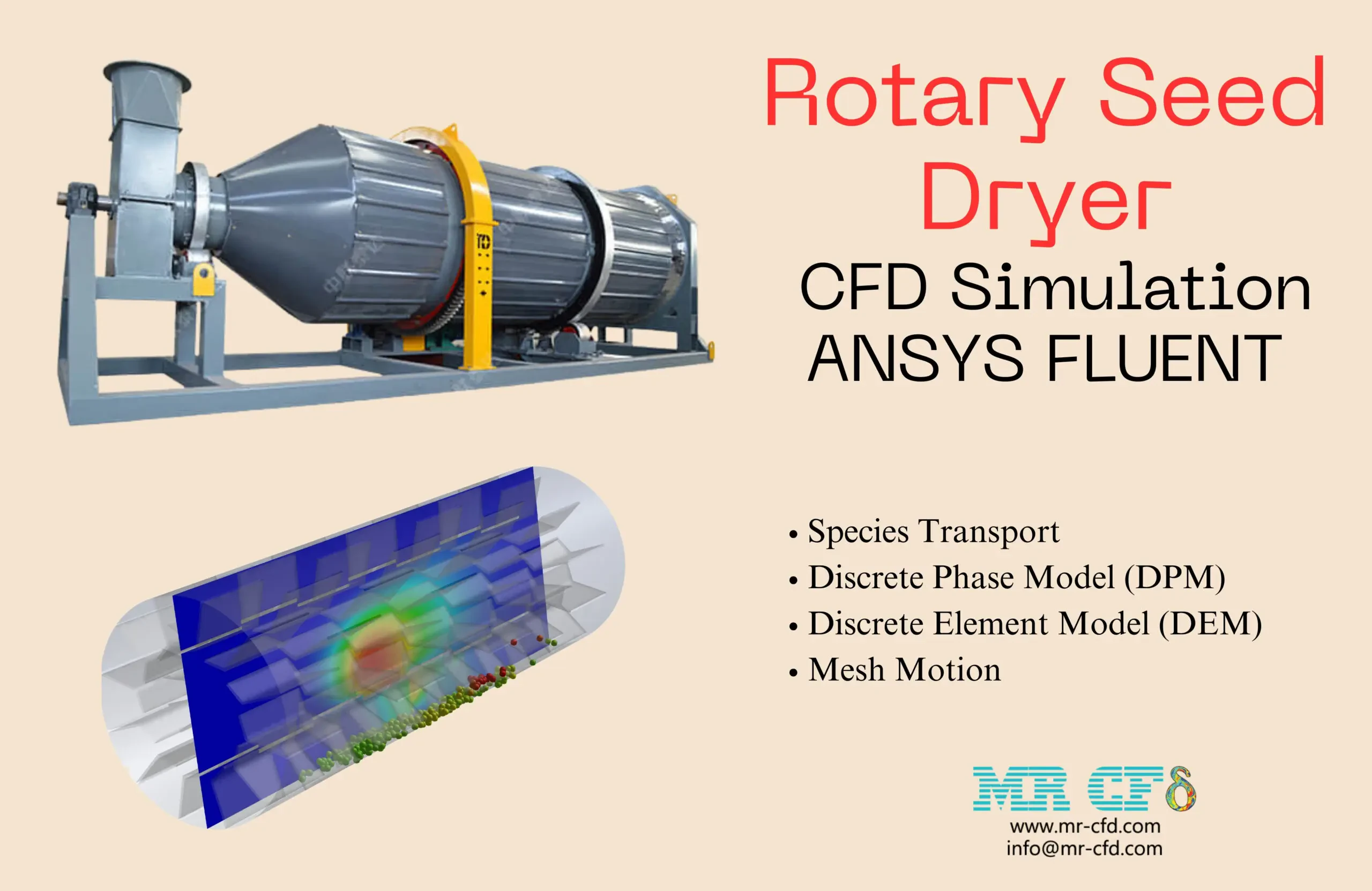
Rotary Seed Dryer CFD Simulation, Using DPM and Moving Mesh, by ANSYS FLUENT
Intermediate, Advanced
Price: $220
This work presents a CFD–DEM simulation of a rotary seed dryer. Hot air flows through the inclined drum at 350 K while the drum rotates at 20 RPM. Seeds are modeled with the Discrete Phase Model (DPM) coupled with evaporation into H₂O vapor. The Discrete Element Method (DEM) accounts for particle–particle and particle–wall collisions, improving realism of seed motion. Contours of H₂O mass fraction reveal zones of strong evaporation, reaching values up to 0.0026. The combined CFD–DPM–DEM approach shows how airflow, fin mixing, and collisions enhance drying efficiency.
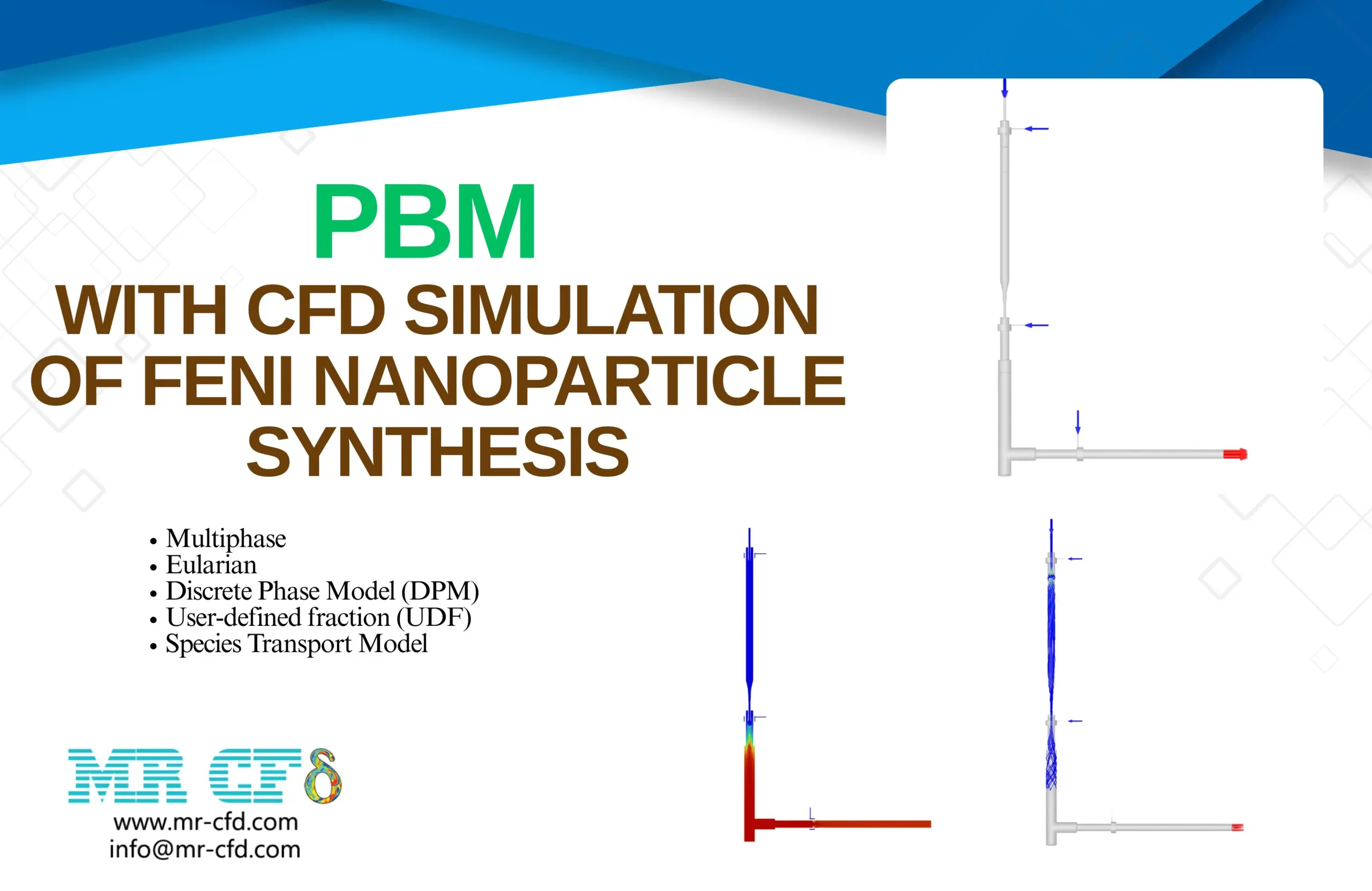
Price: $480
PBM with CFD Simulation of FeNi Nanoparticle Synthesis is performed using ANSYS Fluent . A Multiphase Eulerian approach is applied with FeNi alloy represented in the secondary phase. Powder precursors (FeCl₂ and NiCl₂) are injected into the domain using the Discrete Phase Model (DPM). The Species Transport Model with finite-rate Arrhenius kinetics is used to simulate the reduction reactions. User-Defined Functions (UDFs) implement nucleation, growth, and agglomeration phenomena for nanoparticle prediction.