

Architectural Online Courses
Here's every CFD online course related to Architectural category.
Architectural Engineering: Advanced CFD Training Package
Intermediate, Advanced
Price: $79
Advance your architectural CFD skills with this 9-project ANSYS Fluent training package — covering solar radiation and daylighting on building envelopes, atrium and façade-driven natural ventilation, and urban-scale air pollution and heat island analysis around real building environments.
Price: $49
The final step in the series, this course covers the most demanding version of each project — high-speed and reacting flows, fluid-structure interaction, UDFs, and moving geometry — the kind of coupled, multi-physics problems most CFD engineers never get past. It's built for those who want to solve undefined, real-world problems and defend their results with confidence.
Build Real-World CFD Skills with ANSYS Fluent
Intermediate
Price: $29
Building on the fundamentals, this course tackles harder, more realistic versions of the same 16 engineering fields and flow models, introducing multi-phase interactions, transient behavior, and more demanding boundary conditions. You'll leave with the skills to handle real project complexity, not just tutorial-scale problems.

Price: $9
This course takes you from zero to your first working simulations in ANSYS Fluent, covering foundational projects across 16 engineering fields — aerospace, biomedical, chemical, HVAC, marine, renewable energy, and more — alongside core flow models and Fluent modules. By the end, you'll be comfortable setting up, running, and interpreting basic CFD simulations on your own.
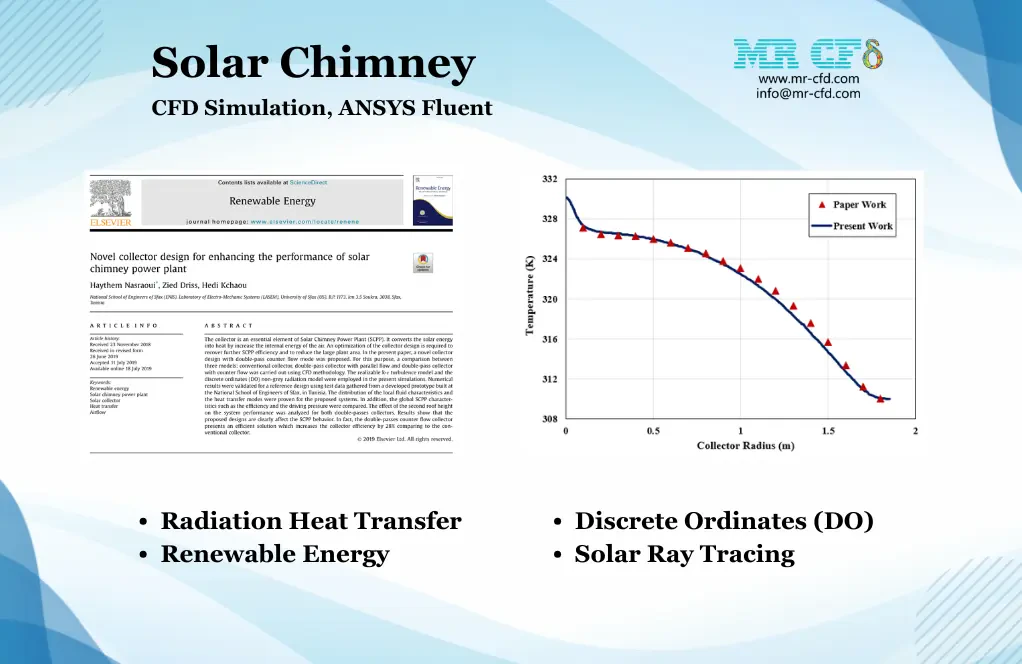
Solar Chimney, Radiation Model, Paper Numerical Validation, ANSYS Fluent
Intermediate, Advanced
Price: $180
This project numerically simulates the Solar Chimney using ANSYS Fluent software. We design the 3-D model with the Design Modeler software. We mesh the model with ANSYS Meshing software. We use the Discrete Ordinates (DO) Radiation Model to define the radiation heat transfer. We use the Solar Ray Tracing to define the solar irradiation. The present CFD work is Validated with a reference Article.
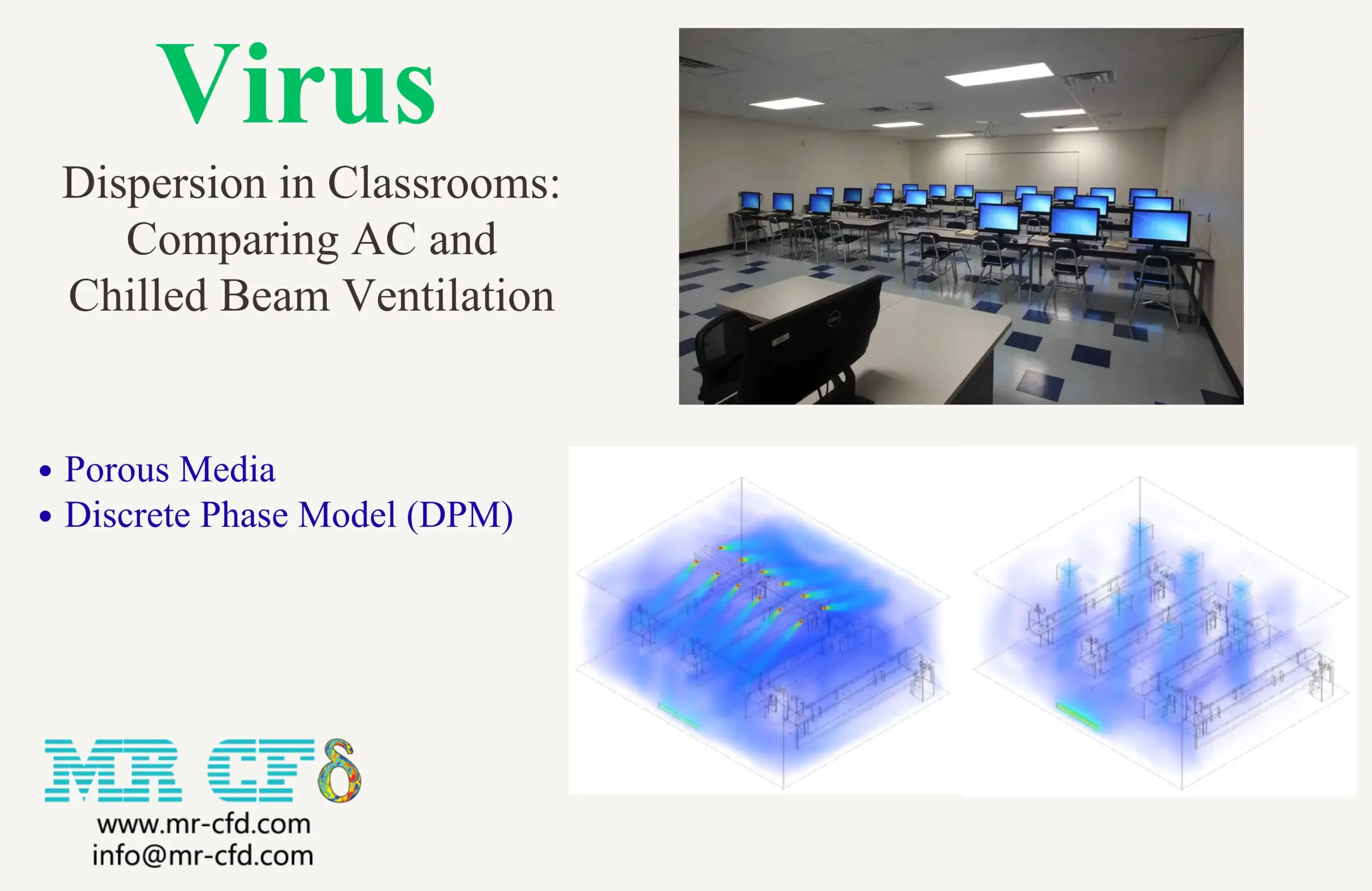
Virus dispersion in classrooms: CFD simulation comparing AC and chilled beam ventilation
Intermediate, Advanced
Price: $240
ANSYS CFD study of virus transport and comfort in a 10×8 m classroom comparing AC and chilled beam ventilation. Room with desks, eight occupants, AC louvers vs. chilled-beam inlets; unstructured mesh refined near jets, walls, and bodies. Steady pressure-based RANS (realizable k-ε), energy on with buoyancy; virus tracked via DPM; appropriate velocity-inlet and pressure-outlet BCs. AC removes particles faster but shows uneven temperatures, while chilled beams improve thermal uniformity with broader mixing that disperses particles more widely.
Price: Free
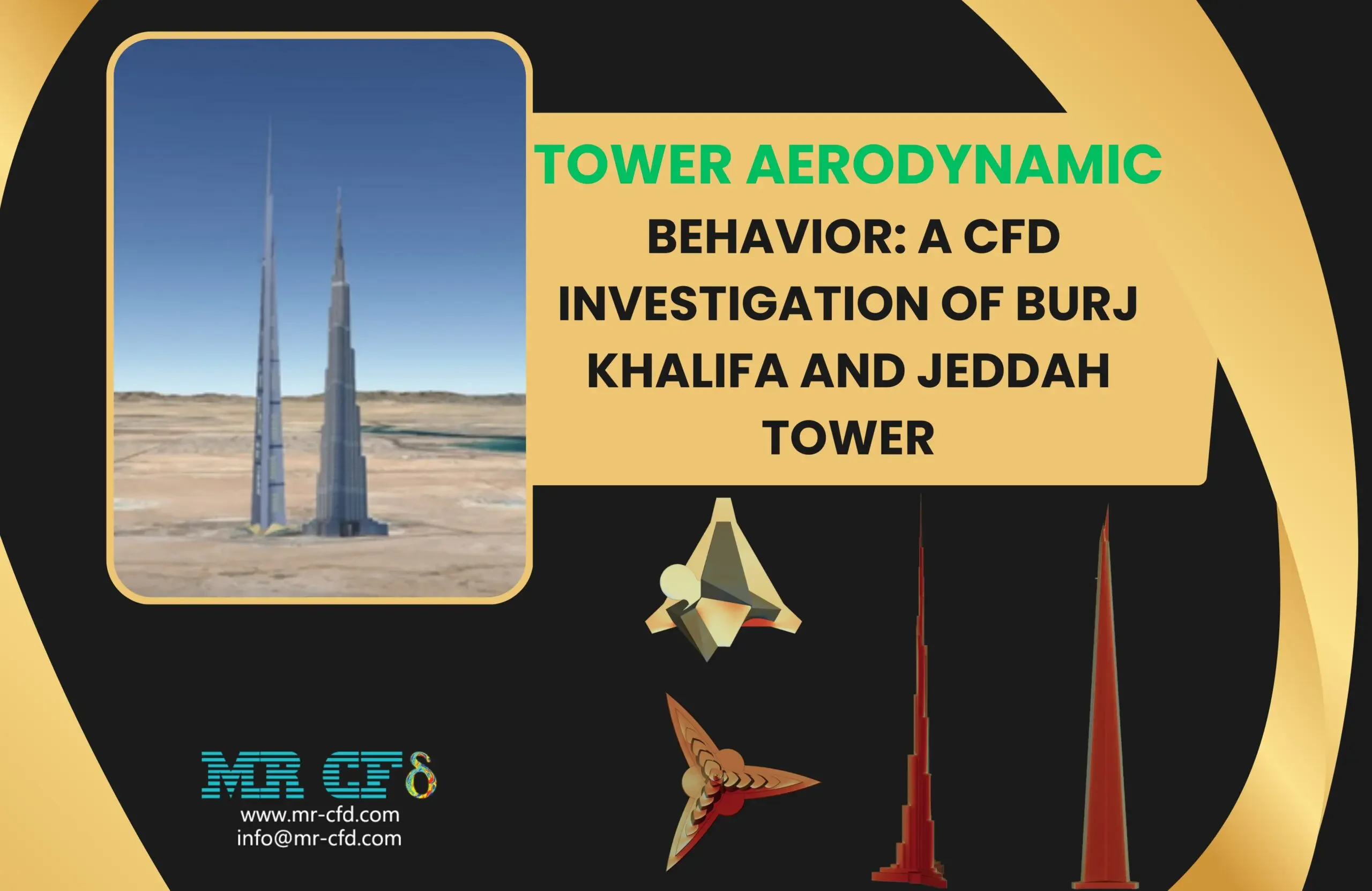
Tower aerodynamic project presents a CFD analysis of the Burj Khalifa (828 m) and Jeddah Tower (1000 m) under a steady 10 m/s wind using ANSYS Fluent. Geometries were built in SpaceClaim/Design Modeler and meshed in ANSYS Meshing, later converted into polyhedral elements for efficiency. A pressure-based steady solver with the Realizable k-ε turbulence model was applied, with velocity-inlet and pressure-outlet boundary conditions. Results show pressure drag dominates in both towers, while torque due to height is a critical factor, influenced strongly by tower geometry.
Price: $240
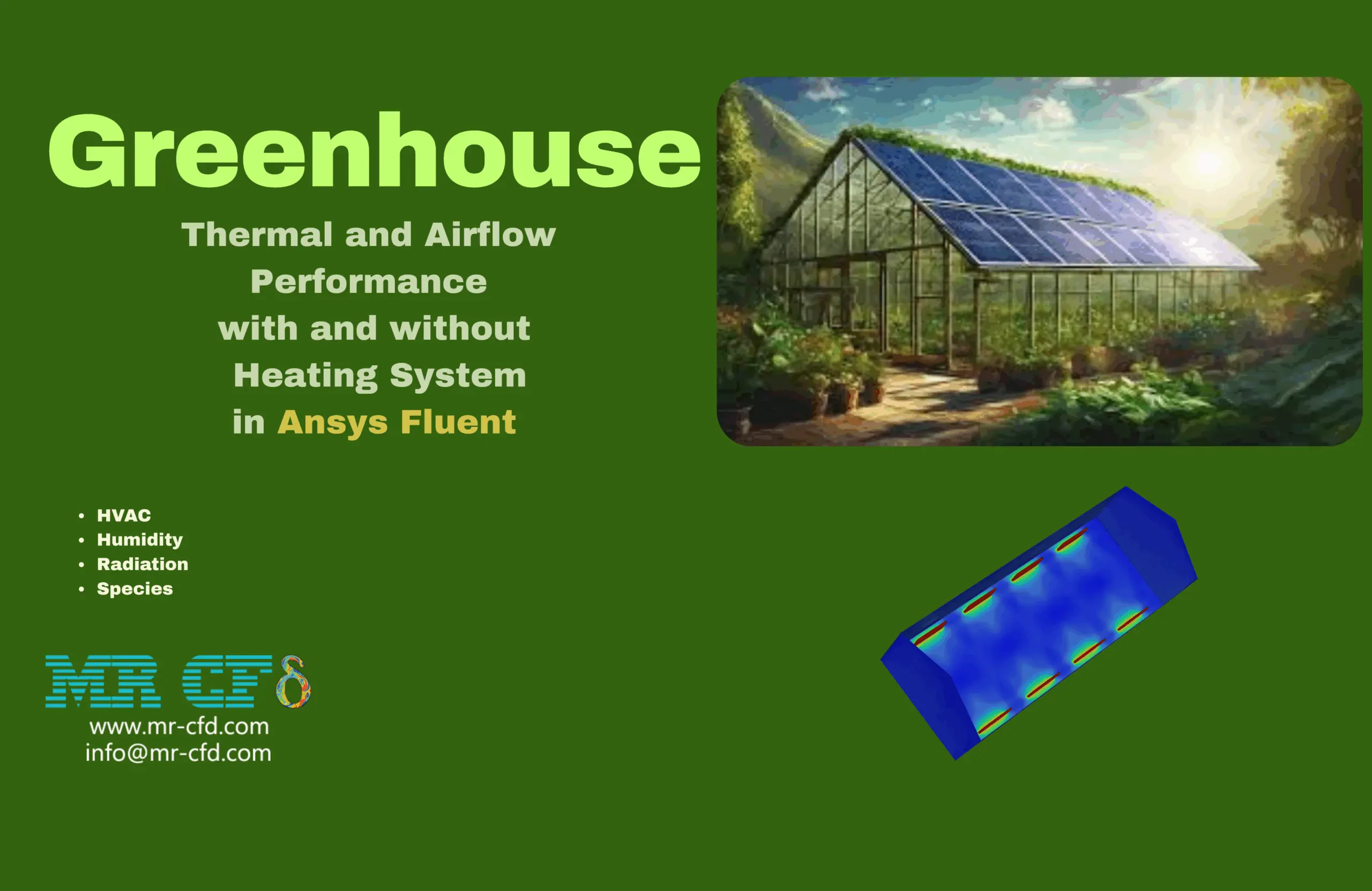
In this project, we have simulated the thermal and airflow performance of a greenhouse with and without a heating system using ANSYS Fluent software. Three-dimensional modeling was done using Design Modeler software. The meshing of the model has been done using ANSYS Meshing software, with approximately 1,860,000 cells for the base case and 3,110,000 cells for the heated case. The energy equation, species transport, and solar ray tracing using the Discrete Ordinates (DO) radiation model are enabled for accurate representation of heat transfer and humidity. The standard K-epsilon model is selected for turbulence characteristics of fluid flow.
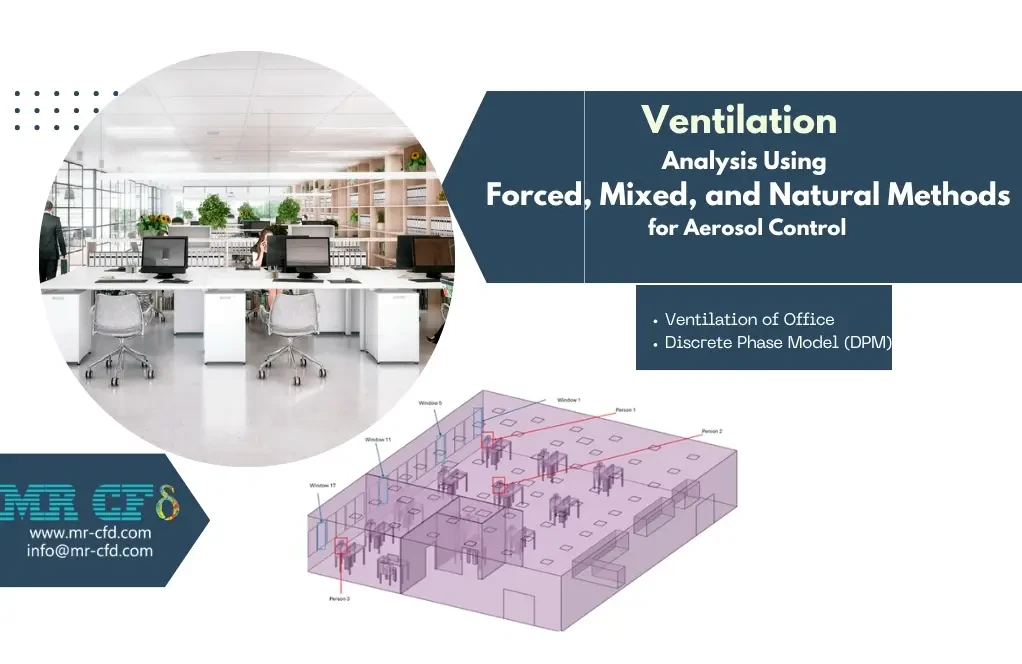
Ventilation Analysis Using Forced, Mixed, and Natural Methods for Aerosol Control
Intermediate, Advanced
Price: Free
Expert-level training package utilizing DPM in ANSYS Fluent, featuring comprehensive analysis of ventilation methods for aerosol control in office environments. Focused on understanding airflow patterns and virus dispersion under various scenarios: forced, mixed, and natural ventilation. Analyzes mechanical ventilation using fan coil units, neutral ventilation through open windows, and combined mixed ventilation approaches. Aimed at researchers and professionals seeking advanced understanding and optimization of ventilation systems for aerosol control in indoor settings.