Solar Chimney, Radiation Model, Paper Numerical Validation, ANSYS Fluent
Price: $180
- This project numerically simulates the Solar Chimney using ANSYS Fluent software.
- We design the 3-D model with the Design Modeler software.
- We mesh the model with ANSYS Meshing software.
- We use the Discrete Ordinates (DO) Radiation Model to define the radiation heat transfer.
- We use the Solar Ray Tracing to define the solar irradiation.
- The present CFD work is Validated with a reference Article.
Solar Chimney, Radiation Model, Paper Numerical Validation, ANSYS Fluent
Price: $180
- This project numerically simulates the Solar Chimney using ANSYS Fluent software.
- We design the 3-D model with the Design Modeler software.
- We mesh the model with ANSYS Meshing software.
- We use the Discrete Ordinates (DO) Radiation Model to define the radiation heat transfer.
- We use the Solar Ray Tracing to define the solar irradiation.
- The present CFD work is Validated with a reference Article.
Description
In this project, we performed a CFD simulation of a solar chimney via ANSYS Fluent software.
This product is provided according to the simulation of a reference article, “Novel collector design for enhancing the performance of solar chimney power plant”. Then, the results of the present work are compared and validated with the reference article.
A solar chimney consists of a tall tower mounted at the center of a wide circular collector. The air is supplied through a gap between the absorber and the collector roof, and then is discharged through the top of the tower.
Solar irradiation on the absorber plate causes a heat transfer to the airflow below the collector roof. When air temperature increases, the buoyancy effect becomes dominant. So, the air moves upward at a considerable speed.
Methodology
First, we modeled the computational domain of the solar chimney in 3D using Design Modeler software. To reduce computational cost, half of the geometry is modeled as the computational domain.
Next, we meshed the model using ANYS Meshing software, and 574,182 cells were generated.
Finally, we set up this solar chimney simulation using the Radiation model in ANSYS Fluent software.
For this purpose, we used the Discrete Ordinates (DO) radiation model to solve the radiative heat transfer equation in the computational domain. Then, we utilized the Solar Ray Tracing option to define the incident solar irradiation.
Note that according to the reference article, three configurations are proposed for the design of solar chimneys, including the standard collector (single-pass), the double-roof collector (double-pass with parallel flow), and the double-roof collector (double-pass with counter flow). For present validation, we chose the single-pass solar chimney, which is considered a conventional design.
Conclusion
For post-processing, we obtained contours corresponding to the distributions of the temperature, velocity, and pressure. The results show that natural convection is occurring properly. The solar irradiation is absorbed by the absorber plate, and the incident heat is transferred to the supply airflow. The heated air is affected by the buoyancy effect and moves up through the chimney.
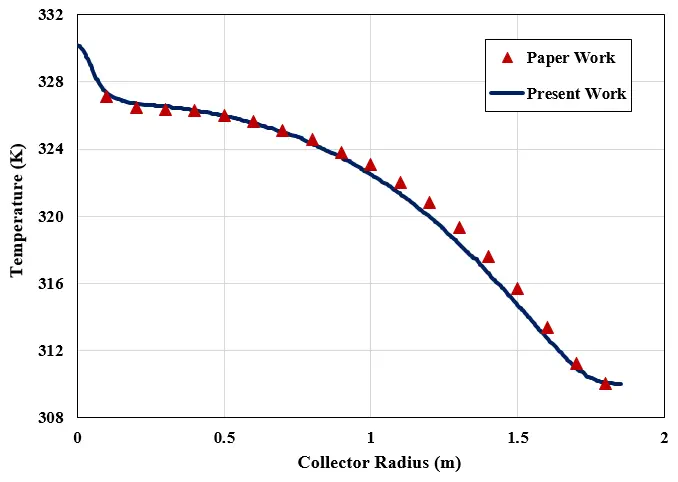
We performed a validation procedure for our present numerical study based on one of the Temperature profiles mentioned in the reference article. Therefore, we obtained the distribution of the air temperature along the collector radius. Therefore, we present the results in the following curve, which shows that the present numerical work is highly accurate and precise.
Comparison of the present work with the paper work confirms that the accuracy of the results is very high and the percentage of deviation is very low. The average error is approximately 0.13%, and the minimum and maximum errors are 0.004% at 0.4 meters and 0.36% at 1.5 meters, respectively.