

Rotary Equipments Online Courses
Here's every CFD online course related to Rotary Equipments category.
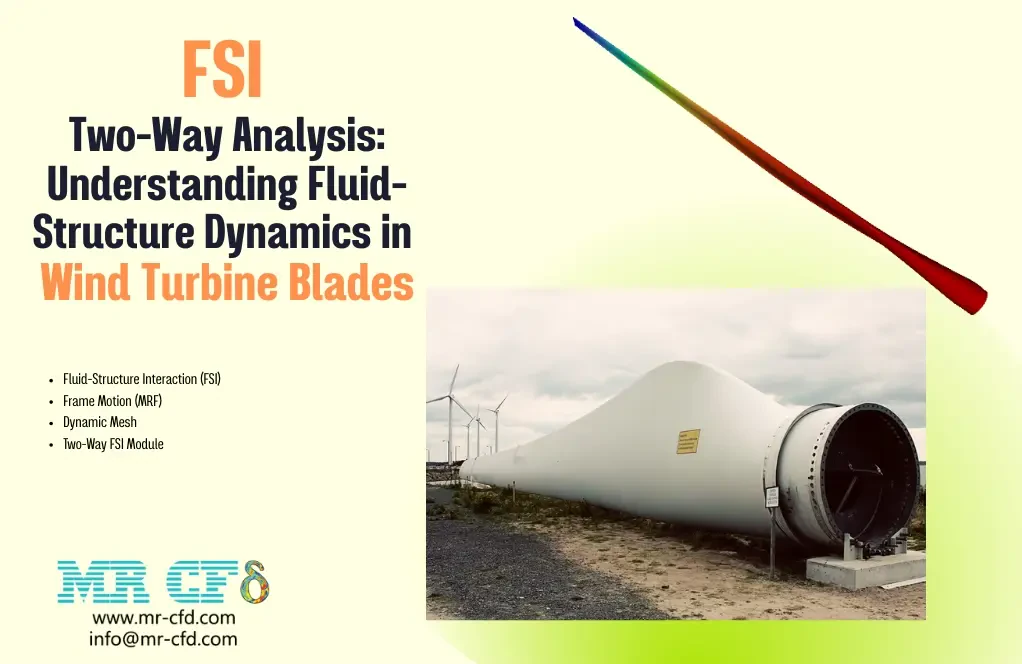
FSI Two-Way Analysis: Understanding Fluid-Structure Dynamics in Wind Turbine Blades
Intermediate, Advanced
Price: $270
This project focuses on the two-way Fluid-Structure Interaction (FSI) simulation of wind turbine blades to analyze their performance under specified conditions. Utilizing a dynamic mesh and advanced computational techniques, the study aims to evaluate key parameters such as torque, maximum stress, and total deformation. By modifying the geometry in ANSYS Spaceclaim and conducting the simulation with 990,399 cells, the project demonstrates how the blade’s structural integrity is affected by fluid flow and mechanical forces. The results, including stress distribution and displacement, provide insights into optimizing wind turbine design for improved efficiency and durability.
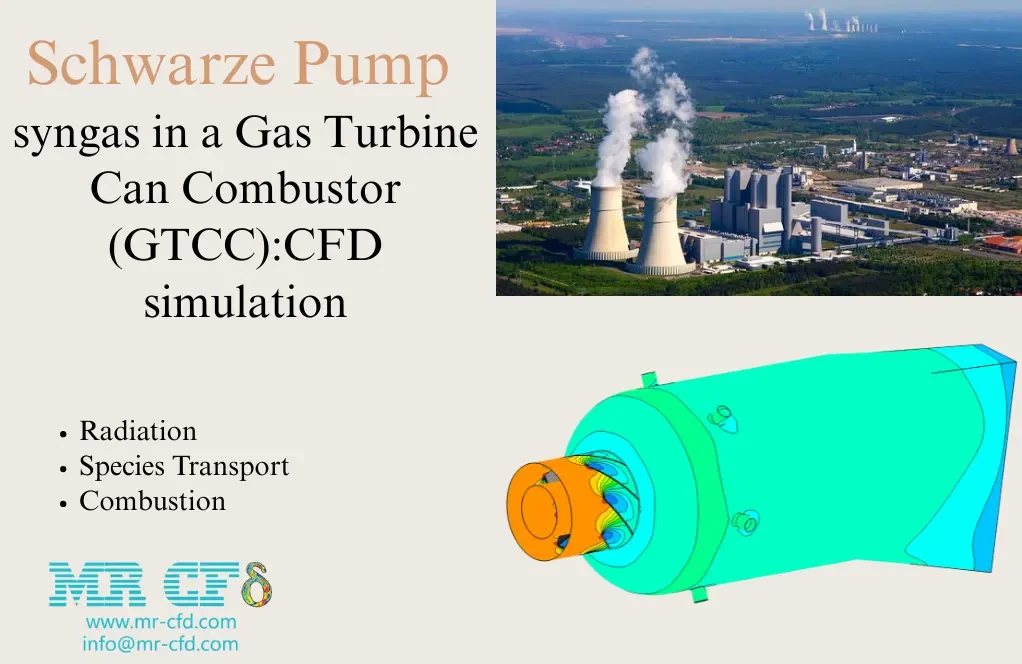
Syngas Fuel Combustion in Gas Turbine Can Combustor: CFD simulation
Intermediate, Advanced
Price: $300
The report details a simulation of a Gas Turbine Can Combustor (GTCC) using Computational Fluid Dynamics (CFD) to analyze the combustion and emission characteristics of Schwarze Pumpe syngas. The setup includes a combustion system with six fuel injectors, a primary air inlet, and six secondary air inlets. The analysis uses a sophisticated mesh and applies the standard k-ε turbulence model and the P1 radiation model for accurate simulations. Key findings show that the combustor design effectively facilitates mixing and combustion, achieving a maximum inner flame temperature of approximately 1900 K. The study also successfully models pollutant formation, such as NOx, providing insights into emission control. Overall, the simulation demonstrates high combustion efficiency, supported by detailed species volume fraction contours, confirming complete fuel combustion at the outlet and the viability of the GTCC in optimizing syngas combustion processes.

Price: Free
Introduction to the Design of Experiment (DOE) in ANSYS Fluent software Introduction to the Central Composite Design (CCD) Introduction to the Rotatable, VIF-Optimality, G-Optimality, and Face-Centered Introduction to the Box-Behnken Design (BBD) Introduction to the Optimal Space-Filling Design Introduction to the Sparse Grid Initialization Introduction to the Latin Hypercube Sampling Design Introduction to the Custom and Custom+Sampling

Computational Fluid Dynamics (CFD): Introduction
Beginner, Intermediate, Advanced
Price: Free
This is the first session of a Computational Fluid Dynamics (CFD) course, focusing on equations and numerical methods for discretization and solving them in detail. The course is designed by the Mister CFD team to help students and engineers understand the numerical techniques used in software like Ansys Fluent, rather than focusing on fundamental coding. It introduces CFD as a method for solving nonlinear partial differential equations (Navier-Stokes equations) through numerical techniques, since general analytical solutions aren’t available. The document covers three main numerical methods: Finite Difference Method (FDM), Finite Volume Method (FVM), and Finite Element Method (FEM), with their advantages and limitations. It explains different types of Partial Differential Equations (PDEs) including their classifications based on order, linearity, and behavior (Elliptic, Parabolic, and Hyperbolic). The content concludes with detailed explanations of conservation equations, numerical errors in CFD, and the importance of Taylor series in discretization processes.
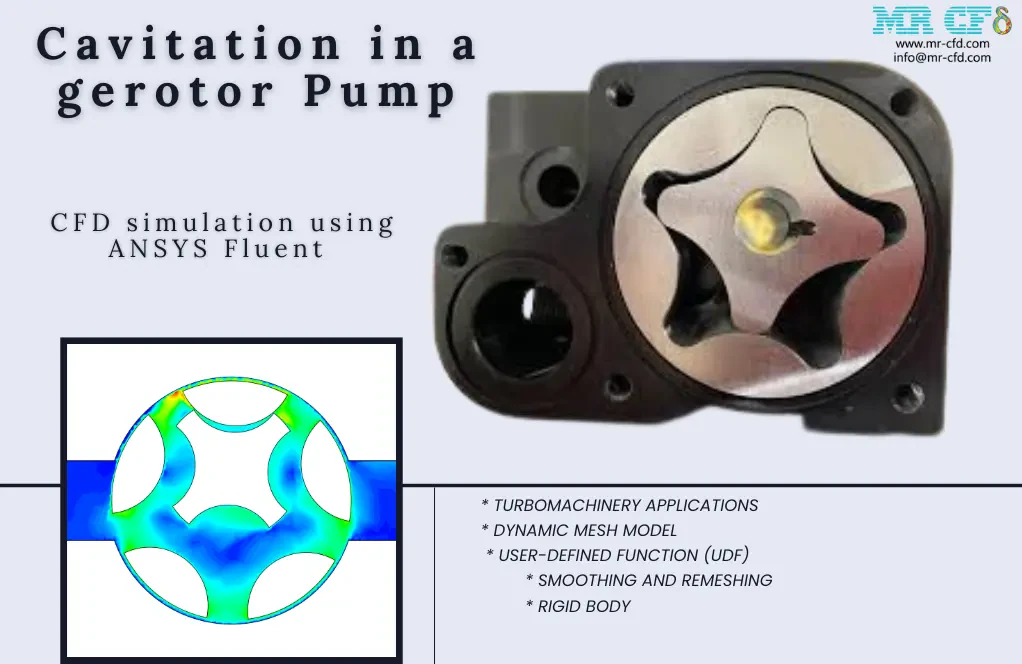
Numerical Investigation of Cavitation Phenomena in a 2D Gerotor Pump Using ANSYS Fluent
Intermediate, Advanced
Price: $144
This study presents a detailed numerical investigation of cavitation phenomena in a gerotor pump using computational fluid dynamics (CFD) simulation The physical modeling incorporated a mixture model for multiphase flow A key aspect of the simulation was the implementation of dynamic mesh capabilities through User Defined Functions (UDFs)
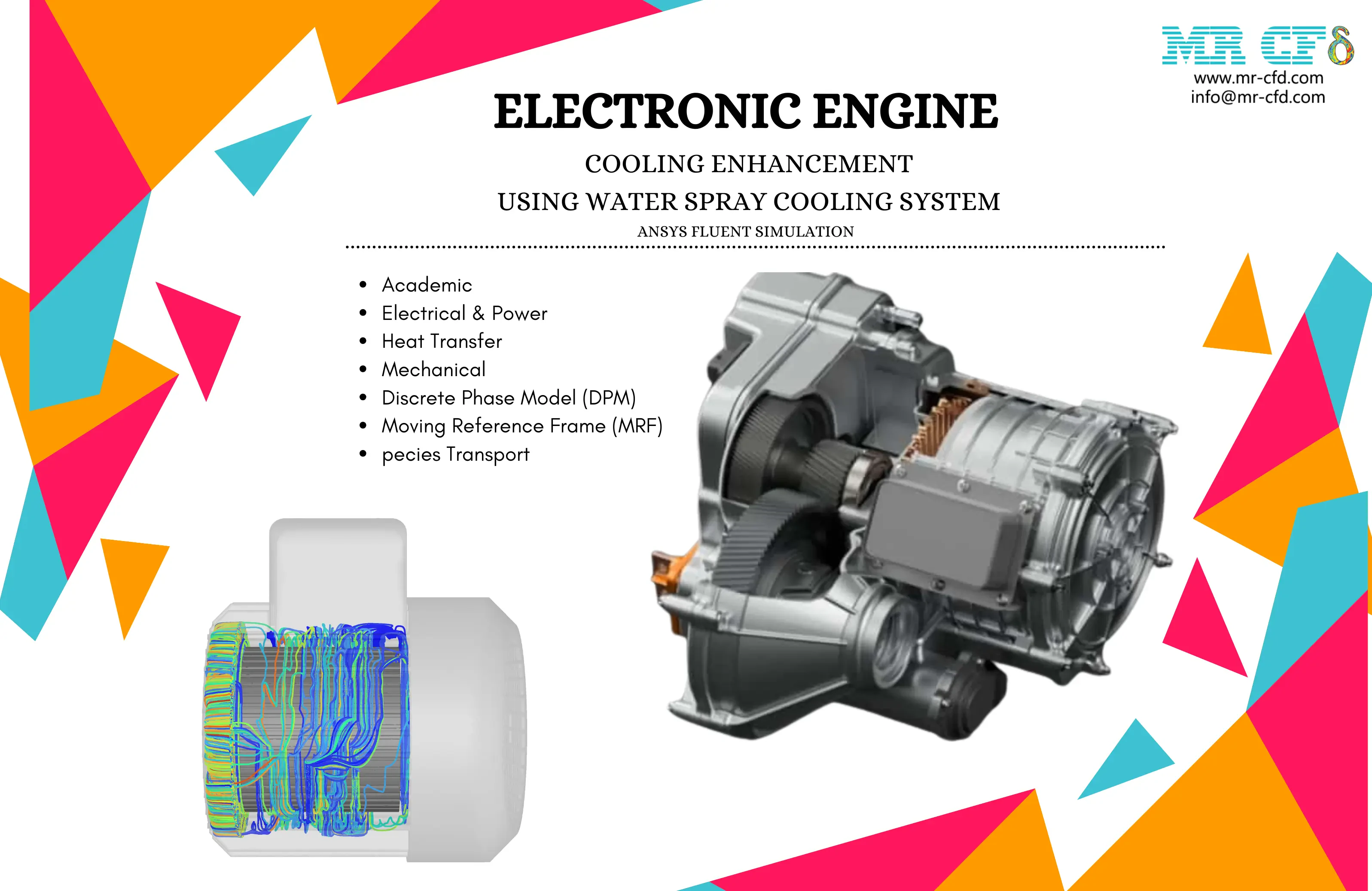
Electronic Engine Cooling Enhancement with and without Water Spray Cooling System
Intermediate, Advanced
Price: $240
This project investigates the thermal management of an electronic engine using CFD simulation through ANSYS Fluent software suite The primary objective was to compare the cooling effectiveness of the engine under two conditions: without water spray cooling and with water spray cooling The simulation workflow began with geometry creation in SpaceClaim, followed by mesh generation in ANSYS Meshing. The simulation framework utilised species transport modelling and implemented a two-way coupled discrete phase model (DPM) specifically for water spray simulation

Price: $200
The computational fluid dynamics (CFD) analysis of a Francis turbine was conducted using ANSYS Fluent software to investigate its performance characteristics and flow behavior. This study aims to provide detailed insights into the pressure distribution, velocity patterns, and potential cavitation phenomena within the turbine system. The simulation incorporates advanced numerical models and careful consideration of boundary conditions to ensure accurate results.
Fluid-Structure Interaction over HAWT Turbine Vibration (two-way)
Intermediate, Advanced
Price: $60
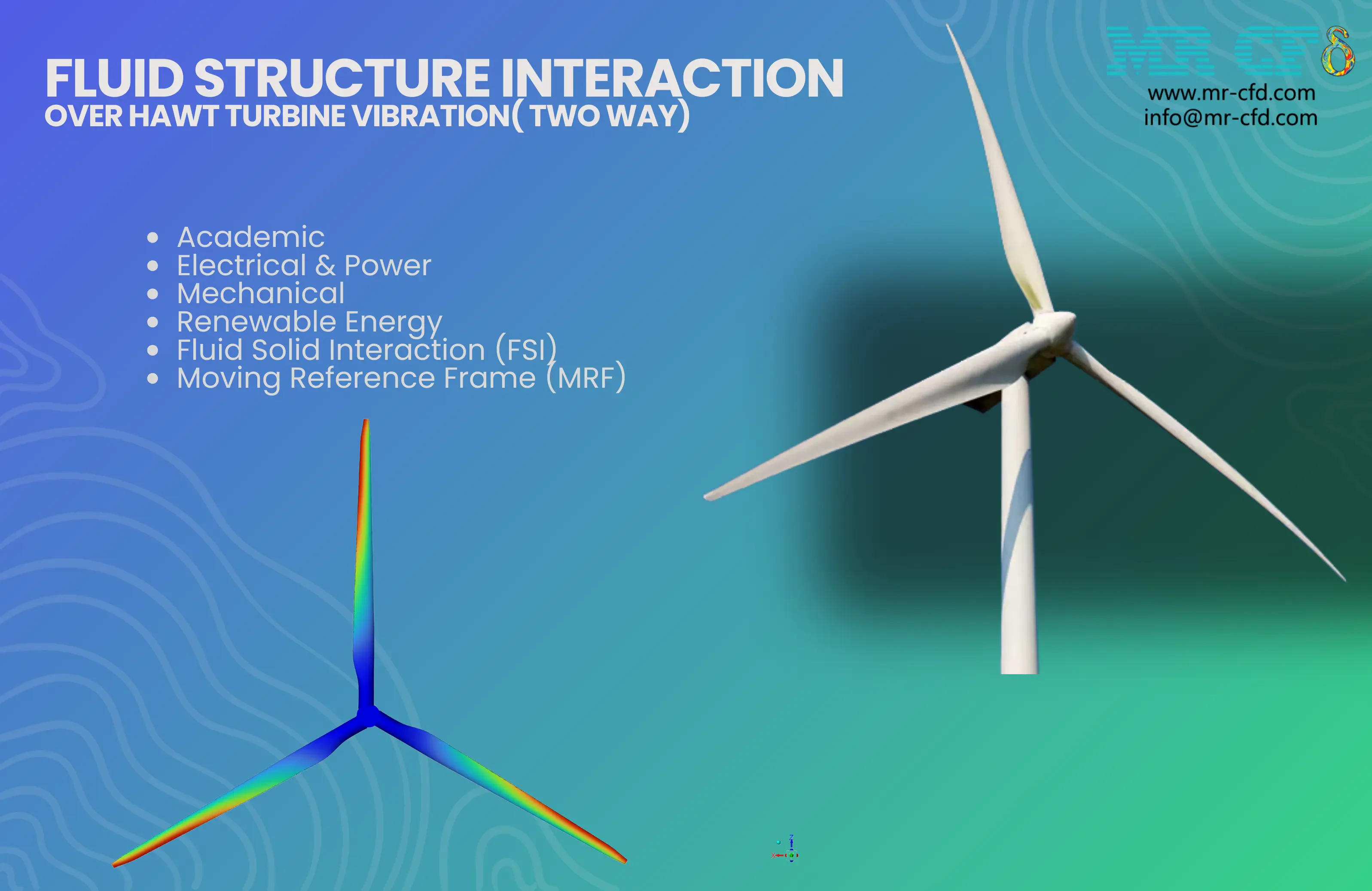
this report presents a FSI analysis of a HAWT using CFD. The geometry was created using ANSYS Design Modeler, and meshing was performed with ANSYS Meshing, resulting in a high-fidelity model with 3,465,821 cells. The simulation leverages (MRF) approach for rotating domains and dynamic mesh methods to capture the complex fluid-structure interactions. A two-way FSI approach was employed to capture the mutual interaction between the fluid flow and the structural deformation of the turbine blades.
Fluid-Structure Interaction in a Vertical Axis Water Turbine using MRF Method, Ansys Fluent
Intermediate, Advanced
Price: $30
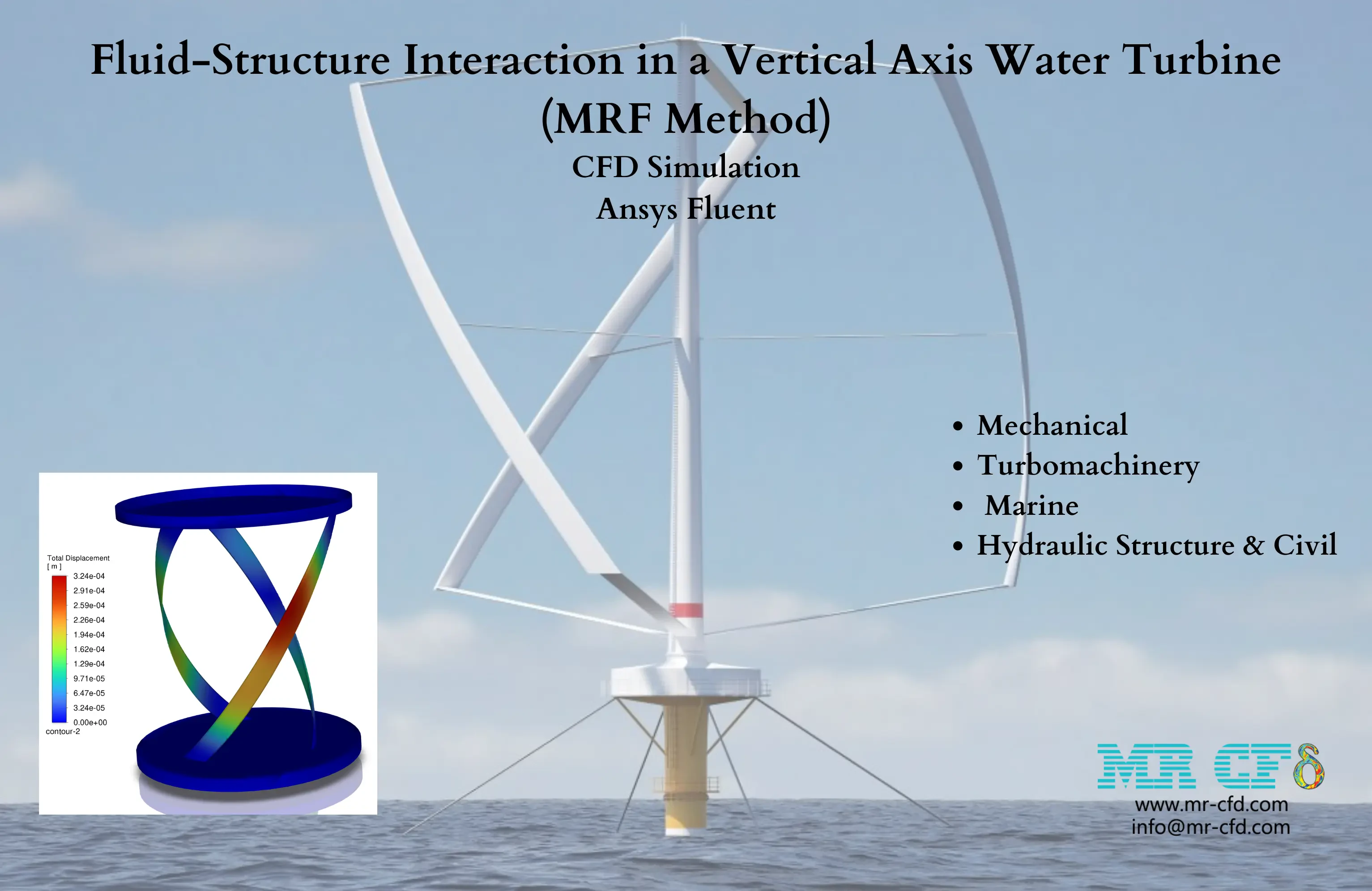
The problem numerically simulates the Fluid-Structure Interaction over Vertical Turbine using ANSYS Fluent software. We designed the 3-D model using the Design Modeler software. The mesh grid is generated using ANSYS Meshing, and the element number equals 705,465. The Frame Motion method is used to rotate the turbine. FSI model analyses total strain, and stress over the VAWT turbine.