

Combustion GOLDEN Training Package
Price:
$6,863
$2,399
Combustion CFD Simulation GOLDEN Training Package by MR CFD delivers 85+ ANSYS Fluent tutorials covering advanced combustion. Ideal for professors, engineering managers, and companies, it rapidly upskills teams for real combustion projects analysis—backed by 15 years CFD expertise, including 1-year technical support and 3 months HPC access.
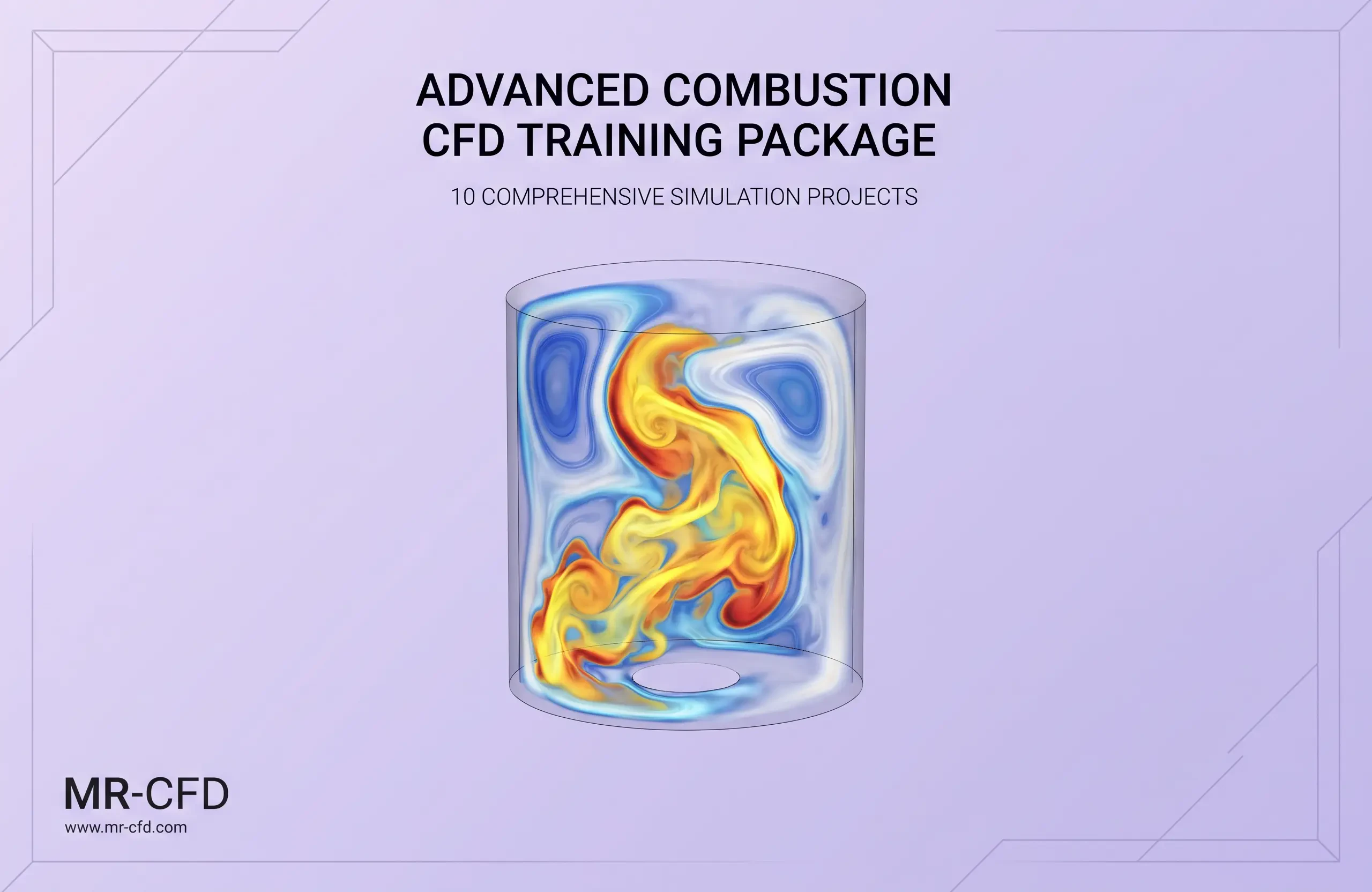
Price: $109
Advance your combustion CFD skills with this 10-project ANSYS Fluent training package — covering fundamental and particle-based combustion, specialized combustion environments, and radiation and thermoacoustic coupling.
Combustion: Intermediate CFD Training Package
Intermediate
Price: $69
Build intermediate-level expertise in combustion CFD with this 10-project ANSYS Fluent training package — covering core premixed and non-premixed combustion models, applied industrial combustion systems, fire safety, and advanced electrohydrodynamic and hypersonic combustion physics.
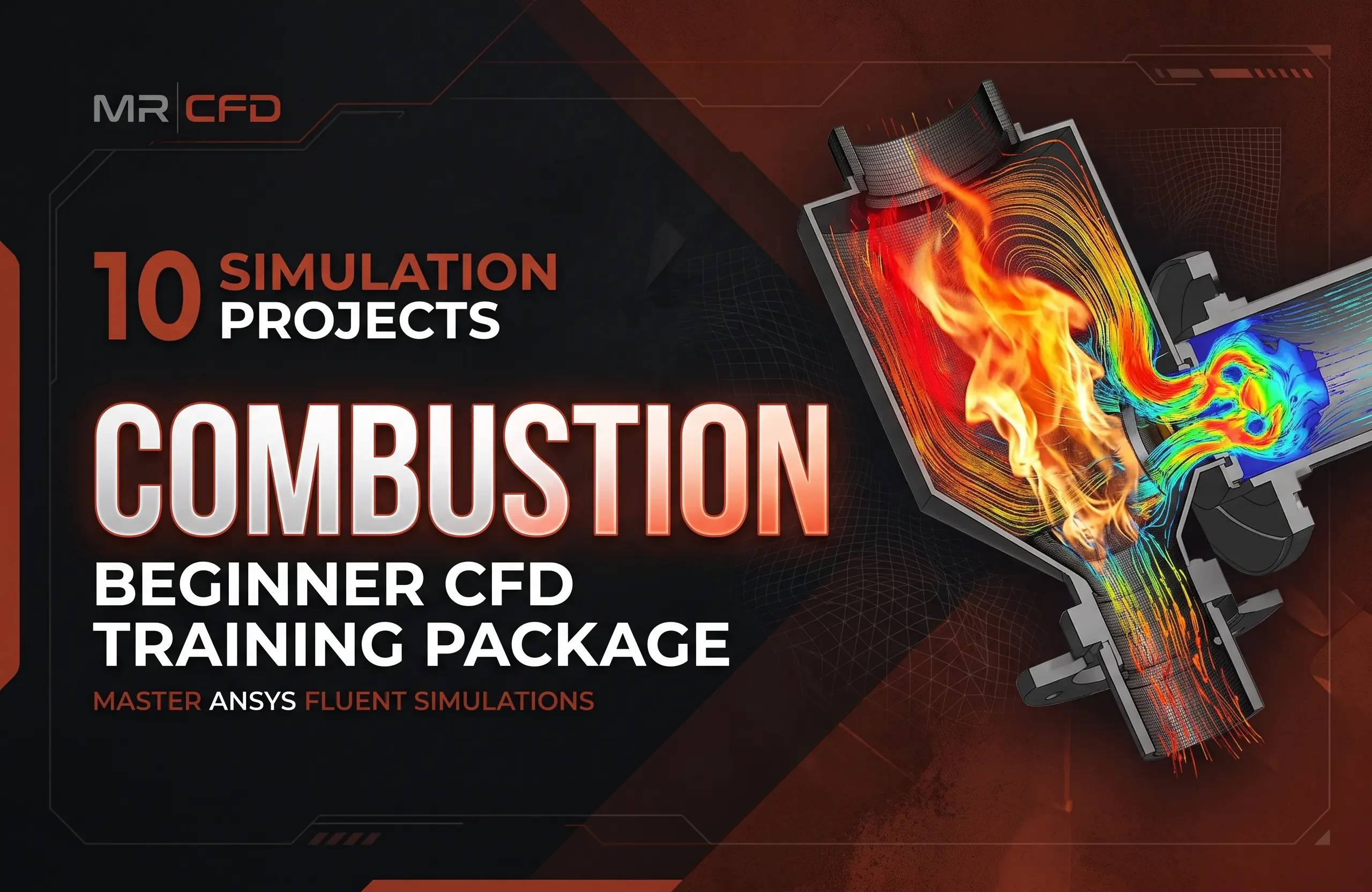
Price: $29
Combustion: Beginner CFD Training Package is a ten-project introduction to combustion simulation in ANSYS Fluent. Starting from everyday methane combustion and building through combustion chambers, swirl-stabilized flames, spray combustion, and industrial flares, it gives newcomers a hands-on, application-driven foundation in the CFD techniques behind modern combustion engineering — one real engineering case at a time.
Price: $420
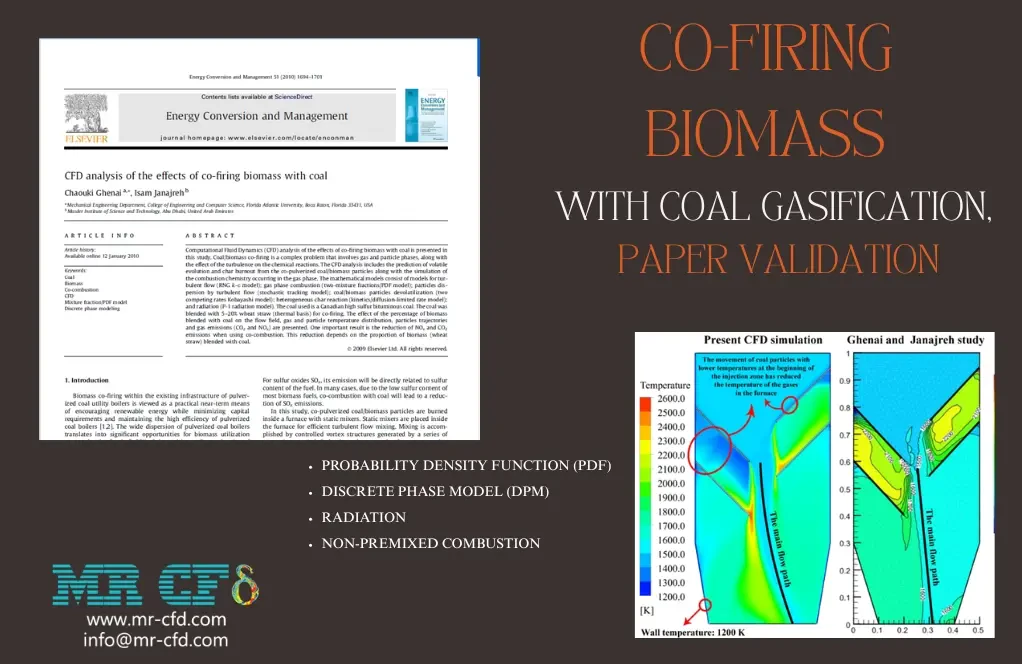
Co-firing Biomass with Coal Gasification. This project involves the simulation of coal and biomass co-firing in a furnace using CFD techniques. The primary objectives are to examine the combustion characteristics and validate the simulation results against the study by Ghenai and Janajreh. The furnace is defined with specific boundary conditions, and simulations are performed using an unsteady, incompressible flow model. The turbulent flow within the furnace is modeled using the k-e RNG turbulent model, thermal radiation is simulated with the P1 model, and combustion is analyzed with a PDF model. The simulation incorporates the kinetics/diffusion-limited rate model for particle combustion and the two competing rates Kobayashi model for devolatilization. Results are compared in terms of temperature contours and particle trajectories, confirming the simulation’s accuracy with a maximum error of approximately 5% in particle temperature ranges.
Price: $27
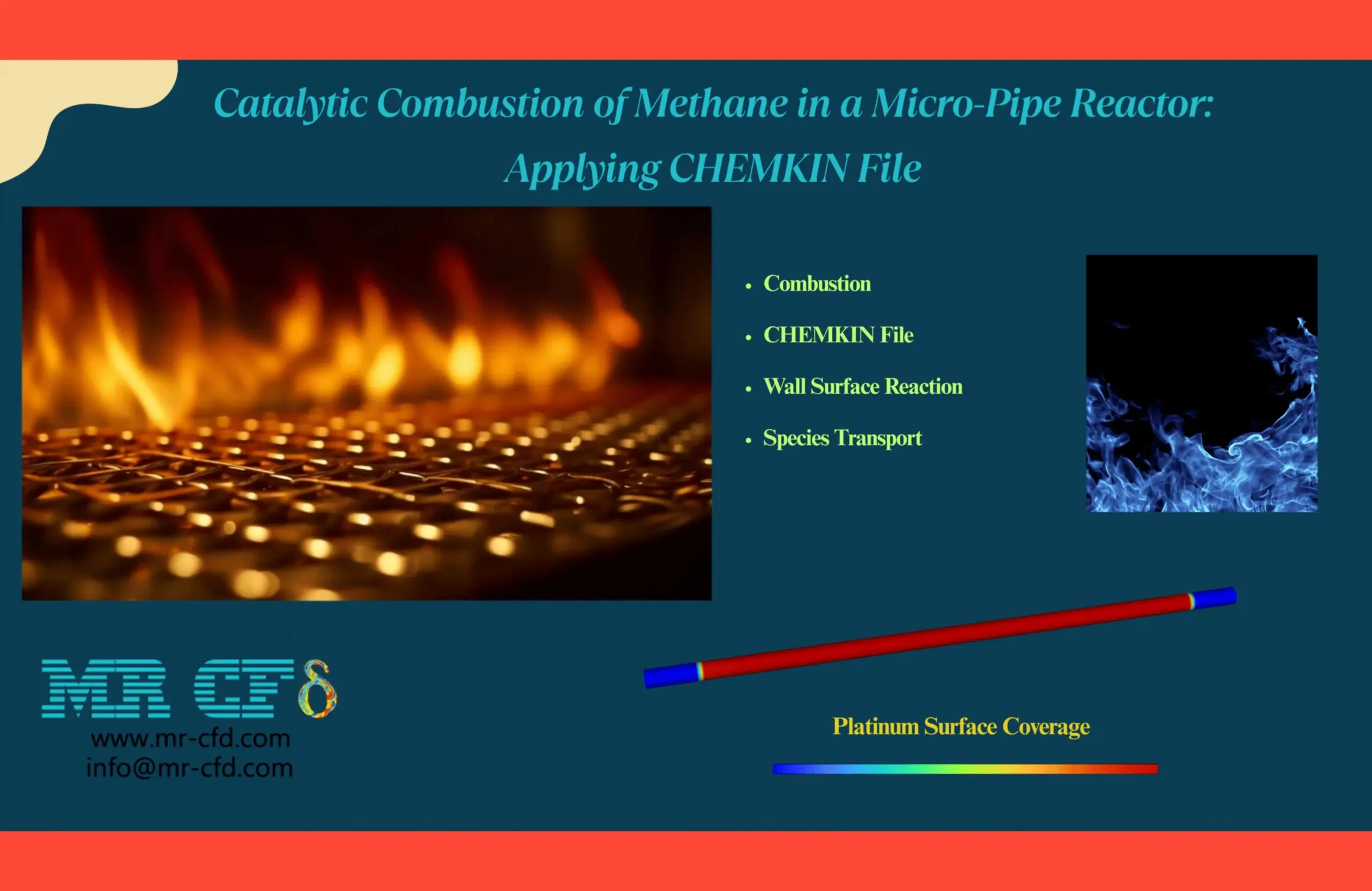
This report presents a simulation which investigates the catalytic combustion of methane in a micro-pipe reactor. A CHEMKIN file was created to define detailed wall surface reactions based on the reactions reported by Deutschmann (1996). The geometry of the micro-reactor was created using ANSYS SpaceClaim software. A high-quality hexahedral elements mesh was generated using ANSYS Meshing software. Appropriate species transport settings and boundary conditions were applied to correctly simulate the volumetric and wall surface reactions.
Price: $72
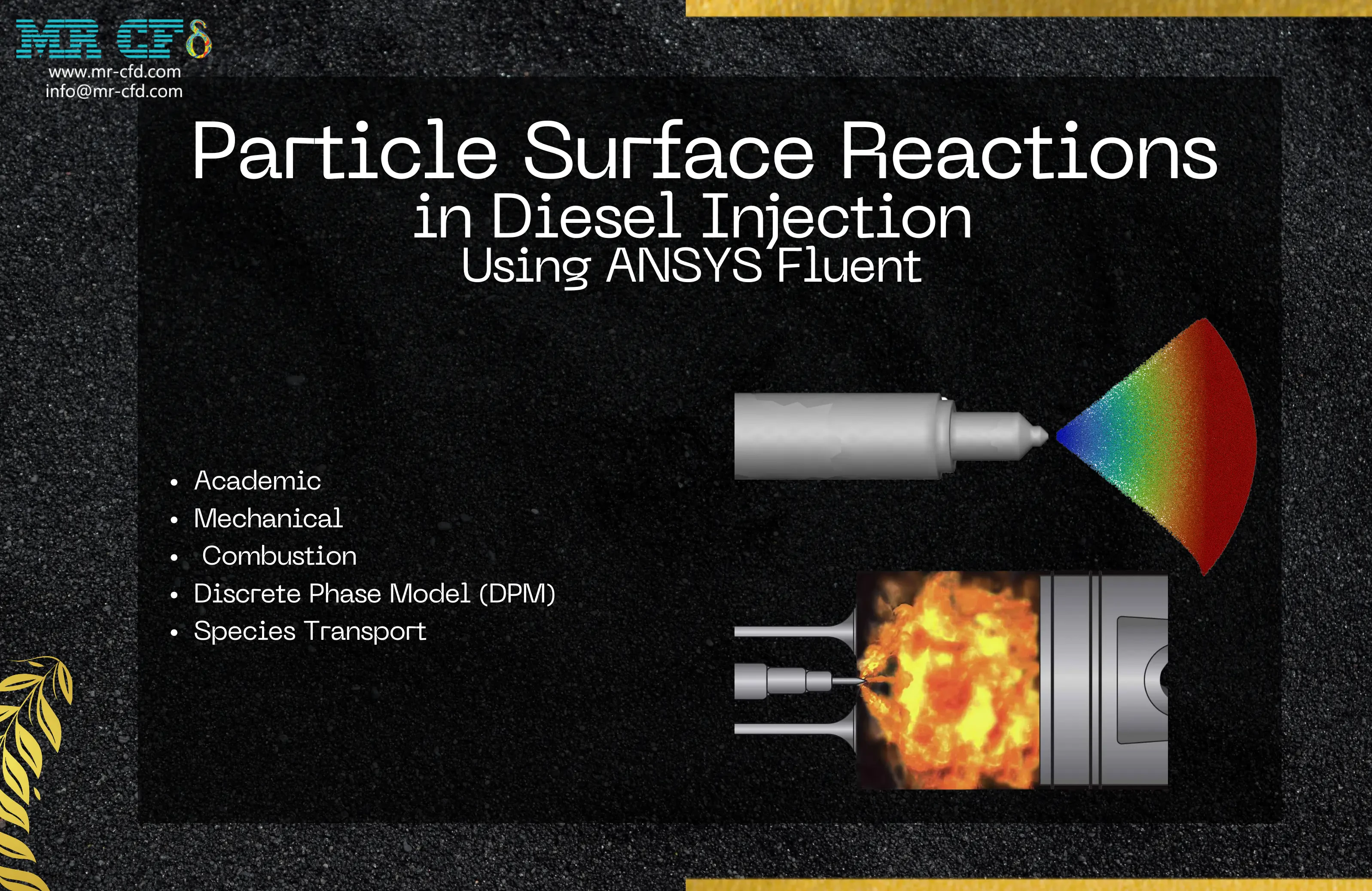
The main objective of this study is to analyze the behavior of the reacting spray The study combines the finite-rate chemistry and eddy dissipation models to capture kinetic-controlled and turbulence-driven reaction dynamics Water evaporates first due to its lower boiling point, while gasoline undergoes thermal decomposition and combustion The mesh was generated using ANSYS Meshing. The final mesh comprises 1,250,256 cells, balancing computational accuracy and efficiency.
Price: $260
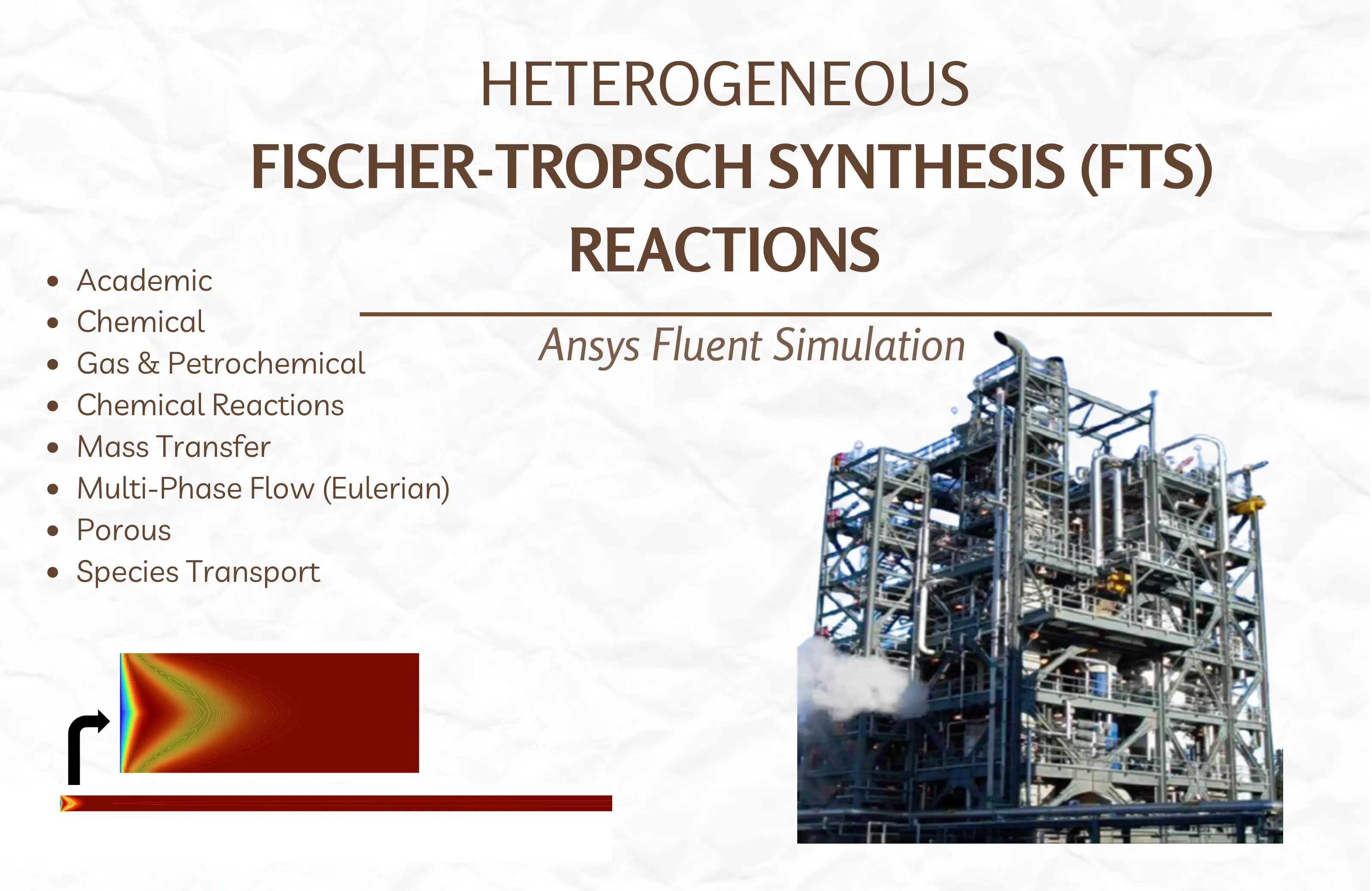
This report presents the simulation of a reactive multiphase system incorporating heterogeneous Fischer-Tropsch synthesis reactions in a porous medium An iron (Fe) catalyst catalyzes the reactions, and the reaction rates are determined using Arrhenius kinetics. The Eulerian multiphase model is employed to investigate the interaction between different phases A Lee mass transfer model is applied for the phase change of water between liquid and gaseous states. A 2D geometry was created using SpaceClaim and The domain was meshed in ANSYS Meshing, using a structured mesh with 105,000 structured elements.
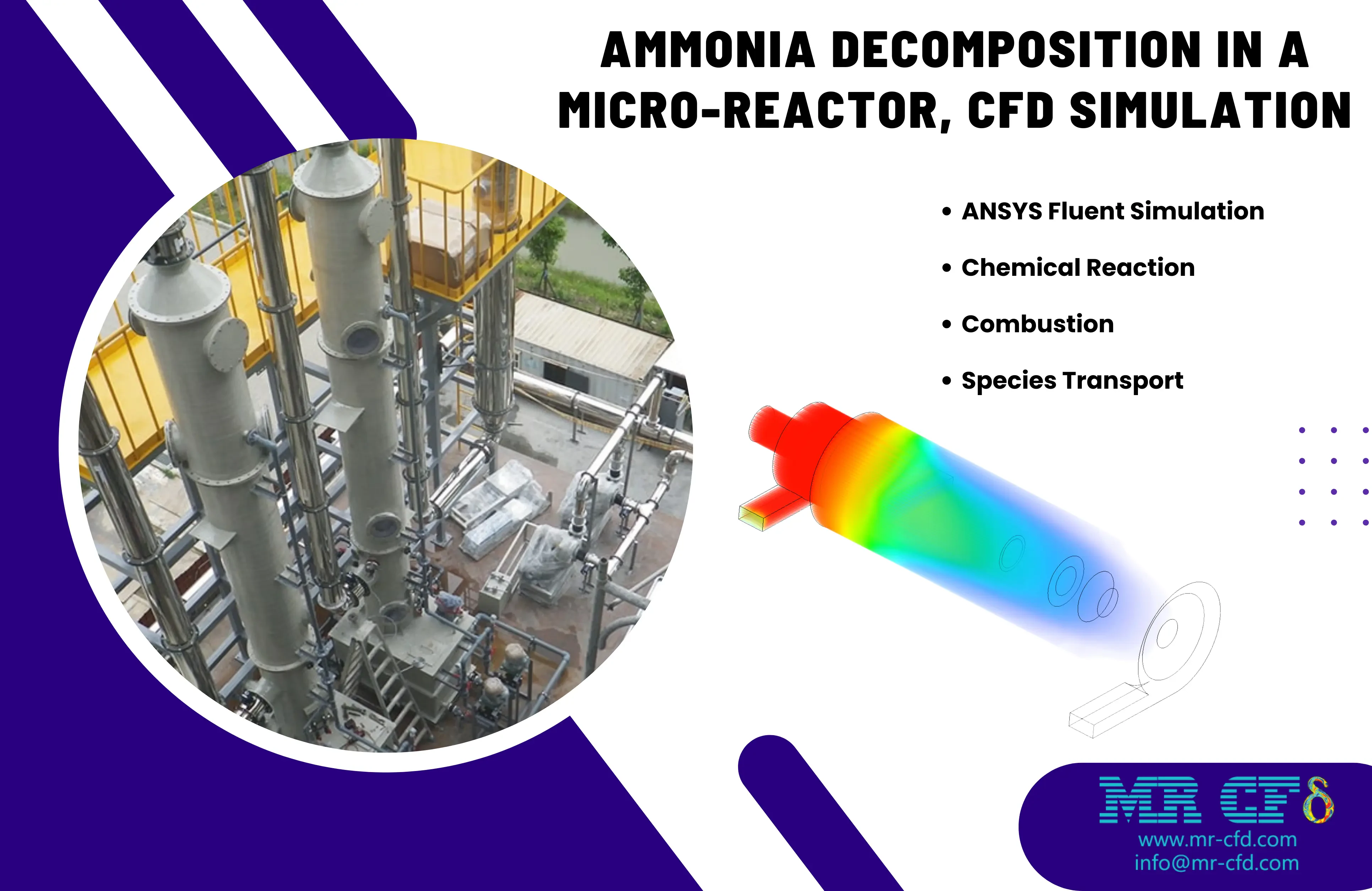
Ammonia Decomposition in a Micro-Reactor, CFD Simulation
Intermediate, Advanced
Price: $14
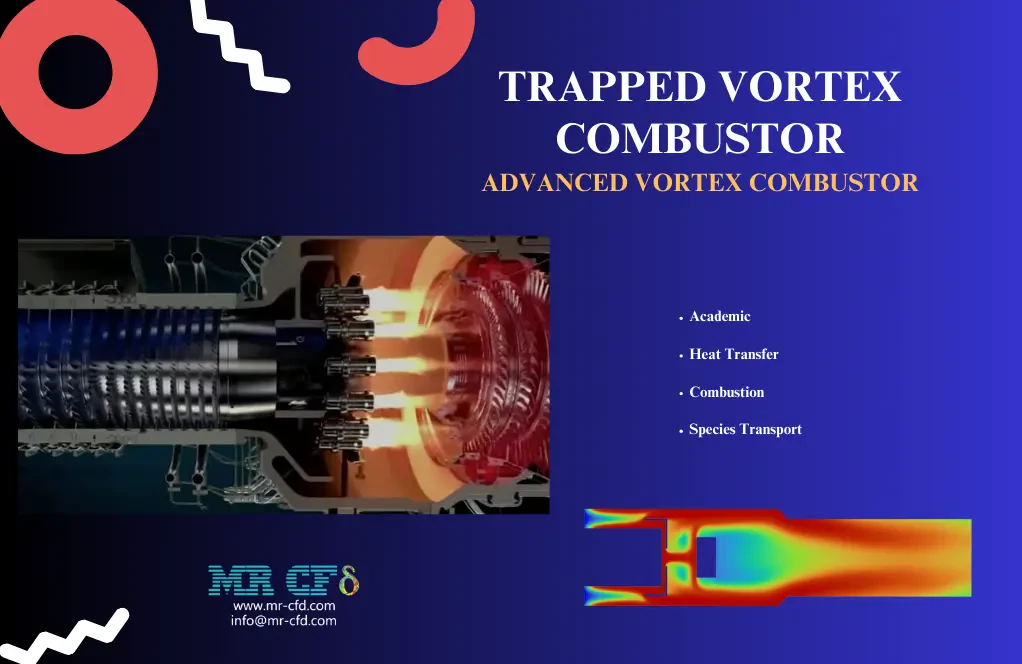
This report presents a simulation which investigates the production of hydrogen gas from ammonia, using the heat of the propane-air reaction. The ammonia conversion rate and the overall system efficiency were calculated. The geometry of the ammonia decomposition micro-combustor was created using ANSYS SpaceClaim software. A high-quality tetrahedron elements mesh was generated using ANSYS Meshing software. Appropriate species transport settings and boundary conditions were applied to correctly simulate the rate of ammonia decomposition.
Trapped Vortex Combustor, CFD Simulation
Intermediate
Price: $16
This report presents a simulation examining the difference in thermal efficiency between a conventional combustor and an AVC. The formation of NOx and its emission in these two combustion chambers have been compared. The geometry of the AVC and the conventional combustor was created using ANSYS SpaceClaim software. A high-quality hexahedral elements mesh was generated using ANSYS Meshing software. Appropriate species transport and NOx settings were applied and the thermal efficiency of the combustors and the NOx ppm was calculated.

Complete Combustion CFD Course for Flames, Fuels, Reacting Flow, and Emissions Simulation
The Complete Combustion CFD Course: +85 Simulations is a specialized training solution for engineers, universities, professors, research institutes, companies, technical managers, and CFD teams that need practical expertise in combustion simulation, flame modeling, reacting flow, fuel combustion, radiation, and pollutant prediction.
Developed by MR CFD, this course is part of MR CFD’s professional CFD Courses and CFD Complete Courses is designed specifically for combustion engineering applications. The course is also offered as the Combustion GOLDEN Training Package, giving buyers access to a focused all-in-one combustion simulation library for academic, industrial, research, energy, chemical, and aerospace applications.
This complete course covers premixed combustion, non-premixed combustion, partially premixed combustion, DPM combustion, particle combustion, biomass combustion, methane combustion, hydrogen combustion, gas turbine combustors, furnaces, flares, combustion chambers, fluidized bed combustion, radiation in combustion, pollutant prediction, soot formation, NO emissions, combustion optimization, and advanced reacting-flow workflows.
Why Choose This Complete Combustion CFD Course?
This course is built for buyers who need practical combustion simulation capability, not only theoretical knowledge of flames and fuels. It helps engineering teams, academic departments, and industrial companies train users faster, reduce modeling uncertainty, and standardize CFD workflows for combustion and reacting-flow applications.
| Business Need | How This Complete CFD Course Solves It |
| Faster combustion project onboarding | New engineers can learn from complete, pre-built combustion CFD projects instead of disconnected tutorials. |
| Focused reacting-flow coverage | The course is dedicated to combustion chambers, flames, fuels, burners, furnaces, gas turbines, biomass, radiation, emissions, and reacting-flow models. |
| Reduced training cost | One comprehensive course replaces scattered learning resources, repeated internal training, and multiple single-topic tutorials. |
| Academic teaching support | Professors can use the simulations as practical teaching material for students, interns, and research assistants. |
| Enterprise workflow consistency | Teams can follow proven workflows for premixed, non-premixed, DPM, radiation, soot, NOx, and fuel combustion modeling. |
| Real project readiness | Learners work with applied CFD simulations based on combustion chambers, furnaces, flares, gas turbines, burners, engines, tunnels, and industrial systems. |
A Specialized Combustion CFD Course, Not a General Chemical or Heat Transfer Package
This complete course is intentionally different from broader chemical engineering or heat transfer CFD training. A general chemical package may include reactors, separation, multiphase flow, fuel cells, dryers, and process equipment. A general heat transfer package may cover HVAC, radiation, electronics cooling, heat exchangers, PCM, and thermal systems. This course focuses specifically on combustion CFD simulation and reacting-flow analysis.
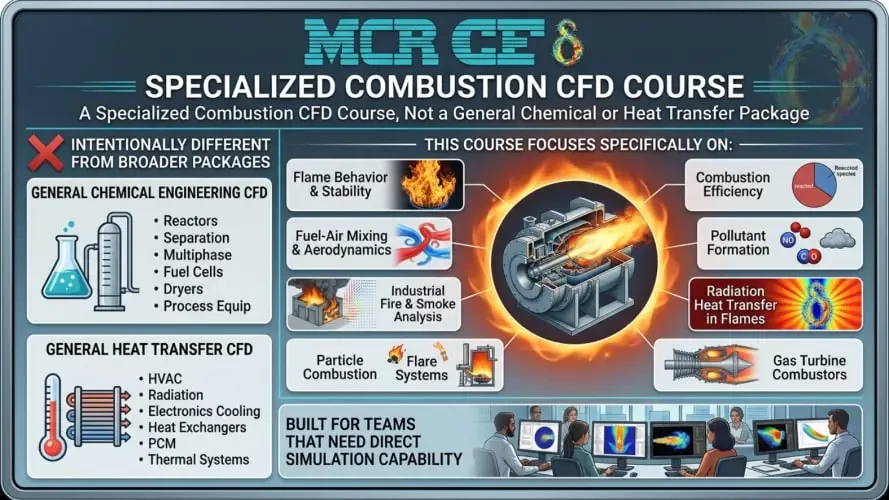
It is built for teams that need direct simulation capability for flame behavior, fuel-air mixing, combustion efficiency, pollutant formation, radiation heat transfer in flames, gas turbine combustors, furnace performance, flare systems, particle combustion, and industrial fire and smoke analysis.
| Feature | Complete Combustion CFD Course | General Chemical or Heat Transfer CFD Course |
| Main focus | Combustion, flames, fuel reactions, chambers, burners, furnaces, emissions, and reacting flows | Broad chemical processes or general thermal engineering topics |
| Best for | Combustion engineers, energy teams, propulsion groups, chemical engineers, professors, and CFD specialists | General process, thermal, or mechanical simulation teams |
| Technical depth | Focused premixed, non-premixed, DPM, particle combustion, radiation, soot, NOx, and fuel modeling | Wider but less specialized coverage across many CFD topics |
| Project scope | Gas turbines, furnaces, flares, chambers, biomass, methane, hydrogen, liquid fuels, radiation, and pollutants | Broader applications with less dedicated combustion depth |
| Purchase motivation | Build complete combustion simulation capability | Build general CFD capability across many unrelated topics |
Complete CFD Training for Combustion, Energy, and Reacting-Flow Teams
This course gives your organization a structured path to combustion CFD mastery. It supports users who need to simulate flame formation, fuel-air mixing, chemical reactions, combustion chambers, gas turbine combustors, furnaces, flares, biomass combustion, hydrogen combustion, methane combustion, liquid fuel droplets, DPM spray combustion, radiation heat transfer, soot formation, NO emissions, pollutant prediction, fire and smoke behavior, and combustion optimization.
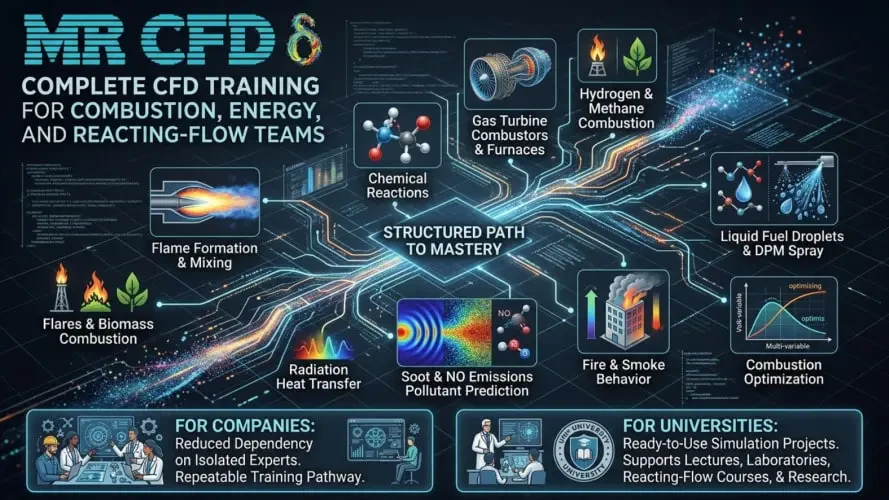
For companies, this complete combustion CFD course reduces dependency on isolated experts and creates a repeatable training pathway for combustion engineers, mechanical engineers, chemical engineers, energy engineers, aerospace propulsion teams, process engineers, and R&D departments. For universities and institutes, it provides ready-to-use simulation projects that can support lectures, laboratories, reacting-flow courses, energy research, propulsion studies, and advanced CFD training programs.
What You Get in This Combustion CFD Course
| Included Asset | Value for the Buyer |
| +85 CFD simulation projects | A focused combustion and reacting-flow CFD library in one complete course package. |
| Step-by-step tutorials | Practical guidance from geometry creation to final post-processing. |
| Complete simulation workflows | Geometry, meshing, solver setup, combustion model selection, flame analysis, emissions evaluation, and engineering interpretation. |
| Advanced combustion case studies | Coverage of premixed, non-premixed, DPM, particle combustion, gas turbines, furnaces, flares, biomass, methane, hydrogen, radiation, soot, and NOx. |
| 1 year of technical support | Direct support from MR CFD experts for course users. |
| 3 months of HPC access | Additional computational resources for selected learning and simulation needs. |
| Regular course enhancements | Continued value through updates for emerging combustion applications such as particle injection effects, advanced chambers, and optimized reacting-flow systems. |
Combustion CFD Topics Covered in This Complete Course
This complete CFD course covers a focused range of combustion and reacting-flow simulations, from fundamental flame models to advanced industrial combustion systems, pollutant prediction, radiation, and fuel-specific applications.
| Training Area | Covered Topics |
| Combustion fundamentals | Combustion concepts, model selection, flame behavior, reacting-flow setup, temperature fields, species transport, and post-processing. |
| Combustion chambers | Transient combustion chambers, multi-fuel combustion chambers, DPM spray chambers, combusting particles, thermoacoustic analysis, and chamber performance optimization. |
| Premixed combustion | Finite rate models, no-TCI approaches, eddy dissipation, turbulent V-shaped flames, Zimont formulation, eddy dissipation / finite rate models, and validation projects. |
| Non-premixed combustion | Eddy dissipation, steady diffusion flamelet, non-adiabatic chemical equilibrium, composition PDF transport, and non-premixed reacting-flow cases. |
| Partially premixed combustion | Partially premixed combustion modeling, mixed flame regimes, non-adiabatic equilibrium, and hybrid combustion applications. |
| DPM and particle combustion | DPM spray combustion, wet combustion with combusting particles, biomass combustion, liquid fuel combustion, particle injection effects, and particle surface reaction. |
| Biomass and solid fuel combustion | Biomass combustion, biomass waste incinerators, co-firing biomass with coal gasification, solid fuel ramjet systems, and validation-based biomass projects. |
| Methane combustion | Methane-air combustion in gas turbine combustors, methane combustion in gas stoves, methane leakage fire scenarios, and catalytic methane combustion. |
| Hydrogen combustion | Hydrogen combustion in furnaces, high-temperature reacting-flow behavior, and clean fuel combustion applications. |
| Gas turbine combustion | Gas turbine combustion chambers, syngas fuel combustion, soot formation in kerosene flames, and combustor flow-reaction interaction. |
| Furnace and kiln combustion | Industrial furnace studies, furnace combustion processes, hydrogen furnace combustion, lime kiln combustion, and high-temperature industrial systems. |
| Flare systems | Flare combustion, wood gas flare emissions, NO and soot evaluation, and industrial flare performance analysis. |
| Fluidized bed combustion | Circulating fluidized bed boilers, fluidized bed reactors with reaction, CFB gasifiers, and gas-solid combustion systems. |
| Radiation in combustion | Radiation heat transfer in combustion chambers, porous media effects, Rosseland radiation, train tunnel combustion, and radiation-coupled flame modeling. |
| Pollutant prediction | Pollutant prediction in combustion chambers, NOx-related analysis, soot formation, emissions evaluation, and environmental performance assessment. |
| Combustion optimization | DOE-based chamber optimization, ramjet engine combustion optimization, SR-71 Blackbird industrial application, and performance improvement workflows. |
Advanced Combustion CFD Modules Included
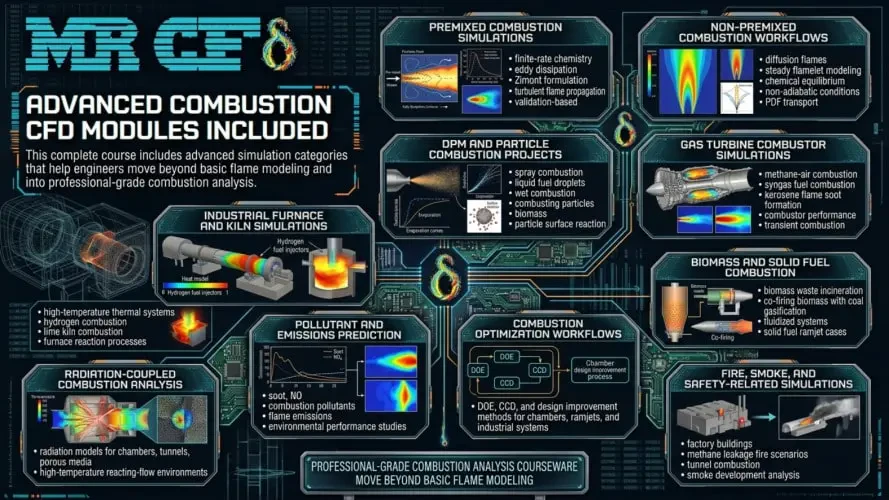
This complete course includes advanced simulation categories that help engineers move beyond basic flame modeling and into professional-grade combustion analysis.
Key advanced modules include:
Premixed combustion simulations for finite-rate chemistry, eddy dissipation, Zimont formulation, turbulent flame propagation, and validation-based flame studies.
Non-premixed combustion workflows for diffusion flames, steady flamelet modeling, chemical equilibrium, non-adiabatic conditions, and PDF transport.
DPM and particle combustion projects for spray combustion, liquid fuel droplets, wet combustion, combusting particles, biomass, and particle surface reaction.
Gas turbine combustor simulations for methane-air combustion, syngas fuel combustion, kerosene flame soot formation, combustor performance, and transient combustion.
Industrial furnace and kiln simulations for high-temperature thermal systems, hydrogen combustion, lime kiln combustion, and furnace reaction processes.
Biomass and solid fuel combustion for biomass waste incineration, co-firing biomass with coal gasification, fluidized systems, and solid fuel ramjet cases.
Radiation-coupled combustion analysis using radiation models for chambers, tunnels, porous media, and high-temperature reacting-flow environments.
Pollutant and emissions prediction for soot, NO, combustion pollutants, flame emissions, and environmental performance studies.
Combustion optimization workflows using DOE, CCD, and design improvement methods for chambers, ramjets, and industrial systems.
Fire, smoke, and safety-related simulations for factory buildings, methane leakage fire scenarios, tunnel combustion, and smoke development analysis.
Complete Combustion CFD Course vs Standard Combustion Tutorials
<div class="compare-chart">
| Feature | Complete Combustion CFD Course | Standard Combustion CFD Tutorial |
| Main purpose | Comprehensive CFD training for combustion, flame, fuel, emissions, and reacting-flow analysis | Single-topic learning for one combustion model or case |
| Best for | Combustion engineers, energy teams, chemical engineers, propulsion teams, professors, companies, and CFD specialists | Individual learners studying one basic combustion workflow |
| Content depth | +85 applied combustion CFD simulations | Limited number of cases |
| Project variety | Premixed, non-premixed, DPM, biomass, furnaces, flares, gas turbines, methane, hydrogen, radiation, soot, NOx, and optimization | Usually limited to one flame type or one combustion chamber |
| Business value | Reduces training cost, accelerates onboarding, and standardizes combustion CFD capability | Builds knowledge in a narrow CFD task |
| Purchase motivation | Build complete combustion simulation capability | Learn one combustion simulation example |
</div>
Who Should Buy This Complete Combustion CFD Course?
This course is ideal for combustion engineers, mechanical engineers, chemical engineers, energy engineers, aerospace propulsion teams, process engineers, environmental engineers, university professors, research institutes, technical managers, product development teams, and advanced CFD practitioners.
It is especially valuable for organizations that want to train multiple users, reduce repeated onboarding, support academic programs, standardize combustion CFD workflows, and improve internal simulation capability for flames, fuels, emissions, chambers, furnaces, and reacting-flow systems.
Business Benefits of Buying This Complete Combustion CFD Course
| ROI Driver | Business Impact |
| Faster combustion onboarding | New engineers become productive sooner on reacting-flow and combustion CFD projects. |
| Reduced external training dependency | Teams can learn from a complete internal combustion simulation resource. |
| Better workflow consistency | Engineers follow proven combustion CFD workflows instead of scattered tutorials. |
| Lower project risk | Teams learn from pre-built, practical combustion and flame simulation examples. |
| Stronger academic outcomes | Instructors can assign realistic combustion CFD projects for flames, fuels, emissions, radiation, and reacting flows. |
| Faster design improvement | Teams can evaluate combustion efficiency, pollutant formation, flame stability, thermal behavior, and chamber performance more efficiently. |
| Higher long-term value | One complete course supports repeated training across departments, students, interns, and new employees. |
Why This Complete CFD Course Is Built for Direct Purchase
When your team needs serious combustion CFD capability, buying isolated tutorials one by one creates gaps, duplicated effort, and inconsistent learning outcomes. This complete course removes that friction by giving you a specialized combustion simulation library in one purchase.
You get practical training built around real combustion engineering applications, including combustion chambers, gas turbines, furnaces, flares, biomass, methane, hydrogen, liquid fuels, DPM spray combustion, particle combustion, pollutant prediction, soot formation, NO emissions, radiation heat transfer, fire and smoke, and combustion optimization. That makes this course a strong choice for buyers who want immediate access to a focused, organized, and commercially valuable combustion CFD learning system.
Final Conversion Section
Invest in the Combustion GOLDEN Training Package: +85 Simulations (All in One Course) and give your team a complete combustion CFD training system built for advanced industrial, academic, chemical, energy, and aerospace applications.
Whether you manage a university lab, a corporate CFD department, a combustion engineering team, an energy systems group, a chemical process unit, a propulsion research center, or a technical training center, this course helps you reduce training time, improve simulation quality, and build long-term internal expertise.
Instead of purchasing separate tutorials and managing disconnected learning materials, choose one complete combustion CFD course that delivers depth, technical support, HPC access, and practical project readiness in a single solution.
FAQ: Complete Combustion CFD Course
What is included in the Complete Combustion CFD Course?
The course includes +85 CFD simulation projects covering premixed combustion, non-premixed combustion, partially premixed combustion, DPM combustion, particle combustion, gas turbines, furnaces, flares, biomass, methane, hydrogen, radiation, soot, NOx, and pollutant prediction.
Who is this combustion CFD course designed for?
This course is designed for combustion engineers, mechanical engineers, chemical engineers, energy engineers, aerospace propulsion teams, university professors, research institutes, technical managers, and advanced CFD users who need practical combustion simulation training.
Is this course different from a general chemical CFD course?
Yes. A general chemical CFD course may cover reactors, separation, multiphase flow, fuel cells, and process equipment, while this course focuses specifically on combustion, flame modeling, fuel reactions, emissions, radiation, chambers, furnaces, and reacting-flow systems.
Does this course cover premixed and non-premixed combustion?
Yes. The course includes premixed combustion, non-premixed combustion, partially premixed combustion, eddy dissipation, finite rate models, steady diffusion flamelet, PDF transport, and Zimont formulation workflows.
Does this course include DPM and particle combustion?
Yes. The course includes DPM spray combustion, wet combustion with combusting particles, biomass combustion, liquid fuel combustion, particle injection effects, and diesel fuel particle surface reaction.
Are gas turbine and furnace combustion simulations included?
Yes. The course covers gas turbine combustion chambers, methane-air combustion, syngas combustion, kerosene flame soot formation, industrial furnaces, hydrogen combustion in furnaces, and lime kiln combustion.
Does this course cover pollutant prediction and emissions?
Yes. The course includes pollutant prediction, soot formation, NO and soot emissions from flares, combustion chamber pollutants, and environmental performance analysis.
Does this course include radiation in combustion?
Yes. The course includes radiation heat transfer in combustion chambers, Rosseland radiation, porous medium effects on combustion with radiation, and train tunnel combustion with radiation modeling.
Is technical support included after purchasing the course?
Yes. Buyers receive 1 year of non-limited technical support from MR CFD experts, helping learners and teams resolve technical questions related to the course simulations.
Why should I buy this complete combustion CFD course instead of separate tutorials?
Buying this complete combustion CFD course gives you a more organized, focused, and cost-effective training solution. It supports team-wide learning, reduces repeated training costs, and gives access to a specialized combustion CFD simulation library in one purchase.