

Combustion Online Courses
Here's every CFD online course related to Combustion category.
Price: $109
Advance your combustion CFD skills with this 10-project ANSYS Fluent training package — covering fundamental and particle-based combustion, specialized combustion environments, and radiation and thermoacoustic coupling.
Combustion: Intermediate CFD Training Package
Intermediate
Price: $69
Build intermediate-level expertise in combustion CFD with this 10-project ANSYS Fluent training package — covering core premixed and non-premixed combustion models, applied industrial combustion systems, fire safety, and advanced electrohydrodynamic and hypersonic combustion physics.
Price: $29
Combustion: Beginner CFD Training Package is a ten-project introduction to combustion simulation in ANSYS Fluent. Starting from everyday methane combustion and building through combustion chambers, swirl-stabilized flames, spray combustion, and industrial flares, it gives newcomers a hands-on, application-driven foundation in the CFD techniques behind modern combustion engineering — one real engineering case at a time.
Price: $49
The final step in the series, this course covers the most demanding version of each project — high-speed and reacting flows, fluid-structure interaction, UDFs, and moving geometry — the kind of coupled, multi-physics problems most CFD engineers never get past. It's built for those who want to solve undefined, real-world problems and defend their results with confidence.
Build Real-World CFD Skills with ANSYS Fluent
Intermediate
Price: $29
Building on the fundamentals, this course tackles harder, more realistic versions of the same 16 engineering fields and flow models, introducing multi-phase interactions, transient behavior, and more demanding boundary conditions. You'll leave with the skills to handle real project complexity, not just tutorial-scale problems.
Price: $9
This course takes you from zero to your first working simulations in ANSYS Fluent, covering foundational projects across 16 engineering fields — aerospace, biomedical, chemical, HVAC, marine, renewable energy, and more — alongside core flow models and Fluent modules. By the end, you'll be comfortable setting up, running, and interpreting basic CFD simulations on your own.
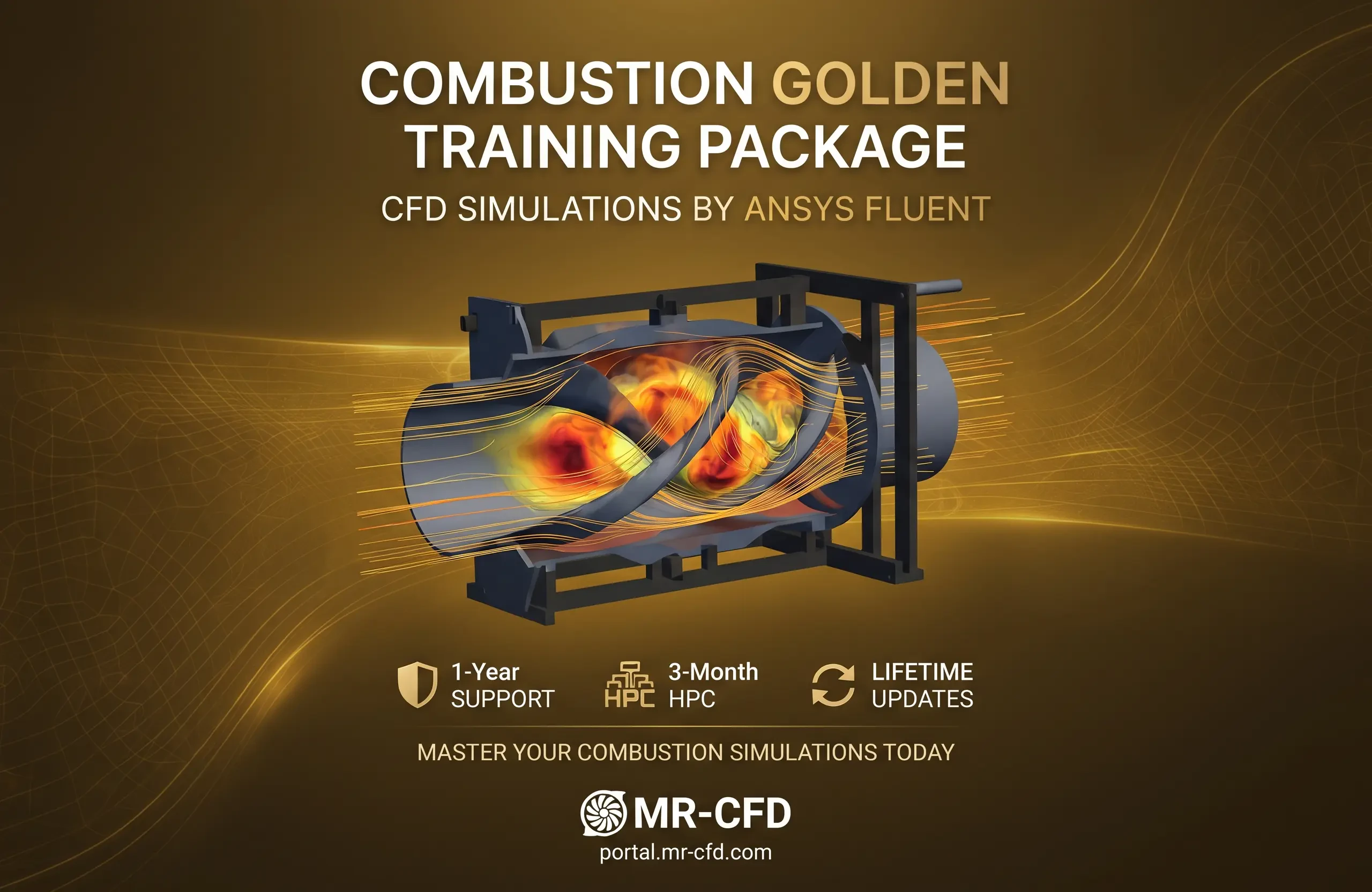
Combustion GOLDEN Training Package
Beginner, Intermediate, Advanced
Price: $2,159
Combustion CFD Simulation GOLDEN Training Package by MR CFD delivers 85+ ANSYS Fluent tutorials covering advanced combustion. Ideal for professors, engineering managers, and companies, it rapidly upskills teams for real combustion projects analysis—backed by 15 years CFD expertise, including 1-year technical support and 3 months HPC access.
Optimization, DOE: CFD Simulation Masterclass
Beginner, Intermediate, Advanced
Price: $299
Master optimization process with our “Optimization (DOE and RSM): All Levels” CFD course using ANSYS Fluent. From basics to advanced, learn to perform Optimization procedures with different types of Design of Experiments (DOEs) and various Response Surface methodologies (RSMs). This course equips you with the essential skills to optimize all construction designs in all engineering fields using CFD. Ideal for beginners and experts alike, enhance your capabilities in design optimization for cutting-edge research and industrial applications.
Price: $420
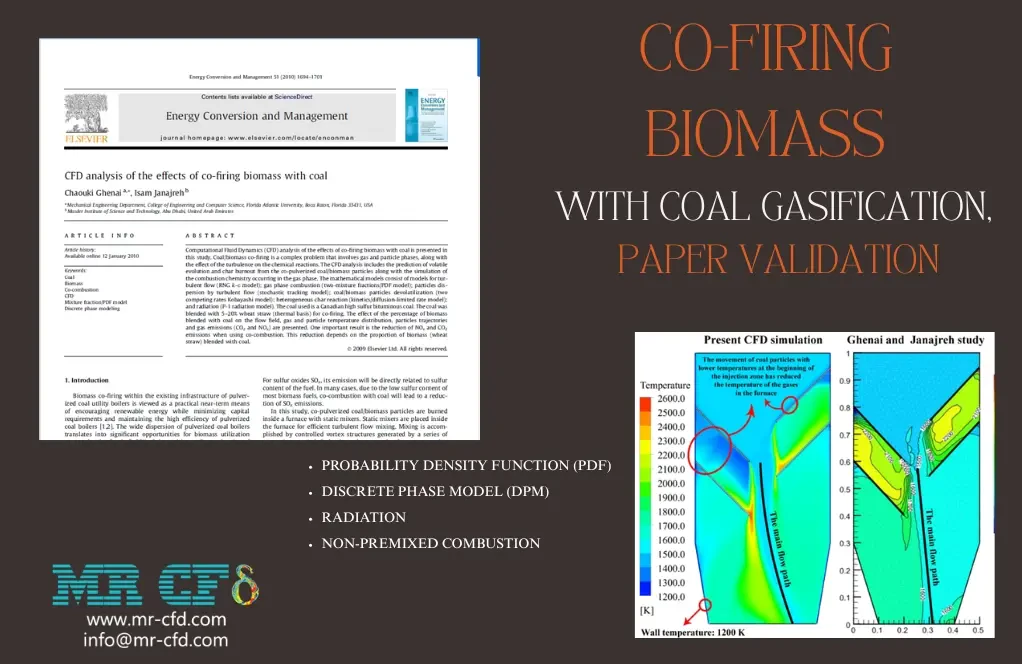
Co-firing Biomass with Coal Gasification. This project involves the simulation of coal and biomass co-firing in a furnace using CFD techniques. The primary objectives are to examine the combustion characteristics and validate the simulation results against the study by Ghenai and Janajreh. The furnace is defined with specific boundary conditions, and simulations are performed using an unsteady, incompressible flow model. The turbulent flow within the furnace is modeled using the k-e RNG turbulent model, thermal radiation is simulated with the P1 model, and combustion is analyzed with a PDF model. The simulation incorporates the kinetics/diffusion-limited rate model for particle combustion and the two competing rates Kobayashi model for devolatilization. Results are compared in terms of temperature contours and particle trajectories, confirming the simulation’s accuracy with a maximum error of approximately 5% in particle temperature ranges.