

Dehumidifier With DPM Model, CFD Simulation ANSYS Fluent Training
Price: $12
The present simulation is about a Dehumidifier With DPM Model via ANSYS Fluent, and the results of this simulation have been analyzed.
Dehumidifier With DPM Model, CFD Simulation ANSYS Fluent Training
Price: $12
The present simulation is about a Dehumidifier With DPM Model via ANSYS Fluent, and the results of this simulation have been analyzed.
Dehumidifier With DPM Model Description
The present simulation is about a dehumidifier via ANSYS Fluent. A dehumidifier is an air conditioning device that reduces and maintains the level of humidity in the air. This device is used to increase the health and thermal comfort of the people in the environment, eliminate the musty odor, and prevent mildew growth by removing water from humid air.
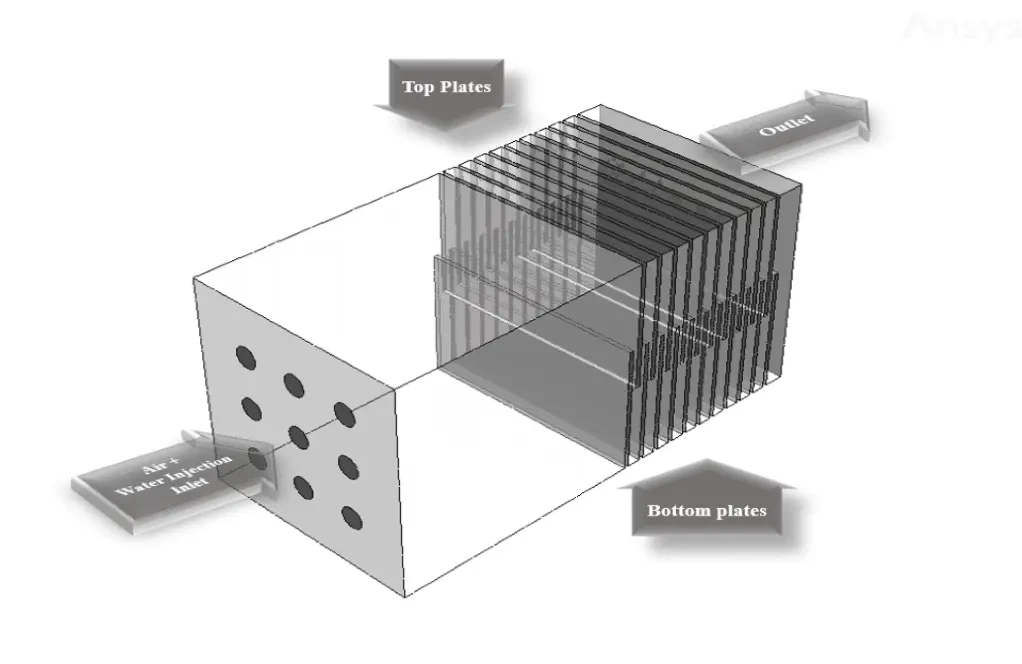
This project uses moisture absorption by surfaces to dehumidify the air. A chamber is designed where several rows of plates are placed inside the barrier as flow barriers. The presence of these barriers causes the humid airflow to pass through a winding path and constantly contact different plates, thus trapping the moisture in the air by these plates.
In this study, humid airflow is assumed to be a combination of airflow as a continuous medium and injection of many water particles as a discrete medium. Therefore, the discrete phase model (DPM) is used, and an injection is defined.
The use of the discrete phase model causes the solution approach to change from Eulerian-Eulerian to Eulerian-Lagrangian. In this modeling, a continuous airflow with a velocity of 0.05 m/s and a temperature of 373.15 K enters the chamber and collides with 21 plates perpendicular to the flow path. Simultaneously, the water flow is sprayed in a discrete environment from the nine holes of the chamber inlet to the continuous airflow.
Water injection is defined as inert particles with a diameter of 0.0001 m and a mass flow rate of 1e-5 kg/s, and a velocity of 0.05 m/s. Also, the behavior of discrete particles in contact with the surface of the plates is defined as a trap so that the discrete particles are separated from the continuous airflow and dehumidification results.
Geometry & Mesh
The present geometry is designed in a 3D model via Design Modeler. The computational zone is the interior of a dehumidifier. Inside the chamber, 21 rows of plates are designed as obstacles perpendicular to the fluid flow path.
Ten plates are connected to the upper level of the chamber, and eleven plates are connected to the lower level of the chamber and are placed in the middle with one arrangement. The air inlet is from the chamber's left side, and nine separate vents are defined as the center for spraying water with discrete particles.
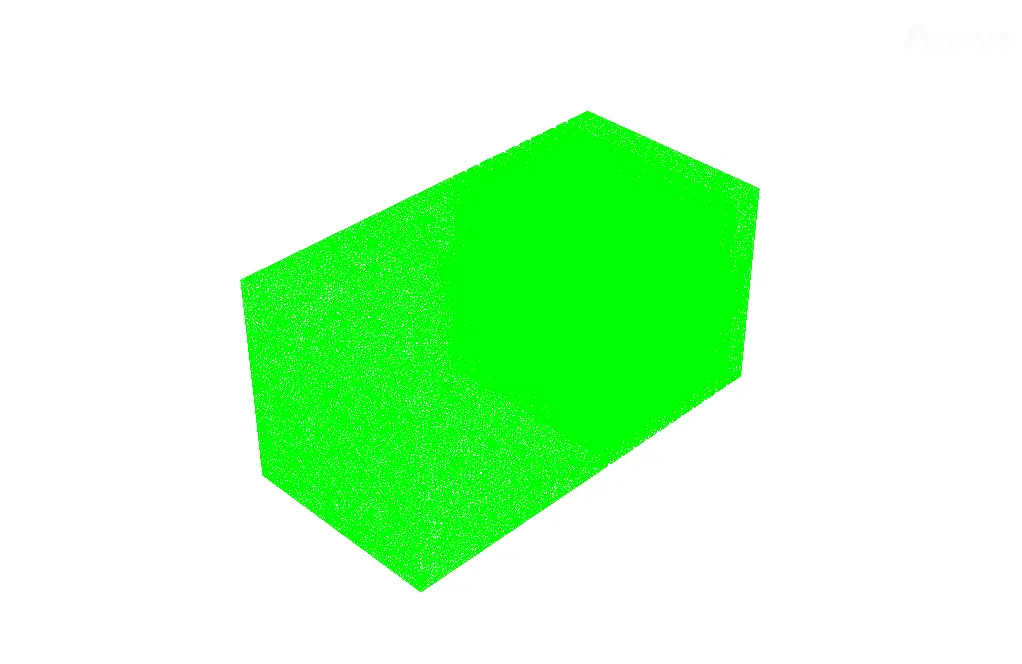
The mesh of the present model has been done via ANSYS Meshing. Mesh is done unstructured, and the number of production cells equals 2863327.
Set-up & Solution
Assumptions used in this simulation:
- pressure-based solver is used.
- The present simulation is steady.
- The effect of gravity on the model is ignored.
| Models | ||
| Viscous | k-epsilon | |
| k-epsilon model | realizable | |
| near-wall treatment | standard wall function | |
| Discrete Phase | On | |
| interaction | interaction with continuous phase | |
| Injection | On | |
| injection type | surface | |
| particle type | inert | |
| diameter | 0.0001 m | |
| velocity | 0.05 m.s-1 | |
| total flow rate | 1e-5 kg.s-1 | |
| Energy | On | |
| Boundary conditions | ||
| Inlet | Velocity Inlet | |
| velocity magnitude | 0.05 m.s-1 | |
| temperature | 373.15 K | |
| discrete phase BC type | escape | |
| Outlet | Pressure Outlet | |
| gauge pressure | 0 Pascal | |
| discrete phase BC type | escape | |
| Plates | Wall | |
| wall motion | stationary wall | |
| heat flux | 0 W.m-2 | |
| discrete phase BC type | trap | |
| Methods | ||
| Pressure-Velocity Coupling | SIMPLE | |
| pressure | second-order | |
| momentum | first-order upwind | |
| turbulent kinetic energy | first-order upwind | |
| turbulent dissipation rate | first-order upwind | |
| energy | first-order upwind | |
| Initialization | ||
| Initialization methods | Standard | |
| gauge pressure | 0 Pascal | |
| temperature in chamber | 373.15 K | |
| temperature | 373.15 K | |
Dehumidifier With DPM Model Results
After calculation, 2D and 3D contours related to velocity, pressure, pressure gradient, and DPM concentration are obtained. The particle tracks based on residence time are also shown. The results show that the fluid flow passes through a tortuous path through the space between the plates and is in constant contact with the surface of the plates.
These contacts cause discrete water particles in the air to be trapped by these plates in the space between the plates. Thus, the dehumidification process of moist air is done correctly by trapping water droplets. The results show that the 175 tracked water particles are all trapped by the plates.