

Facade CFD Simulation Considering Radiation (HVAC), ANSYS Fluent CFD Simulation Tutorial
Price: $24
- The present problem simulates the ventilation applying the double façade of the building by ANSYS Fluent software
- The geometry of the present model is three-dimensional and is drawn using Design Modeler software.
- The meshing of the present model has been done using ANSYS Meshing software. The element number is 4264442.
- The DO solar Radiation model is applied.
Facade CFD Simulation Considering Radiation (HVAC), ANSYS Fluent CFD Simulation Tutorial
Price: $24
- The present problem simulates the ventilation applying the double façade of the building by ANSYS Fluent software
- The geometry of the present model is three-dimensional and is drawn using Design Modeler software.
- The meshing of the present model has been done using ANSYS Meshing software. The element number is 4264442.
- The DO solar Radiation model is applied.
Facade Project Description
The Facade CFD simulates the airflow through the space between the two walls of the double façade of the building by ANSYS Fluent software applying a steady state, and Pressure-based solver, considering the gravity effect.
The geometry of the Facade CFD is three-dimensional and is drawn using Design Modeler software. The geometry consists of a rectangular cube chamber and several rows of shutter-like plates called shading.
The compartment has dimensions of 3 meters, 1.5 meters, and 0.2 meters. Shading plates also have a thin thickness with a slope of 45 degrees and are located in 120 rows. The meshing of the present model has been done using ANSYS Meshing software. The mesh type is unstructured and the element number is 4264442.
It is also assumed that the ambient airflow around the shells has a temperature of 300 K and a heat transfer coefficient of 10 W.m-2.K-1. Also, in the space between these two walls, a shutter-shaped shading is used, which helps the ventilation process in the system.
The purpose of this study is to investigate the behavior of fluid flow in an upward motion and heat transfer in space between two shells and between shading plates.
Methodology
The Energy equation is On to capture the temperature, and the Viscous is set as the Standard k-epsilon model.
To move the airflow upwards in this space based on the density changes caused by the pressure and temperature changes, the boundary condition of the pressure equal to the atmospheric pressure at the inlet and outlet of this space has been used.
The main cause of temperature changes is the presence of solar energy on the plates of these shells; therefore, the radiation energy model of Discrete Ordinates (DO) and the solar ray tracing model have been used.
Facade Results
At the end of the Facade CFD solution process, two-dimensional and three-dimensional contours related to pressure and velocity, and temperature, as well as two-dimensional and three-dimensional pathlines were obtained. The two-dimensional contours are drawn in the XY section and in the middle of the space between the two shells.
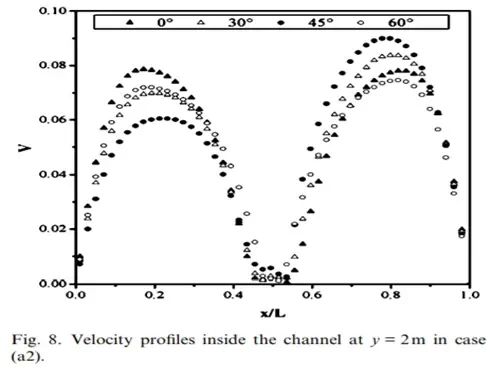
The diagram of the velocity distribution in the XZ section of the model is plotted at a height of 2 m from the floor of the model in the line passing through the center of the geometry and in line with the x-axis between -0.1 and +0.1. The geometric model has an angle of 45 degrees.
You can obtain Geometry & Mesh file, and a comprehensive Training Movie that presents how to solve the problem and extract all desired results.