

Gas Particle Movement Through the Nozzle Simulation
Price: $30
In this project, gas-particles movement through the convergence-divergence nozzle has been simulated and the results of this simulation have been investigated.
Gas Particle Movement Through the Nozzle Simulation
Price: $30
In this project, gas-particles movement through the convergence-divergence nozzle has been simulated and the results of this simulation have been investigated.
Gas Particle Movement Through the Nozzle, CFD Simulation Tutorial by Ansys Fluent
This simulation is modeling gas-particle movement through the convergence-divergence nozzle by a Two-way DPM model in Ansys fluent software. The nozzle is in grossly overexpanded condition. These kinds of nozzles are used in the gas and petrochemical industry.
Geometry & Mesh
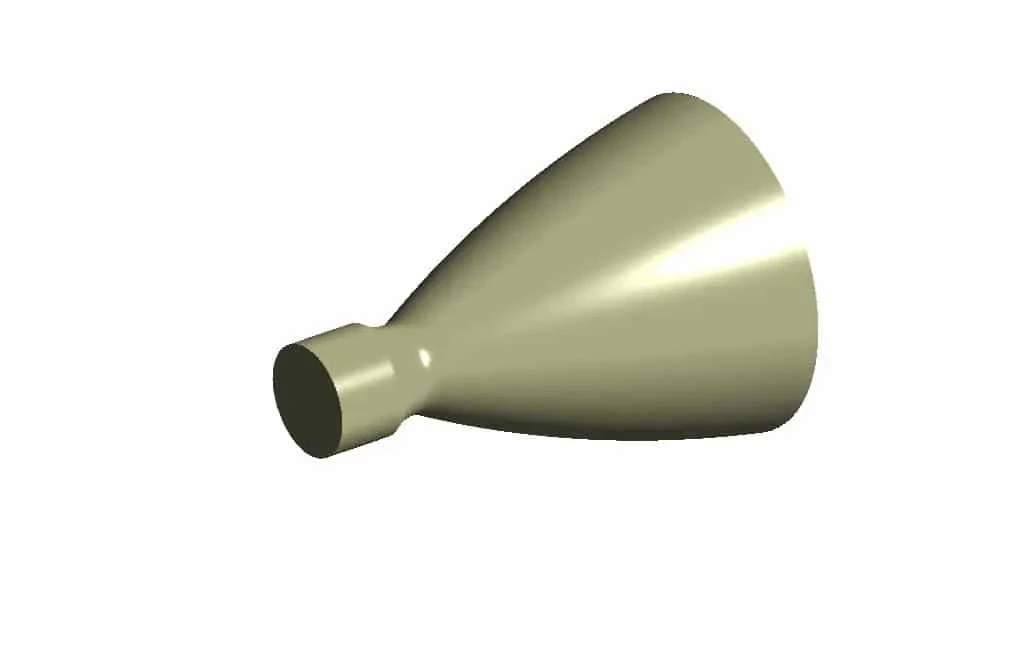
The 3-D geometry of the present model is carried out using Design Modeler software.
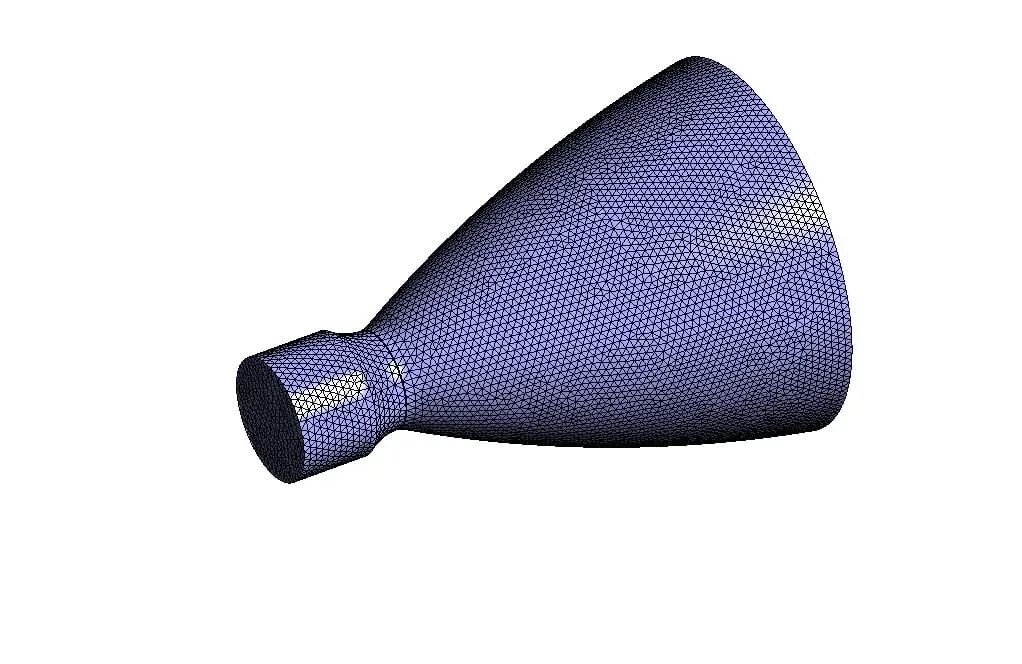
The meshing of this present model has been generated by ANSYS Meshing software. The mesh grid is unstructured, and the total cell number is 16245216.
Gas Particles Movement CFD Simulation
To simulate the present model, several assumptions are considered, which are:
- The solver is pressure-based.
- Simulation has only examined fluid behavior; in other words, heat transfer simulation has not been performed.
- The gravity effect is ignored.
The following is a summary of the steps for defining the problem and its solution
| Models | |||
| K-epsilon | Viscous model | ||
| Realizable | k-epsilon model | ||
| Scalable wall function | k-epsilon options | ||
| air | primary phase | ||
| Gas | Particle | ||
| explicit | formulation | ||
| Boundary conditions | |||
| Velocity-inlet | inlet | ||
| Discrete phase pressure | escape | ||
| 448000 | initial gauge pressure | ||
| 5 m/s | velocity magnitude | water | |
| Pressure outlet | outlet | ||
| Discrete phase condition | Escape | ||
| 0 | Supersonic gage pressure | water | |
| wall | wall | ||
| stationary wall | wall motion | ||
| Solution Methods | |||
| Phase coupled | pressure-velocity coupling | ||
| PRESTO! | pressure | ||
| first-order upwind | momentum | ||
| first-order upwind | specific dissipation rate | ||
| first-order upwind | volume fraction | ||
| Initialization | |||
| hybrid | initialization method | ||
| 52 m/s | water velocity (0,y,0) | ||
| 0 m/s | particle velocity (x,y,z) | ||
Results
At the end of the solution process, two-dimensional and three-dimensional velocity and static enthalpy and turbulence kinetic energy are obtained. This 3-D simulation shows how gas particles enter the nozzle from the inlet and travel through a nozzle and how the nozzle effect particle velocity in other simulation conditions.