

Open Channel Flow: Beginner CFD Training Package
Price: $29
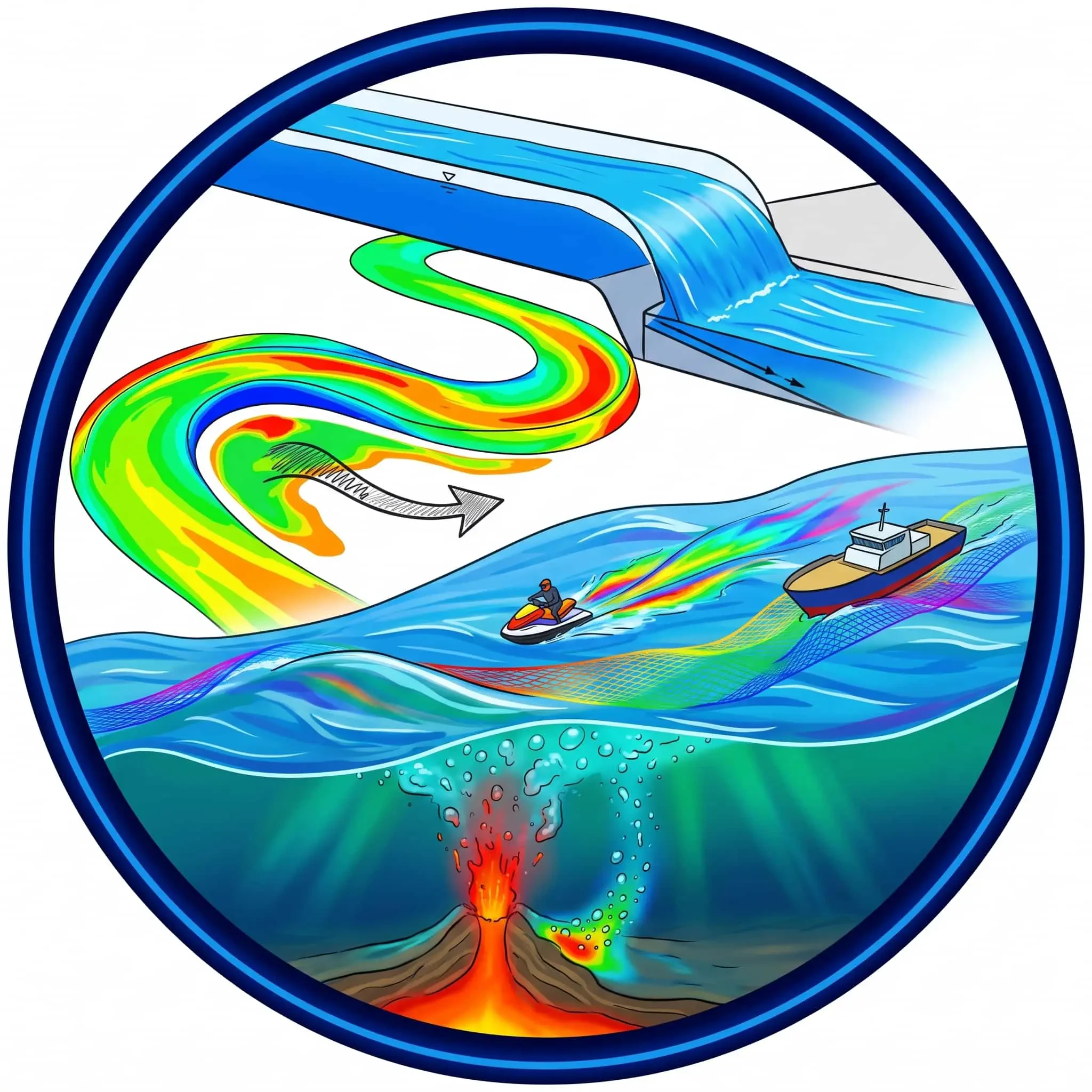
Open Channel Flow: Beginner CFD Training Package is a ten-project introduction to open-channel and free-surface flow simulation in ANSYS Fluent. Starting from basic open-channel flow and building through channel bends and outlets, river pollutant transport, spillways, sea waves, and moving bodies up to sub-oceanic volcanic activity, it gives newcomers a hands-on, application-driven foundation in the VOF and free-surface techniques behind modern hydraulic and environmental engineering — one real engineering case at a time.
Sub-Oceanic Volcanic Activity
Sub-Oceanic Volcanic Activity — ANSYS Fluent CFD SimulationDescriptionThis project simulates sub-oceanic volcanic activity using ANSYS Fluent and the Volume of Fluid (VOF) multiphase model — a complex and critical environmental scenario. Sub-oceanic volcanic eruptions play a crucial role in shaping the planet's oceans and climate, and their accurate simulation supports oceanographic research, ocean engineering, tsunami forecasting, and weather and climate science. The simulation captures the interaction between water, lava, and vapor on the sea floor, combining wave modeling with the extreme thermal effects of an eruption. As the capstone of the Open Channel Flow: Beginner CFD Training Package, it is the most complex and specialized case in the set, bringing together free-surface waves, multiphase interaction, and mass transfer in a single environmental problem.MethodologyThe underwater topography is designed in ANSYS Design Modeler and meshed in ANSYS Meshing with an unstructured grid optimized for a challenging multiphase scenario. The VOF multiphase model is configured to capture the interaction between water, lava, and vapor. The Open Channel Flow model is enabled together with the Open Channel Wave boundary submodel for realistic wave simulation, and Fifth-Order Stokes Wave Theory is implemented for accurate surface-wave patterns. Mass transfer is modeled using the Lee model to represent evaporation and condensation — capturing the vapor generation caused by the extreme eruption temperatures and its effect on the ocean hydrodynamics.AnalysisPost-processing focuses on the interaction between the eruption and the sea surface: the disruption of the wave patterns due to the volcanic activity, and the hydrodynamic effects of vapor generation on the ocean surface dynamics. From these results you can interpret the complex multiphase behavior, validate the model against known oceanic and volcanic phenomena, and connect the findings to real-world applications such as tsunami prediction, ocean engineering, and climate research. By the end of this project, you'll be able to set up a VOF simulation coupling water, lava, and vapor, apply the open-channel wave submodel with Fifth-Order Stokes wave theory, implement evaporation and condensation with the Lee mass-transfer model, and interpret the wave–eruption interaction that governs this environmental scenario.
Open Channel Flow: Beginner CFD Training Package
Price: $29
Open Channel Flow: Beginner CFD Training Package is a ten-project introduction to open-channel and free-surface flow simulation in ANSYS Fluent. Starting from basic open-channel flow and building through channel bends and outlets, river pollutant transport, spillways, sea waves, and moving bodies up to sub-oceanic volcanic activity, it gives newcomers a hands-on, application-driven foundation in the VOF and free-surface techniques behind modern hydraulic and environmental engineering — one real engineering case at a time.
-
DescriptionThis project uses ANSYS Fluent to simulate two-phase open channel flow, modeling the interaction between water and air inside a channel — a core problem in hydraulic and open-channel flow engineering. Open channels, whether natural (rivers) or artificial (canals, irrigation channels, water transmission systems), are widely used for water conveyance, transport, and irrigation. Water enters the channel at a mass flow rate of approximately 60 kg/s, and its interface behavior with the air phase above it is resolved using Fluent's open channel flow modeling capability.MethodologyThe geometry is built in DesignModeler and meshed in ANSYS Meshing using a structured grid of 214,560 elements. The simulation uses a pressure-based, steady-state solver, with gravity applied at -9.81 m/s² in the Y direction. Turbulence is modeled using the standard k-omega model with shear flow correction, while the VOF multiphase model with the open channel sub-model captures the water-air interface, with air as the primary phase and water as the secondary phase.Boundary conditions specify a mass flow inlet for water (60.071524 kg/s), with an open channel free surface level of 0.24 m and bottom level of 0 m, using density interpolation from neighboring cells. The outlet is set as a pressure outlet, and walls are treated as stationary. The solution uses the SIMPLE scheme for pressure-velocity coupling, PRESTO! for pressure discretization, second-order upwind for momentum, a compressive scheme for volume fraction, and first-order upwind for turbulent kinetic energy and dissipation rate. Standard initialization is applied with zero gauge pressure, zero velocity, and a water volume fraction of 0.ConclusionResults include 3D and 2D contours of velocity, pressure, and water volume fraction, characterizing the flow behavior and free-surface interaction within the open channel.
Lesson 1 14m 19s -
Open Channel with a Side Outlet — ANSYS Fluent CFD SimulationDescriptionThis project simulates free-surface flow through an open channel using ANSYS Fluent, with the open-channel flow model as its central theme. An open channel is a waterway — natural or artificial — used to convey water for purposes such as transport, service-water supply, and irrigation; in effect, an engineered version of a river. Canals of this kind are widely used in industry, from water-transmission systems to air ducts, and their shape and dimensions are dictated by their intended use. The defining feature of such flows, and the core of this study, is the presence of a free surface between water and the air above it, which must be tracked accurately as the flow develops. Within the Open Channel Flow: Beginner CFD Training Package, this project adds a branch to the open-channel progression, introducing flow diversion into a side outlet.MethodologyThe configuration studied here is an open channel with a 180° bend and a side outlet. Water enters the canal at a mass flow rate of 45 kg/s, and partway through the bent section a set of obstacles reduces the flow pressure and diverts a portion of the incoming water into the side outlet — representing water drawn off to irrigate an adjacent farm. The aim is to understand how the bend, the obstacles, and the side outlet together govern the flow distribution, pressure field, and water level within the channel. The geometry was created in Gambit and meshed in ANSYS Meshing with an unstructured grid of 178,093 cells. Because two phases — water and air — are present with a sharp, well-defined interface between them, the simulation uses a multiphase approach built on the Volume of Fluid (VOF) model. VOF is the natural choice for open-channel flow precisely because the phase boundary is distinct: it tracks the fraction of each cell occupied by water versus air and so resolves the free surface directly. To set up the problem, the initial water level is specified, with water filling the channel to a depth of 0.15 m and air occupying the region above it.AnalysisAfter solving, the simulation yields contours of velocity, pressure, and the volume fraction of water and air. The pressure field shows elevated pressure in the lower part of the channel, where the water column stands to its defined level, consistent with the expected hydrostatic behavior. The volume-fraction contours correctly capture the stratified arrangement of the two phases — water occupying the lower portion of the channel and air flowing above it — confirming that the VOF model reproduces the free surface faithfully. By the end of this project, you'll be able to set up an open-channel VOF simulation with a defined initial water level, model flow diversion into a side outlet, and interpret the velocity, pressure, and volume-fraction fields to analyze flow distribution and water levels in practical canal and irrigation applications.
Lesson 2 13m 11s -
DescriptionThis project simulates two-phase flow of water and air inside an open channel with a 180-degree bend using ANSYS Fluent. This is fundamentally a free-surface flow problem: the water moves with an open, deformable interface between the liquid and the air above it, and accurately capturing the position and shape of that free surface is the central modeling challenge. To handle it, the multiphase VOF (Volume of Fluid) model is used — the standard approach for free-surface currents — with air defined as the primary phase and water as the secondary phase. Because the water flows with a free surface inside the channel, the open channel flow sub-model is also employed, with the water level set at 0.2 m.A stream of water 0.2 m deep, with a mass flow rate of 94.83 kg/s, enters the channel and, after traveling through the 180-degree arc, exits the outlet at atmospheric pressure. For the upper boundary of the channel — where air passes — a relative pressure condition of 0 Pa is applied.Geometry & MeshThe model was built in 3D using Design Modeler. It is a channel with a rectangular cross-section following a 180-degree arc; the cross-section is 1 m wide and 0.7 m high. Meshing was performed in ANSYS Meshing using a structured grid of 2,316,480 elements, shown in the figure below.MethodologySeveral assumptions underpin the simulation: a pressure-based solver is used, the simulation is steady, and gravity acts at −9.81 m/s² along the vertical axis.Viscous model — RNG k-epsilon with standard wall functionsMultiphase model — VOF with 2 Eulerian phases (air and water), implicit formulation, the open channel flow sub-model, and sharp interface modelingBoundary conditions — Inlet: mass flow inlet with a free-surface water level of 0.2 m, bottom level of 0 m, water mass flow rate of 94.83 kg/s, and air mass flow rate of 0 kg/s; Outlet and top: pressure outlet at 0 Pa gauge; inner, outer, and bottom walls: stationaryMethods — SIMPLE pressure-velocity coupling; second-order for pressure; second-order upwind for momentum; compressive scheme for volume fraction; first-order upwind for turbulent kinetic energy and turbulent dissipation rateInitialization — standard method, with 0 Pa gauge pressure, zero velocity in all directions, water volume fraction 0, and air volume fraction 1ConclusionOn completion of the solution, three-dimensional contours of pressure, velocity, turbulent kinetic energy, and the volume fractions of water and air within the 180-degree bend were obtained. Because the VOF model tracks the free surface directly, the results reveal how the water surface deforms as the flow negotiates the curve — including the superelevation of the water on the outer wall of the bend, where the centripetal effect raises the free surface, and the corresponding drop along the inner wall. This redistribution of water depth and velocity around the arc is precisely the behavior that free-surface modeling is designed to capture, making the VOF and open-channel approach essential to obtaining physically meaningful results.
Lesson 3 15m 5s -
Pollution Spread in a Stagnant River, ANSYS Fluent TrainingDescriptionThis project simulates the entry and spread of a pollutant into a stagnant river using ANSYS Fluent.The core of this case is open-channel flow — flow in a channel or river whose upper surface is open to the atmosphere and free to deform, rather than being fully enclosed by walls. In open-channel problems the position and shape of the free surface is part of the solution, and gravity governs how the water and anything riding on it settle and move. A river receiving a discharge is a natural example: the pollutant enters at the surface and spreads across it, so tracking that free surface is essential, which is exactly what the open-channel (free-surface VOF) approach is built for.The application itself is an environmental one. Water pollution from industrial waste is a serious concern: chemical by-products discharged into rivers endanger aquatic life and can enter the human food chain through it, causing disease. Simulating how a pollutant disperses once it reaches a river helps predict how far and how fast contamination travels.The 3-D geometry was built in Design Modeler, with a river inlet width of 11.05 m. The domain was meshed in ANSYS Meshing with 161,562 elements, and because the spreading process evolves in time, a transient solver is used.Simulation MethodologyThe two phases — water and pollutant — are handled with the VOF multiphase model. The pollutant enters through a non-uniform profile partway along the river and diffuses into the water. Because its density is lower than that of water, it floats and spreads along the free surface. Turbulence is solved with the realizable k-ε model using scalable wall functions, pressure-velocity coupling is SIMPLE, and momentum and the volume fraction use second-order upwind discretization. The river water itself is initially stagnant, and the pollutant enters at 8 m/s.Results & ConclusionAfter solving, contours of velocity, pressure, and pollutant volume fraction were obtained. The results show the pollutant progressively diffusing into the river water over time, with the pressure near the pollutant inlet higher than elsewhere. The cross-sectional pressure contour also shows pressure increasing with depth, as expected for a body of water under gravity.
Lesson 4 12m 39s -
DescriptionThis project simulates pollution transport in a meandering river using ANSYS Fluent, investigated through CFD analysis. Water pollution is the contamination of water bodies — usually the result of human activity — in a way that harms their legitimate uses. Such pollution prevents a body of water from delivering the ecosystem services it would otherwise provide, and it is broadly classified as either surface water pollution or groundwater pollution.The model was built in 3D using Design Modeler. The river's width at the inlet is 14.035 m, and the pollutant enters through two circular profiles, each 3 m in diameter. Meshing was performed in ANSYS Meshing, producing 762,433 elements. Because of the time-dependent nature of the problem, a transient solver was used.MethodologyThis study employs the VOF (Volume of Fluid) multiphase model to solve the two-phase flow field. To represent the free surface of the river, the open channel option within the multiphase module was enabled, allowing the air–water interface and the gravity-driven surface flow to be captured accurately.Pollutant enters the river through two circular inlet profiles near its start and then diffuses into the water. Because the pollutant is less dense than water, it accumulates at the river's surface, and the flow carries it downstream, spreading the contamination along the channel.The Realizable k-epsilon viscous model with scalable wall functions was used to resolve the turbulent flow. Pressure-velocity coupling was handled with the SIMPLE scheme. A second-order upwind scheme was applied to the momentum equations, while a first-order upwind scheme was used for the turbulent kinetic energy and turbulent dissipation rate. Water enters the domain at 35 m/s, and the pollutant enters at 5 m/s.ConclusionOnce the solution was complete, contours of velocity, pressure, pollutant volume fraction, water volume fraction, eddy viscosity, and streamlines were extracted and presented across different time steps.As the results show, the pollutant enters the river through the two circular inlet profiles and gradually diffuses across the water surface over time. Driven by the river's flow, the pollution spreads along the free surface and ultimately leads to widespread contamination of the channel.
Lesson 5 12m 50s -
Wide-Edge (Broad-Crested) Spillway — ANSYS Fluent CFD Simulation TrainingIntroductionA wide-edge (broad-crested) spillway is a cascading structure with a long horizontal crown aligned with the flow direction, such that the error arising from the hydrostatic pressure distribution can be neglected thanks to the acceleration of the radial flow. These spillways operate so that the upstream flow is subcritical while the flow over the spillway itself becomes supercritical, creating a flow-control section above the crown. One characteristic of these structures is that, a short distance from the crown, the flow lines run nearly parallel.In this type of spillway, the crest is wide and substantial relative to the other dimensions. The crowns may be wide, horizontal, or follow a specific curvature. Although they can be used to measure discharge, they serve most often as dam spillways — and sometimes as the dam itself, when water is allowed to pass through — and can store large volumes of water when needed.Project DescriptionThis project investigates the flow inside a wide-edge spillway using ANSYS Fluent. There is a deliberate elevation difference between the main channel and the sub-channel, in part to store a portion of the flowing water. The RNG k-epsilon model solves the turbulent flow equations, while the multiphase VOF model captures the two phases of water and air within the open channel. Water enters the channel at a mass flow rate of 65 kg/s and passes into the second channel after striking the middle section of the spillway.Geometry & MeshThe geometry was created in ANSYS Design Modeler and meshed in ANSYS Meshing using a structured grid, for a total of 981,900 elements.MethodologySeveral key assumptions underpin the model. The simulation uses a pressure-based solver and is run as steady-state, so the results do not vary with time. Gravity is applied at −9.81 m/s² in the Y direction.Turbulence is modeled with the RNG k-epsilon model using standard wall functions, and the two phases — air as the primary phase and water as the secondary phase — are handled with the VOF approach. Water enters through a mass-flow inlet (65 kg/s) defined as an open-channel boundary, with a free-surface level of 0.08 m, a bottom level of 0 m, and density interpolation taken from the neighboring cell. The outlets are set as pressure outlets, and the walls are treated as stationary.For the solution methods, pressure–velocity coupling uses the SIMPLE scheme. Pressure is discretized with PRESTO! and momentum with second-order upwind, while volume fraction, turbulent kinetic energy, and turbulent dissipation rate all use first-order upwind. The solution is initialized with the standard method: gauge pressure 0 Pa, velocity 0 m/s, turbulent kinetic energy 1 m²/s², turbulent dissipation rate 1 m²/s³, and water volume fraction 0.ResultsThe water volume fraction contour shows that, because of the height difference and the absence of any inlet flow in the sub-channel, the water volume fraction takes nonzero values in the upper part of the sub-channel. Once the solution is complete, 3D contours of pressure, velocity, volume fractions, and related quantities are extracted and presented.
Lesson 6 22m 21s -
Short Wave in the Sea — ANSYS Fluent CFD SimulationDescriptionThis project presents a CFD simulation of short waves on the sea surface — a fundamental problem in coastal, marine, and offshore engineering. Using ANSYS Fluent's ability to generate waves directly at a boundary, you'll create a realistic propagating wave field and track how the air–water interface evolves over time, all based on First-Order Airy (linear) wave theory. This is your introduction to wave generation in CFD, a capability that underpins the design of breakwaters, offshore platforms, ships, and coastal structures. Within the Open Channel Flow: Beginner CFD Training Package, this project extends free-surface modeling from channels to open water, introducing the generation of a controlled wave field on the sea surface.MethodologyThe 2D sea domain (210 cm long × 76 cm high) is designed in SpaceClaim and meshed in ANSYS Meshing with an unstructured grid of roughly 55,000 cells suited to free-surface wave tracking. Air and water are modeled with the VOF multiphase model using sharp interface modeling and an explicit formulation with implicit body force. The open-channel wave boundary condition is applied at the inlet to send waves into the domain based on First-Order Airy wave theory. The case is solved with a transient, pressure-based solver using the laminar viscous model — appropriate for this wave problem — with adaptive time stepping for stable, efficient wave propagation. PRESTO! pressure discretization and Compressive volume-fraction discretization are used to keep the air–water interface sharp, and the initial water region is patched to set up the sea surface.AnalysisPost-processing focuses on the velocity contours and the evolving free surface, observing how the moving waves propagate across the domain and induce vortices and turbulence in the air above the surface. From these results you can follow how the wave field develops in time and how the air–water interface deforms as the waves travel. Wave modeling of this kind is essential across naval architecture, coastal protection, renewable wave energy, and offshore oil and gas, and the open-channel wave boundary condition mastered here is the gateway to simulating realistic ocean environments — from ship seakeeping to wave–structure interaction. By the end of this project, you'll be able to set up a transient VOF wave-generation simulation, apply the open-channel wave boundary condition, configure the solver and discretization to keep the interface sharp, and interpret the propagating wave field.
Lesson 7 15m 35s -
Jet Ski (Two-Phase Flow Study) — ANSYS Fluent CFD SimulationDescriptionThis project simulates the motion of a jet ski at the interface between water and air, capturing how a floating body disturbs the free surface as it moves. Flow around floating objects — boats, ships, jet skis — is one of the most common two-fluid phenomena around us, and wherever two fluids meet, the interaction and deformation of the interface becomes the central engineering question. Here the goal is to see how the jet ski rides the surface and reshapes the water behind it. Within the Open Channel Flow: Beginner CFD Training Package, this project applies free-surface modeling to a moving craft, building on the sea-wave case toward the flow around a real floating body.MethodologyThe physics is handled with the Volume of Fluid (VOF) multiphase model, which tracks the sharp water–air interface as it deforms around the moving body — the standard tool for free-surface and open-channel problems where the shape of the surface is itself a key result. The computational domain has an inlet where water enters at a mass flow rate of 50,000 kg/s and a pressure outlet, with the jet ski floating at the interface. The geometry is built in ANSYS Design Modeler and meshed in ANSYS Meshing as an unstructured mesh of roughly 1,748,941 elements — unstructured here to wrap cleanly around the curved hull geometry.AnalysisPost-processing provides contours of pressure and velocity, velocity vectors, and the water volume fraction. The volume-fraction field captures the free surface clearly and shows how the phases interact around the floating body — the jet ski is pushed by the flow, and a distinct wake sequence forms behind it, with water lifted above the undisturbed surface level. That surface jump is exactly the behavior you'd expect from a jet ski's interaction with the water, recovered directly from the simulation. By the end of this project, you'll be able to set up a VOF water–air free-surface case around a floating body, define mass-flow inflow and pressure-outlet conditions, and read free-surface deformation and wake structure from the volume-fraction and velocity fields.
Lesson 8 22m 14s -
DescriptionThis project simulates a floating vessel's motion on water using the dynamic mesh method in ANSYS Fluent. The vessel is positioned at the center of a three-part computational domain, designed so its center of gravity sits along the vertical axis for simulation convenience. The geometry is built in 3D in Design Modeler, and meshed in ANSYS Meshing with an unstructured grid near the vessel and a structured grid elsewhere, totaling 902,808 elements.MethodologyBecause the vessel's motion requires the mesh to deform continuously around it, the Dynamic Mesh model is used, combining smoothing, which adjusts mesh boundaries without changing node count or connectivity, with remeshing, which reconstructs cells that become too distorted when boundary displacement is large relative to local cell size. The domain is divided into a small moving zone around the vessel, a surrounding deforming zone, and a larger stationary outer zone, with the vessel and its moving zone treated as a rigid body via the Six Degrees of Freedom (6-DOF) model. Since the vessel is physically constrained to only vertical translation and rotation about its central axis, a UDF restricts the 6-DOF motion down to these two degrees of freedom, with the vessel's center of gravity and rotation axis specified explicitly in the rigid body setup. The water and air phases are captured with the VOF multiphase model, air above and water below, both entering horizontally at 1.44 m/s and exiting at atmospheric pressure, with an Open Channel boundary condition at the outlet defining the water level. Given the fundamentally time-dependent nature of dynamic mesh motion, the simulation runs transient, covering 7 seconds at a 0.01 second time step.AnalysisThe results include 2D pressure contours on the vessel and 2D velocity and volume fraction contours in the surrounding air-water region, taken at the final second of the simulation, along with time-history plots of the vessel's vertical displacement and rotation angle over the full 7 seconds. These plots show the oscillation amplitude in both displacement and rotation decreasing over time, with the vessel's motion becoming effectively damped by the seventh second. At that point, the vessel settles near a vertical position of z = 0.021 and a rotation angle of Y_theta = -1.338, indicating it reaches a stable floating equilibrium consistent with the physical damping expected in this kind of fluid-structure interaction.
Lesson 9 25m 18s -
Sub-Oceanic Volcanic Activity — ANSYS Fluent CFD SimulationDescriptionThis project simulates sub-oceanic volcanic activity using ANSYS Fluent and the Volume of Fluid (VOF) multiphase model — a complex and critical environmental scenario. Sub-oceanic volcanic eruptions play a crucial role in shaping the planet's oceans and climate, and their accurate simulation supports oceanographic research, ocean engineering, tsunami forecasting, and weather and climate science. The simulation captures the interaction between water, lava, and vapor on the sea floor, combining wave modeling with the extreme thermal effects of an eruption. As the capstone of the Open Channel Flow: Beginner CFD Training Package, it is the most complex and specialized case in the set, bringing together free-surface waves, multiphase interaction, and mass transfer in a single environmental problem.MethodologyThe underwater topography is designed in ANSYS Design Modeler and meshed in ANSYS Meshing with an unstructured grid optimized for a challenging multiphase scenario. The VOF multiphase model is configured to capture the interaction between water, lava, and vapor. The Open Channel Flow model is enabled together with the Open Channel Wave boundary submodel for realistic wave simulation, and Fifth-Order Stokes Wave Theory is implemented for accurate surface-wave patterns. Mass transfer is modeled using the Lee model to represent evaporation and condensation — capturing the vapor generation caused by the extreme eruption temperatures and its effect on the ocean hydrodynamics.AnalysisPost-processing focuses on the interaction between the eruption and the sea surface: the disruption of the wave patterns due to the volcanic activity, and the hydrodynamic effects of vapor generation on the ocean surface dynamics. From these results you can interpret the complex multiphase behavior, validate the model against known oceanic and volcanic phenomena, and connect the findings to real-world applications such as tsunami prediction, ocean engineering, and climate research. By the end of this project, you'll be able to set up a VOF simulation coupling water, lava, and vapor, apply the open-channel wave submodel with Fifth-Order Stokes wave theory, implement evaporation and condensation with the Lee mass-transfer model, and interpret the wave–eruption interaction that governs this environmental scenario.
Lesson 10 35m 37s
Water flowing with a free surface — down a channel, around a river bend, over a spillway, or across the open sea — is one of the most common and important problems in hydraulic and environmental engineering. What defines these flows is the interface between water and air, whose shape is itself a key result of the simulation. This beginner package turns that subject into a structured, confidence-building path: ten carefully sequenced ANSYS Fluent projects that take you from your first open-channel simulation to genuinely complex free-surface and moving-body flows, without assuming prior CFD experience.
The package is ordered deliberately. You begin with basic two-phase open-channel flow, the foundational free-surface case that introduces the Volume of Fluid (VOF) method for tracking the water–air interface. From there you work through channel variations — a side outlet, which adds a branch, and flow inside a 180-degree bend, which adds curvature and the superelevation of the water surface around the arc. By this point you're comfortable defining multiphase boundary conditions, setting a water level, and capturing the free surface.
The middle of the package broadens into environmental and hydraulic applications. Pollution spread in a stagnant river and then in a meandering river introduce species transport and contaminant dispersion in natural watercourses, and a wide-edge spillway with lateral slope brings in a hydraulic structure. The package then moves to open-water and moving-body flows: a short sea wave introduces wave generation and propagation, a jet ski applies free-surface modeling to a fast-moving craft, and a floating vessel adds dynamic mesh for a body moving freely on the water. The package closes with sub-oceanic volcanic activity — the most complex and specialized case, combining multiphase flow with thermal and buoyancy effects on the sea floor.
By the end, you'll have practical, repeatable experience across the core scenarios of open-channel and free-surface CFD — channel flow, bends and outlets, river pollutant transport, spillways, sea waves, and dynamic-mesh moving bodies — all inside ANSYS Fluent. Every project is a complete, self-contained tutorial with geometry, meshing, setup, solution, and results interpretation, so you learn by building real simulations rather than by watching theory. It's the ideal starting point for students, interns, and engineers who want a solid, application-first foundation in open-channel and free-surface CFD before advancing to intermediate and expert-level work.