

Open Channel Flow: Beginner CFD Training Package — Ep 10
Sub-Oceanic Volcanic Activity
- Lesson
- 10
- Run Time
- 35m 37s
- Published
- Aug 10, 2026
- Category
- Open Channel Flow
- Course Progress
- 0%
Sub-Oceanic Volcanic Activity — ANSYS Fluent CFD Simulation
Description
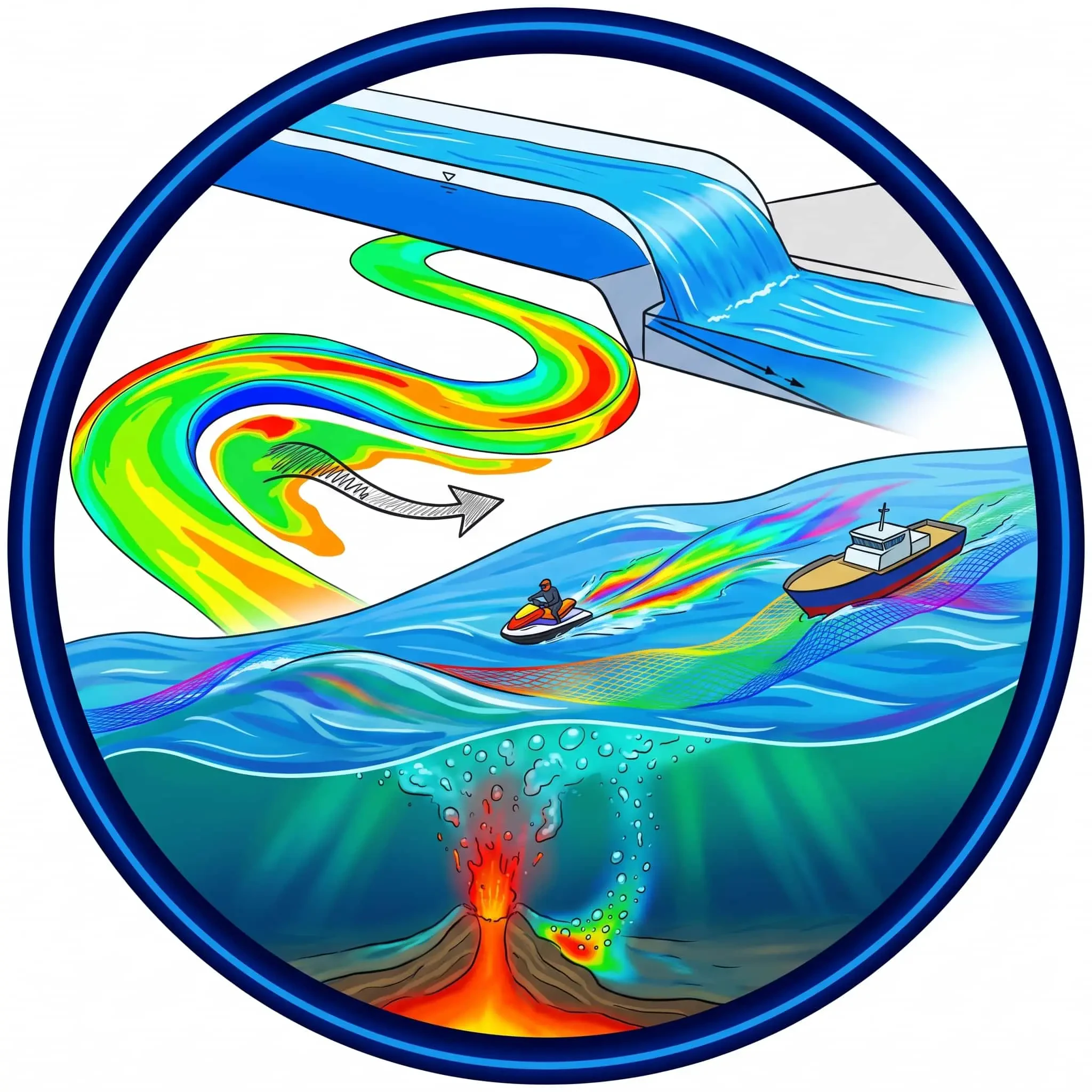
This project simulates sub-oceanic volcanic activity using ANSYS Fluent and the Volume of Fluid (VOF) multiphase model — a complex and critical environmental scenario. Sub-oceanic volcanic eruptions play a crucial role in shaping the planet's oceans and climate, and their accurate simulation supports oceanographic research, ocean engineering, tsunami forecasting, and weather and climate science. The simulation captures the interaction between water, lava, and vapor on the sea floor, combining wave modeling with the extreme thermal effects of an eruption. As the capstone of the Open Channel Flow: Beginner CFD Training Package, it is the most complex and specialized case in the set, bringing together free-surface waves, multiphase interaction, and mass transfer in a single environmental problem.
Methodology
The underwater topography is designed in ANSYS Design Modeler and meshed in ANSYS Meshing with an unstructured grid optimized for a challenging multiphase scenario. The VOF multiphase model is configured to capture the interaction between water, lava, and vapor. The Open Channel Flow model is enabled together with the Open Channel Wave boundary submodel for realistic wave simulation, and Fifth-Order Stokes Wave Theory is implemented for accurate surface-wave patterns. Mass transfer is modeled using the Lee model to represent evaporation and condensation — capturing the vapor generation caused by the extreme eruption temperatures and its effect on the ocean hydrodynamics.
Analysis
Post-processing focuses on the interaction between the eruption and the sea surface: the disruption of the wave patterns due to the volcanic activity, and the hydrodynamic effects of vapor generation on the ocean surface dynamics. From these results you can interpret the complex multiphase behavior, validate the model against known oceanic and volcanic phenomena, and connect the findings to real-world applications such as tsunami prediction, ocean engineering, and climate research. By the end of this project, you'll be able to set up a VOF simulation coupling water, lava, and vapor, apply the open-channel wave submodel with Fifth-Order Stokes wave theory, implement evaporation and condensation with the Lee mass-transfer model, and interpret the wave–eruption interaction that governs this environmental scenario.