Erosion due to Particle Flow in Elbow using DPM CFD Simulation, ANSYS Fluent
Price: $80
- This problem simulates Erosion due to particle flow using Ansys Fluent software.
- The 2-D geometry is designed in Design Modeler software.
- ANSYS Meshing software is used to generate the mesh; the element number equals 14,029.
- In this project, the Erosion due to particle flow is simulated using the DPM
- How the particles flow and lead to the erosion of the solid surface has been well-modeled in this project.
Description
The current project focuses on the numerical simulation of particle motion and erosion in an elbow-shaped pathway using Computational Fluid Dynamics (CFD). The main objectives of this project are to investigate the behavior of particles when they encounter the elbow walls, predict the flow pattern and particle distribution within this geometry, and simulate the erosion caused by particle impacts on the elbow surfaces. The simulation has been carried out using the ANSYS Fluent software and the Discrete Phase Model (DPM) module. The DPM module allows for the tracking of particle trajectories in a Lagrangian manner while considering fluid-particle interactions and modeling particle collisions with the walls. Furthermore, erosion rates and patterns are predicted based on empirical or semi-empirical erosion models, taking into account factors such as particle velocity, impact angle, and material properties. The results obtained from this simulation provide a better understanding of particle transport phenomena and erosion mechanisms in elbow-shaped ducts, which have applications in various industries. The erosion simulation results help identify the regions of the elbow that are most susceptible to erosion damage and are useful in optimizing elbow designs and selecting appropriate materials to minimize erosion effects. The findings of this study can contribute to the development of effective erosion mitigation strategies and improve the reliability, efficiency, and safety of systems involving particle-laden flows in industrial applications.
The DPM (Discrete Phase Model) module is a powerful tool in the ANSYS Fluent software that is used for simulating the behavior of particles in a fluid flow. This module allows users to track the trajectories of particles in a Lagrangian framework while considering the interactions between particles and the fluid.
In this project, a two-dimensional elbow has been designed with a length of 0.04 meters in the x-direction and 0.038 meters in the y-direction. The width of this elbow in the straight sections is considered to be 0.006 meters. The radius of the curvature for the middle section is set to 0.008 meters. The air flow enters the elbow from the inlet with a velocity of 17 meters per second. Additionally, anthracite particles with a diameter of 0.003741 meters are introduced into the elbow from the inlet using a Lagrangian approach, with a velocity of 4 meters per second.
CFD simulation methodology
In this project, the geometry is generated in Design Modeler and meshed in ANSYS Meshing with 14029 elements. In the simulation, the effects of compressibility have been neglected; therefore, a pressure-based solver has been utilized. Furthermore, the results have been obtained for the steady-state condition, and the influence of gravity has also been disregarded. For modeling the turbulent flow, the standard k-epsilon (k-ε) model has been employed. Furthermore, in this project, the DPM (Discrete Phase Model) module has been employed for particle tracking. Within this module, the erosion model is activated to account for erosion. Additionally, an injection has been defined in which the particle type is set as inert and the material is anthracite. The boundary condition type for the discrete phase at the inlet and outlet is defined as “Escape”, while for the walls, “Reflect” is considered. Moreover, all five models, namely Generic, Finnie, McLaury, Oka, and DNV, are activated to account for erosion on the walls.
Conclusion
At the end of the solution process, two-dimensional contours related to pressure, velocity, viscosity and Particle Tracking were obtained. As expected, more erosion has occurred in the middle regions of the elbow due to the higher impact of the particle flow with the solid surface.
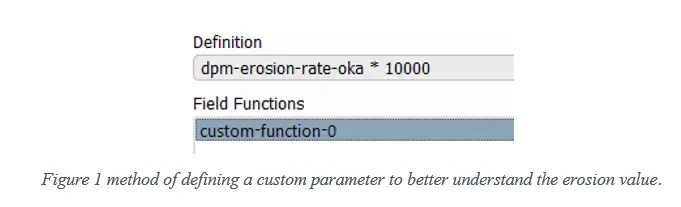
If we take a area-average of the erosion value, we see that the value of this parameter is extremely small, which is difficult to display in the report definition and contour sections due to its small magnitude. Therefore, we define a custom parameter and observe values that are 10,000 times larger. However, note that the actual value is still that extremely small value. The method of defining this custom parameter is shown in Figure 1.
Finally, the maximum erosion rate of DPM (OKA) is obtained as
; Using the custom parameter we defined, which magnifies the erosion values by a factor of 10,000, the maximum erosion rate of is displayed as 0.142 in the output results. This scaled-up value allows for better visualization and analysis of the erosion patterns while keeping in mind that the actual maximum erosion rate remains at .
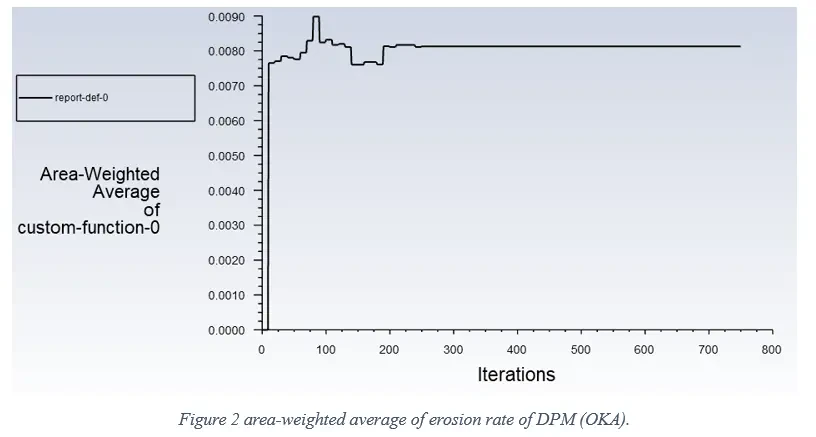
Furthermore, to better understand the erosion values, an area-weighted average has been calculated and displayed in Figure 2. This graph shows the area-weighted average erosion rate over time. The convergence of the graph indicates that the problem has reached a satisfactory level of convergence, meaning that the erosion values have stabilized and the simulation results can be considered reliable. The area-weighted average provides a comprehensive view of the erosion behavior across the entire surface, taking into account the relative sizes of different regions. This information, along with the maximum erosion rate, helps in analyzing and interpreting the erosion patterns and their significance in the context of the study.
By completing this project, you will be able to thoroughly understand the concept of erosion.