

Pollutant Prediction in a Combustion Chamber, ANSYS Fluent CFD Simulation Training
Price: $210
- In this project, the pollutant prediction is simulated inside a combustion chamber by ANSYS Fluent.
- This process will also result in different productions, including pollutants like NOx, SOx, Soot, etc.
- The species transport model is used to analyze the combustion process.
- The Finite Rate / Eddy Dissipation method has been used to investigate the chemical-turbulent interaction of combustion reactants, applying a Probability Density Function (PDF).
- The Ideal Gas equation has also been used to determine the density changes due to temperature changes.

Introduction
Combustion is the result of a chemical process between combustible material and an oxidizing agent associated with the production of heat and the chemical change of raw materials. Heat can be released by producing light in the form of a flame or a glow. Fossil fuels are usually made of organic compounds in the form of gases, liquids, or solids. As mentioned above, burning is a type of oxidation reaction. However, due to the high speed of the combustion reaction, which leads to the production of a high amount of heat in a short time, and the increase in the ambient temperature, and the creation of light and flame, it falls into a particular category. In this study we are going to investigate the pollutant prediction in a combustion chamber.
Project Description
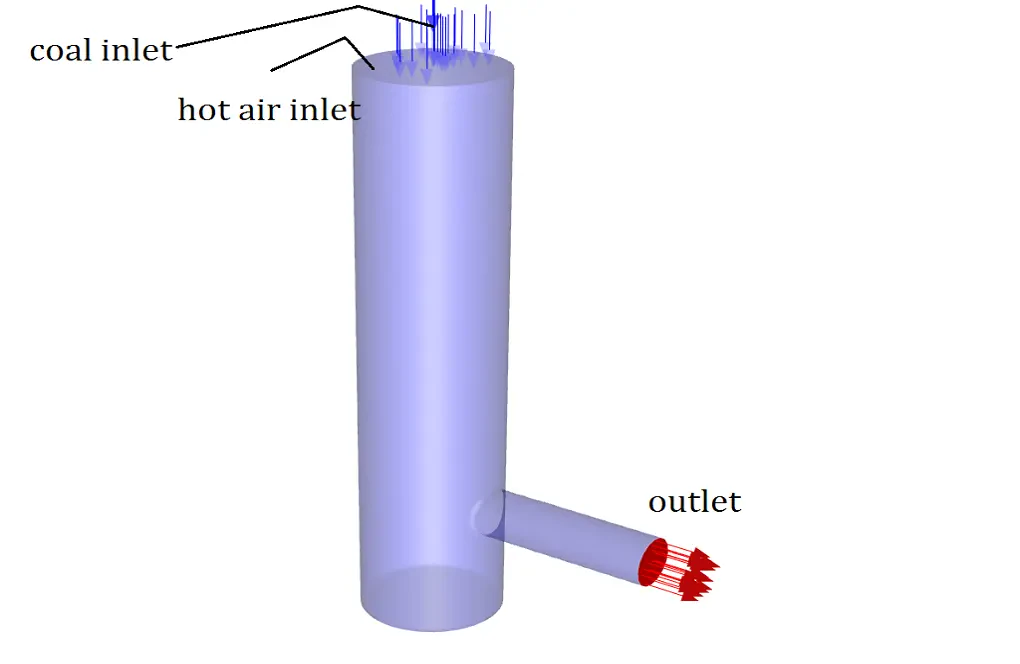
In this project, a combustion reaction is simulated inside a combustion chamber by ANSYS Fluent software. The volatile coal mixture in a gaseous state enters the combustion chamber and mixes with high-temperature airflow (1623 K). As a result, the combustion process takes place. This process will also result in different productions, including pollutants like NOx, SOx, etc., which will be analyzed in this project. The energy equation is activated. K-epsilon Standard viscosity model is used to analyze the mixture's turbulence, and standard wall function is exploited for the regions near the walls.
The species transport model is used to analyze the combustion process. The finite rate Eddy Dissipation method has been used to investigate the chemical-turbulent interaction of combustion reactants, and NOx, SOx, and soot models are activated, and the algebraic approach is used for Turbulence Interaction mode. The ideal gas equation has also been used to determine the density changes due to temperature changes.
Combustion Chamber Geometry & Mesh
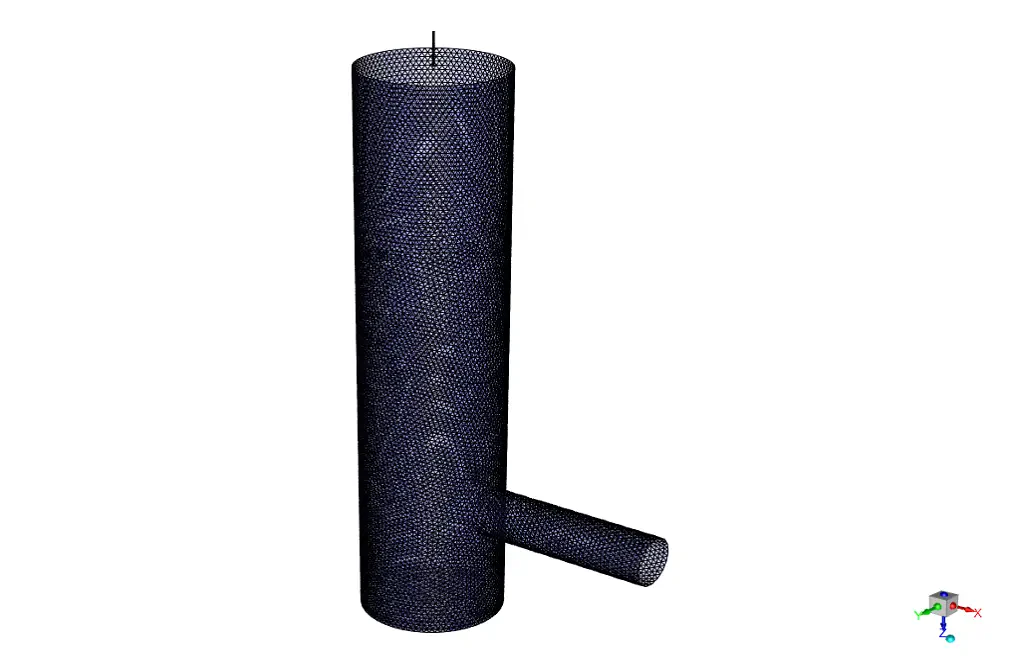
This project's geometry is designed and meshed inside the ANSYS design modeler and meshed in ANSYS meshing software. The mesh type used for this geometry is unstructured, and the total element number is 508367.
Pollutant Prediction CFD Simulation Settings
The critical assumptions considered in this project are:
- Simulation is done using a pressure-based solver.
- The present simulation and its results are considered steady and do not change as a function of time.
- The effect of gravity has not been taken into account.
The applied settings are recapitulated in the following table.
| Models | ||
| Viscous model | k-epsilon | |
| k-epsilon model | standard | |
| near-wall treatment | standard wall function | |
| Energy | on | |
| Species | Species transport | |
| Reactions | Volumetric | |
| Chemistry solver | None-explicit source | |
| Option | Diffusion energy source | |
| Mixture material | Coal-volatiles-air | |
| Turbulence chemistry interaction | Finite rate/Eddy-dissipation | |
| NOx mode | on | |
| Pathways | Thermal NOx + Prompt NOx+Fuel NOx+N2O intermediate | |
Turbulence interaction mode | PDF mode | Temperature/species |
| PDF type | beta | |
| Temperature variance | algebraic | |
| Formation model parameters | ||
| thermal | [O] model | equilibrium |
| Prompt | Equivalence ratio | 1 |
| SOx Formation | on | |
Turbulence interaction mode | PDF mode | Temperature/species |
| PDF type | beta | |
| Temperature variance | algebraic | |
| Soot Model | One-step | |
| Boundary conditions | ||
| Inlet | velocity inlet | |
Coal inlet | Velocity magnitude | 30 m/s |
| Thermal | 300 K | |
| Species (mass fraction) | vol à 1 | |
Hot air inlet | Mass flow rate | 0.031944 Kg/s |
| Thermal | 1623 K | |
| Species (mass fraction) | O2 à 0.21 | |
| Outlet | Pressure outlet | |
| Gauge pressure | 0 Pa | |
| Walls | ||
| wall motion | stationary wall | |
| Heat flux | 0 W/m2 | |
| Species (boundary condition) | Zero diffusive flux | |
| Solution Methods | ||
| Pressure-velocity coupling | SIMPLE | |
| Spatial discretization | pressure | standard |
| momentum | first order upwind | |
| energy | second order upwind | |
| turbulent kinetic energy | first order upwind | |
| turbulent dissipation rate | first order upwind | |
| Species | second order upwind | |
| Pollutants | second order upwind | |
| Initialization | ||
| Initialization method | Standard | |
| gauge pressure | 0 Pa | |
| velocity (x,y,z) | (0,0,1.035874) m/s-1 | |
| temperature | 1423 K | |
| Turbulent kinetic energy | 0.000643821 m2/s2 | |
| Turbulent dissipation rate | 0.0001817394 m2/s3 | |
| O2 | 0.21 | |
| Other species | 0 | |
| pollutants | 0 | |
Results & discussion
When comparing two contours of temperature and NO mass fraction, it can be easily observed that the NOx pollutant is mostly generated at places where the flame has its highest temperature. One way to reduce the generation of this pollution is to reduce the effective temperature of combustion and flame. However, it should be mentioned that lowering the flame temperature will result in an increased amount of generated soot near the flame's advancing edges.
You can obtain Geometry & Mesh file, and a comprehensive Training Movie which presents how to solve the problem and extract all desired results.