

Population Balanced Model Concepts in ANSYS Fluent
Price: Free
- Introduction
- What is the particle state vector?
- What is the number density function?
- Discrete method
- Inhomogeneous discrete method
- Standard moment method
- Quadrature moment method
- DQMOM
- Summary
Population Balanced Model Concepts in ANSYS Fluent
Price: Free
- Introduction
- What is the particle state vector?
- What is the number density function?
- Discrete method
- Inhomogeneous discrete method
- Standard moment method
- Quadrature moment method
- DQMOM
- Summary
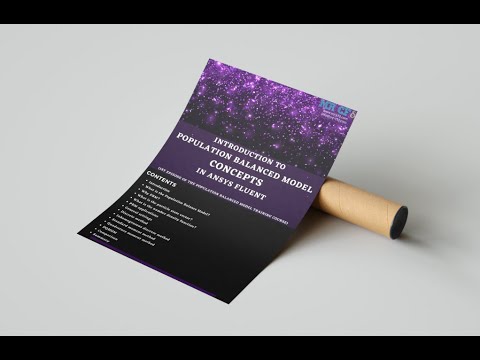
Introduction to Population Balanced Model (PBM) Concepts
The topics we will cover in this session are an introduction to the PBM by explaining some of this model's basic details and underlying physics, such as the particle state vector and number density function.
Next, we talk about the applications of the PBM, where you can see how this model can come to help model-related phenomena. In the next steps, we will talk about the general settings of PBM and introduce the available methods.
Ultimately, the explained methods will be compared, and we will wrap this session up by presenting a summary of the available methods. The topics are as follows:
- Introduction
- What is the Population Balance Model?
- Why PBM?
- What is the particle state vector?
- What is the number density function?
- PBM applications
- General settings
- Discrete method
- Inhomogeneous discrete method
- Standard moment method
- Quadrature moment method
- DQMOM
- Comparison
- Summary
This video is the 1st episode of the Population Balanced Model Training Course.