

Porous Jump in a Perforated Plate CFD Simulation (DPM)
Price: $24
In this project, a Porous Jump, Perforated Plate has been simulated and the results of this simulation have been investigated.
Porous Jump in a Perforated Plate CFD Simulation (DPM)
Price: $24
In this project, a Porous Jump, Perforated Plate has been simulated and the results of this simulation have been investigated.
Porous Jump in a Perforated Plate CFD Simulation, Ansys Fluent Training
Perforated plates have patterns of holes, slots, or decorative shapes. They have a wide area of usage in industrial applications, such as filters, silencers, radiator grilles, ventilation, or separator plates. Porous jump conditions are used to model a thin "membrane'' with known velocity (pressure-drop) characteristics. Examples of uses for the porous jump condition include modeling pressure drops through screens and filters and modeling radiators when you are not concerned with heat transfer. Perforated louvers are generally used indoors to permit air movement from one area to another. Perforated louvers are generally used indoors to permit air movement from one area to another.
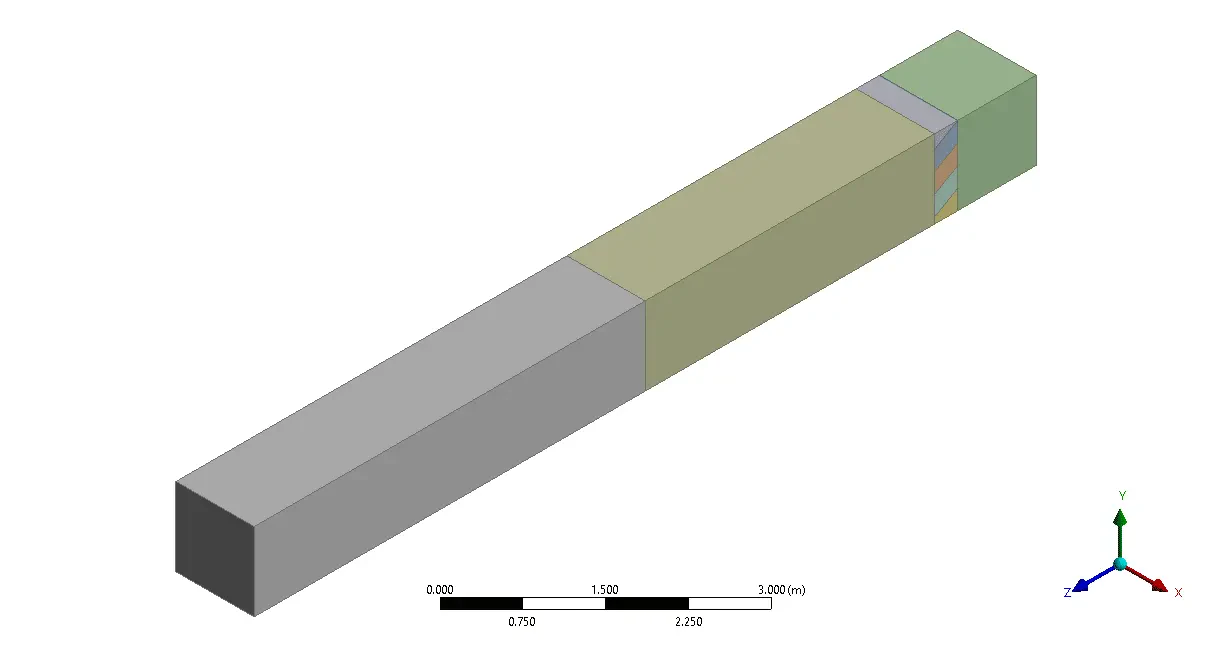
In this project, We used the Ansys Fluent software to simulate the Porous jump, perforated plated louver. The inlet and outlet boundary conditions are velocity inlet and pressure outlet, respectively. The velocity magnitude is 1.5 meters per second. We have introduced a series of fluid flows into a rectangular cube duct and created a porous series to study the flow behavior and heat transfer. The dimensions of this cube are 1*1*10 cubic meters.
Geometry & Mesh
The 3-D geometry of the present model is generated using Design Modeler software.
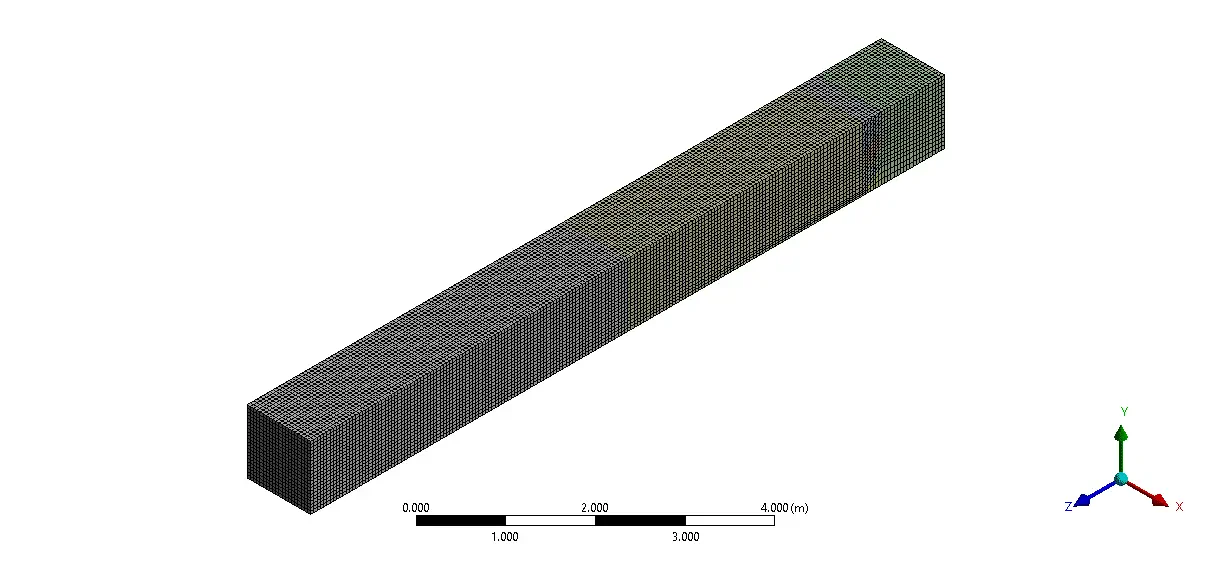
The meshing of the present model has been done using Ansys Meshing software. The mesh type is structured in all of the computational domains, and the element number is equal to 85760.
Model and Solver Sitting
This simulation uses a steady, pressure-based solver with the RNG k-ε turbulence model to capture the shear and recirculation generated by the perforated plate (porous-jump). Air is the working fluid, and the Discrete Phase Model is enabled with one-way coupling to track inert, uniformly sized particles without feedback to the continuous phase. Boundary conditions include a velocity inlet of 1.5 m/s, a pressure outlet at 0 Pa gauge, and stationary no-slip walls; the porous-jump thickness is 0.003 m with the specified pressure-jump coefficient applied to model the plate resistance. DPM settings use Escape at inlet/outlet and Reflect at walls. The case is initialized with Standard Initialization (Compute From: inlet) and advanced with a time scale factor of 1.
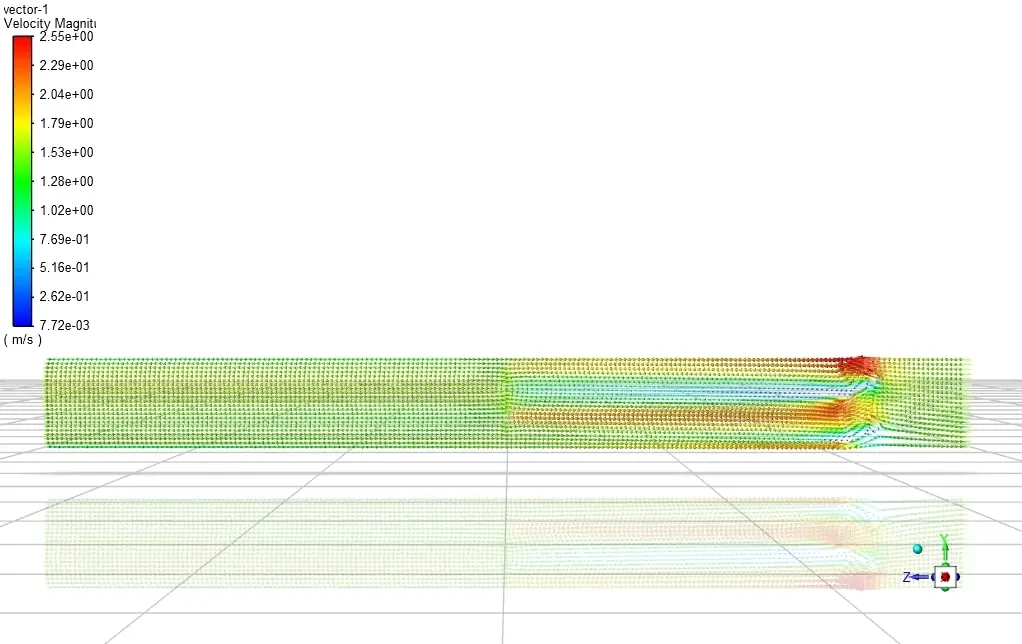
In this simulation, two-dimensional contours related to vectors, velocity, pressure, and contour are fluent and CFD-post software.
Velocity vectors show how the flow is aligned through the perforated plate.
Piping systems often include numerous fittings such as bends (elbows), valves, tees, enlargements and contractions, and many others. Fluids passing through such fittings inevitably emerge as maldistributed flows, which may be undesirable. Consequently, there is a clear need to incorporate fixtures in pipelines to improve flow maldistribution. Perforated plates are a frequently used means of flow homogenization in addition to other flow control applications.