DDPM, Proppant Transport among Multicluster Hydraulic Fractures, Paper Numerical Validation
Price: $320
- The current CFD Analysis Validates the Paper ‘Field-Scale Numerical Investigation of Proppant Transport among Multicluster Hydraulic Fractures’ via ANSYS Fluent software.
- We have designed the geometry using ANSYS Design Modeler software and generated the mesh on this geometry using ANSYS Meshing software. The mesh type is structured.
- The Eulerian multiphase model is used to simulate the proppant.
- The Dense Discrete phase model (DDPM) is used in the simulation.
- The Saffman lift force, virtual mass force, and two-way turbulence coupling models are taken into account.
Proppant Transport among Multicluster Hydraulic Fractures, Paper Numerical Validation
Description
In this project, proppant transport among multicluster hydraulic fractures is simulated using ANSYS Fluent software. The study aims to validate a paper entitled “Field-Scale Numerical Investigation of Proppant Transport among Multicluster Hydraulic Fractures.” Hydraulic fracturing is a process used in the oil and gas industry to stimulate production from reservoirs.
It involves injecting a fluid, typically water mixed with sand and chemicals, under high pressure into a wellbore to create cracks in the deep-rock formations. The sand or similar particulate material, known as proppant, is used to keep these fractures open, allowing oil or gas to flow more freely.
The transport of proppant in these fractures is a critical aspect that affects the efficiency and success of hydraulic fracturing. ANSYS Design modeler designs the model. The computational domain is divided by a structured grid using ANSYS Meshing software.
Methodology of Proppant Transport among Multicluster Hydraulic Fractures
The standard k-epsilon turbulence model is used to predict turbulence effects. In this multiphase project, the secondary phase is considered to be a dense phase. Thus, the Dense Discrete phase model (DDPM) is used along with the Eulerian multiphase model to simulate the proppant. Actually, the carrier, which is the continuous phase, is water liquid.
It's worth mentioning that the discrete phase is solved regarding the 2-way approach. The Saffman lift force, virtual mass force, and two-way turbulence coupling models are taken into account.
Conclusion
As can be seen in the animation, the proppants directly settled down after injection, forming a dune at the bottom of the slot. As shown in contours, proppants were transported to the other end of the slot at 10 seconds of injection. The dune grew quickly in the height dimension.
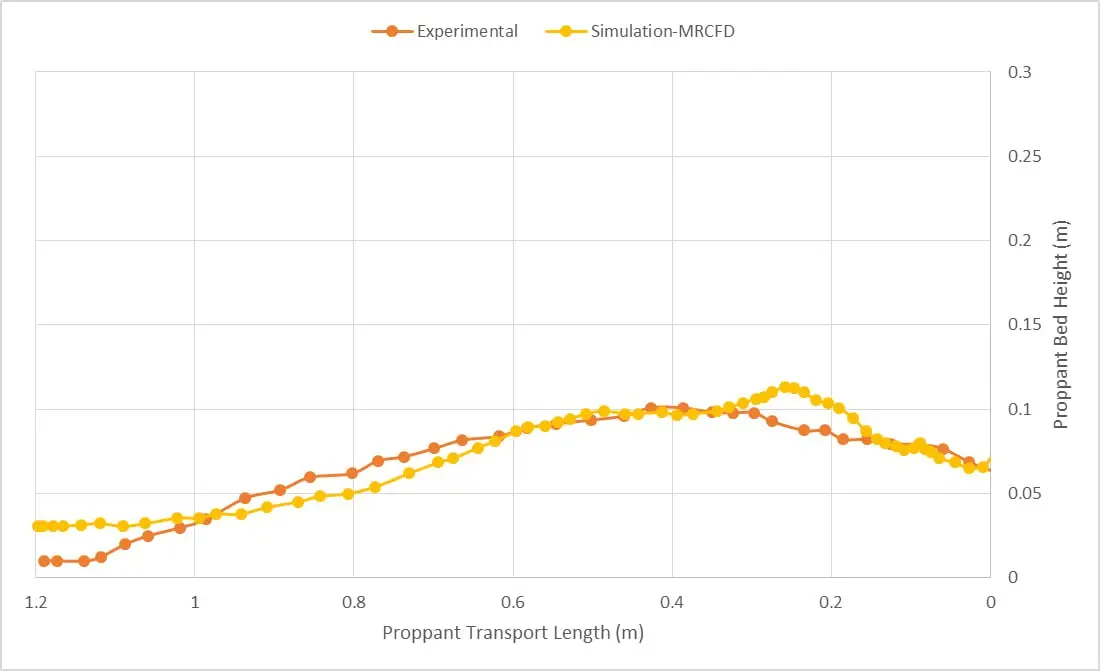
After 17 seconds of simulation, the dune height was almost two times higher than that of 10 seconds. In order to test the accuracy of the simulation, the experimental results that show proppant volume fraction are selected to compare with simulation results. As the figure below shows, the results indicate a good agreement. Based on the measured data, the error is below 12%.