

Sedimentation and Erosion in a Shell and Tube, Ansys Fluent CFD Simulation Training
Price: $140
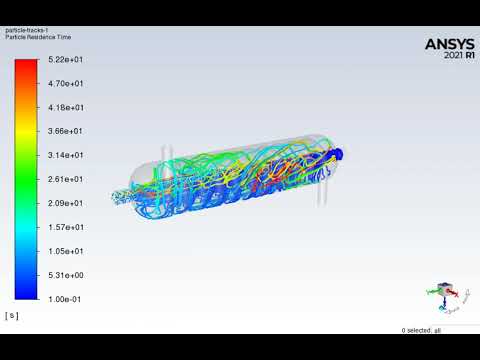
- The problem numerically simulates Sedimentation and Erosion in a Shell and Tube Heat Exchanger using ANSYS Fluent software.
- We design the 3-D model by the Design Modeler software.
- We Mesh the model by ANSYS Meshing software, and the element number equals 640618.
- We perform this simulation as unsteady (Transient).
- We use Discrete Phase Model (DPM) to define Sand Injection inside the heat exchanger.
- We aim to predict the Erosion Effect by different methods: Finnie, Oka, and Mclaury.
Description
The present problem simulates sedimentation and erosion in a shell and tube using ANSYS Fluent software. We perform this CFD project and investigate it by CFD analysis.
The present model is designed in three dimensions using the Design Modeler software. The geometry consists of two-section, 1-shell 2-Tube. The inlet diameters of the shell and tube are 20 cm, and the outlet diameter for both shell and tube is 20 cm.
The meshing of the model was done using ANSYS Meshing software. The element number is 640618.
Also, due to the nature of the problem, the transient solver is enabled.
Sedimentation and Erosion Methodology
In this study, using the DPM (Discrete phase material) method, sedimentation and erosion in a shell and tube were investigated by Ansys Fluent software.
The two-way DPM model, along with the erosion/accretion model, is enabled to accurately investigate the particles' behavior and the erosion phenomenon in the pipe.
Also, rosin-rammler diameter distribution was used to simulate realistic particle distribution inside the domain.
The system consists of two fluids, oil, and water (Water flows in the shell and oil in the tube). Using Ansys Fluent software, the impurity distribution was observed. The software's different erosion models help correctly predict the erosion effect in other cases according to different working conditions.
The velocity inlet of oil and water enters the domain with the speed of 1 m/s with gravity considered as -9.81 m/s-2 on the z-axis. Moreover, the RNG k-epsilon model and energy equation are used to solve the turbulent fluid equations and calculate temperature distribution inside the domain.
Sedimentation and Erosion Conclusion
At the end of the solution process, outlet temperature, velocity, pressure, and erosion for the sedimentation and erosion simulation in a shell and tube are obtained. We see the amount of sand deposition in the shell. Erosion models are first examined.
In model Finnie, like Oka and Mclaury models, uses an empirical correlation to predict erosion. It is used primarily for malleable materials in which the Collision angle and velocity are effective.
The model Oka considers the effect of wall hardness and may be more suitable for investigating the erosion of transmission pipes. Model Mclaury is used to study suspended solids in water and was ideal for the present case.
| zone | The temperature of the inlet(k) | The temperature of the outlet(k) |
| Tube | 900 | 776 |
| shell | 400 | 414.28 |
| zone | oka [kg/m^2] | Mclaury [kg/m^2] |
| Tube | 2.452726e-10 | 3.028e-08 |
| shell | 4.9492331e-09 | 6.43e-07 |