

Series Fans CFD Simulation using MRF Method
Price: $24
- The problem numerically simulates the airflow between two 3-bladed Series Fans using ANSYS Fluent software.
- We design the 3-D model by the Design Modeler software.
- We Mesh the model by ANSYS Meshing software, and the element number equals 1914000.
- We use the Frame Motion to define rotational motion for fan blades.
Series Fans CFD Simulation using MRF Method, ANSYS Fluent Tutorial
In this project, steady air flow is investigated between two 3-bladed Series Fans CFD Simulation rotating at an angular velocity of 300 rpm using ANSYS Fluent software. We perform this CFD project and investigate it by CFD analysis.
The three-dimensional geometry of this project has been designed with spaceclaim software. The meshing of this project has been done with ANSYS Meshing software. The element number is 1914000.
Series Fans Methodology
In this project, steady air flow is investigated between two 3-bladed series fans rotating at an angular velocity of 300 rpm by ANSYS Fluent software. The rotation of fans generates air suction at the inlet boundary with a flow rate of 2.95755 m3/s.
The air velocity reaches values up to 25 m/s on the domain centerline; however, the maximum air velocity in the domain is equal to 47.05 m/s, which is captured downstream of the first fan. Moreover, the RNG k-epsilon model is enabled to solve turbulent fluid equations.
Series Fans Conclusion
At the end of the simulation, two- and three-dimensional contours related to pressure, velocity, velocity vectors, and streamlines are obtained. Also, based on Fluent's calculated data, the air mass flow rate at the inlet equals 3.62019 kg/s.
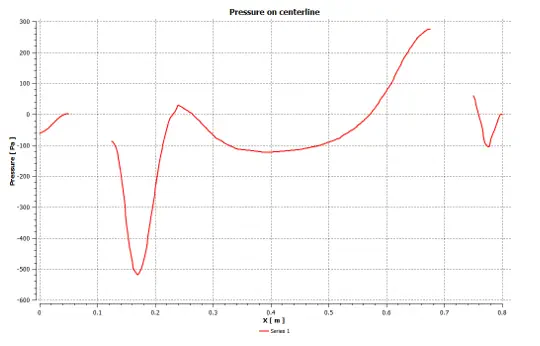
A comparison between the pressure drops of the first and second fan shows that the pressure drops in the first fan have a higher value of 2 times more than the second fan. The pressure drop in the first and second fans equals 500 and 230 Pa, respectively.
Negative gauge pressure is observed downstream of both fans, where the pressure downstream of the first fan is five times less than the dual fan. Gauge pressure downstream of the first and second fan equals -500 and -100 Pa.
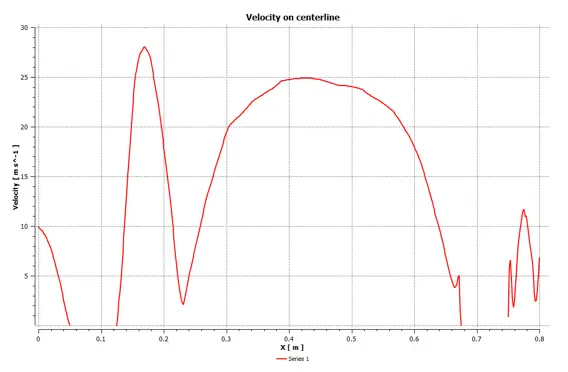
Based on the results obtained from the pressure drop values in both fans, the pressure drop in the first fan is higher, and the velocity magnitude downstream of the first fan has a higher value (28m/s) than the second fan (12m/s).