

Solar Shading Double Glazing façade, Radiation
Price: $24
The present problem simulates the radiation of solar rays into the room's interior considering the effects of a wooden partition as a solar shading, and a double glazing glass of façade, using ANSYS Fluent software.
Solar Shading Double Glazing façade, Radiation
Price: $24
The present problem simulates the radiation of solar rays into the room's interior considering the effects of a wooden partition as a solar shading, and a double glazing glass of façade, using ANSYS Fluent software.
Solar Shading Double Glazing façade, Solar Radiation, ANSYS Fluent CFD Simulation Tutorial
The present problem simulates the radiation of solar rays into the room's interior considering the effects of a wooden partition as a solar shading, and a double glazing glass of façade, using ANSYS Fluent software. Argon gas has accumulated in the space between the two glasses of the double glazing; Because argon gas has low thermal conductivity. Therefore, as an insulating layer, it reduces heat from the outside environment to the room. The Radiation model is used to define the radiant heat transfer due to solar radiation; So the selected radiation model is of type P1. Also, solar ray tracing mode has been activated to define solar radiation.
The room belongs to a region with a latitude and longitude of 24 degrees and 26 degrees and 1 pm, on the 30th day of June. The directions of the sun's rays are obtained based on the longitude and east geographical location of the desired room. The glass walls adjacent to the room are defined as semi-transparent; That is, the sun's rays relative to these walls have all three modes of absorption, diffusion, or reflection. However, the solar shading of this space acts as an opaque body and only allows the sun's rays to be absorbed and reflected and does not allow the rays to pass.
Geometry & Mesh
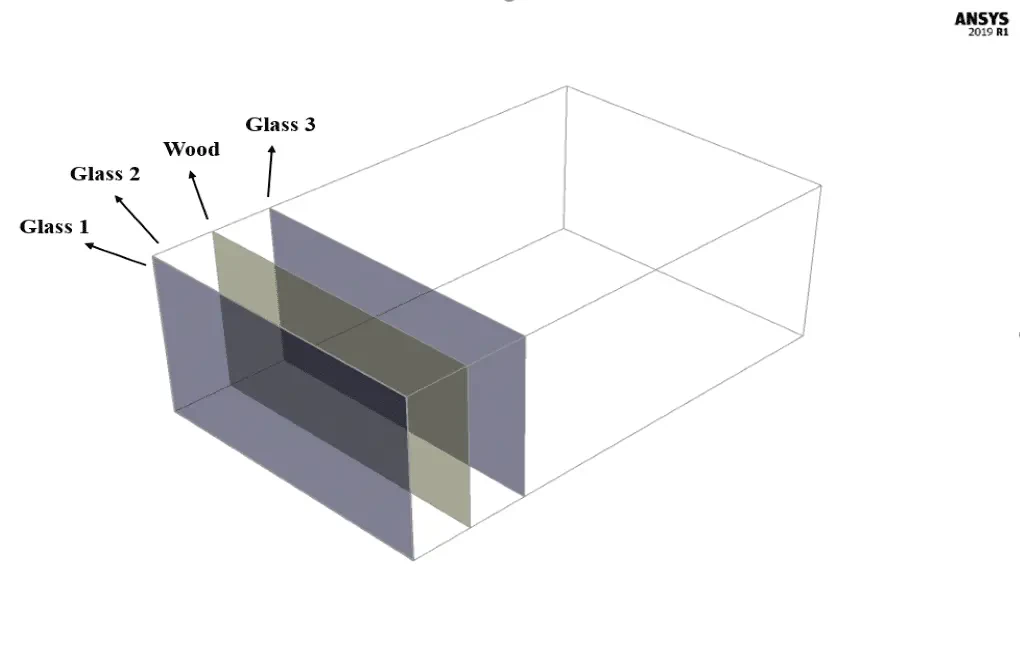
The present model is designed in three dimensions using Design Modeler software. The present model belongs to a room connected to space with a wooden partition as solar shading and a double glazing façade. The desired room has a depth of 6 m, a width of 5 m, and a height of 3 m. Also, the space between the glasses of the double glazing is equal to 2 mm.
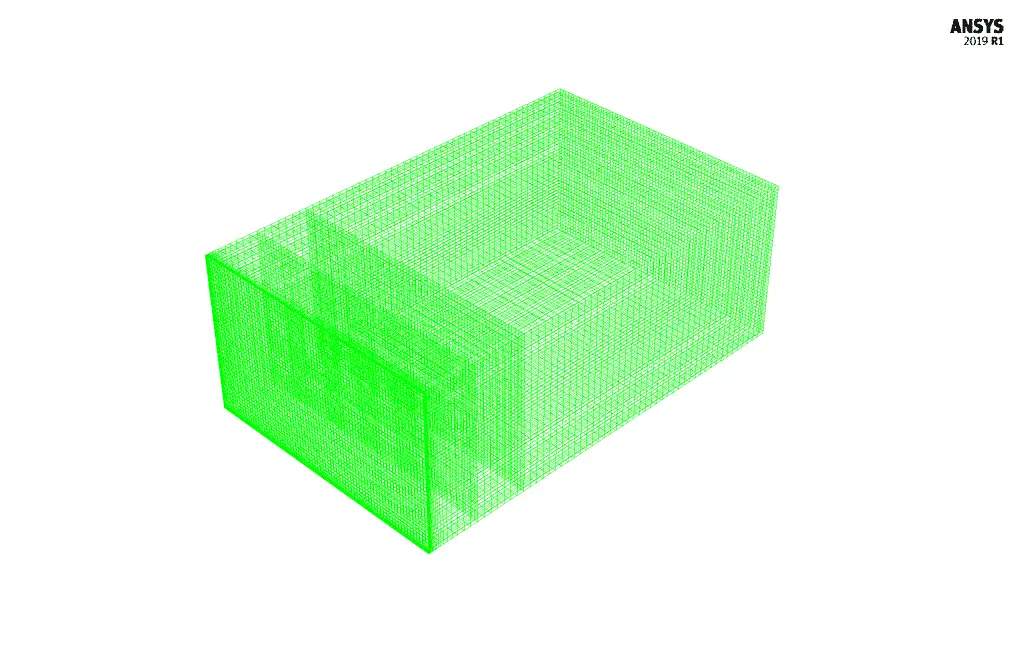
We carry out the model's meshing using ANSYS Meshing software. The mesh type is structured. The element number is 239760. The following figure shows the mesh.
CFD Simulation
We consider several assumptions to simulate the present model:
- We perform a pressure-based solver.
- The simulation is steady.
- The gravity effect on the fluid is ignored.
The following table represents a summary of the defining steps of the problem and its solution:
| Models | ||
| Viscous | k-epsilon | |
| k-epsilon model | standard | |
| near-wall treatment | standard wall function | |
| Radiation Model | P1 | |
| solar load model | solar ray tracing | |
| Energy | On | |
| Boundary conditions | ||
| Glass 1 | Wall | |
| wall motion | stationary wall | |
| thermal condition | convection | |
| heat transfer coefficient | 20 W.m-2.K-1 | |
| free stream temperature | 310 K | |
| BC type | semi-transparent | |
| Glass 2 & Glass 3 | Wall | |
| wall motion | stationary wall | |
| thermal condition | coupled | |
| BC type | semi-transparent | |
| Wood | Wall | |
| wall motion | stationary wall | |
| thermal condition | coupled | |
| BC type | opaque | |
| Room & Argon Wall | Wall | |
| wall motion | stationary wall | |
| thermal condition | convection | |
| heat transfer coefficient | 20 W.m-2.K-1 | |
| free stream temperature | 310 K | |
| BC type | opaque | |
| Methods | ||
| Pressure-Velocity Coupling | SIMPLE | |
| pressure | second order | |
| density | second-order upwind | |
| momentum | second-order upwind | |
| turbulent kinetic energy | first-order upwind | |
| energy dissipation rate | first-order upwind | |
| energy | second-order upwind | |
| Initialization | ||
| Initialization methods | Standard | |
| gauge pressure | 0 pascal | |
| velocity (x,y,z) | 0 m.s-1 | |
| temperature | 310 K | |
Results
At the end of the solution process, two-dimensional and three-dimensional contours related to temperature, pressure, and velocity are obtained. Also, velocity vectors are obtained in two dimensions from the passing screen in the middle of the model. The results show that airflow circulation inside the model's interior spaces and the temperature increase inside the domain due to solar radiation is quite evident.