

Turbulent Asymmetric Vortex Flame CFD Simulation, Paper Numerical Validation
Price: $32
- The current CFD Analysis numerically Validates the Paper "Computational and experimental investigations of turbulent asymmetric vortex flames" via ANSYS Fluent software.
- We have designed and meshed the geometry using GAMBIT®, producing unstructured 375,534 cells.
- The Species Transport model is used to simulate the reaction.
- The turbulent flow is simulated using these turbulence models: RNG k-epsilon, Realizable k-epsilon, Standard k-epsilon, k-omega, Spalart Almaras and Reynolds stress.
Description
In this project, a turbulent asymmetric vortex flame created in a novel asymmetric combustor is simulated using ANSYS Fluent software. The study aims to validate a paper entitled "Computational and experimental investigations of turbulent asymmetric vortex flames."
The intricate interplay between vortical structures inside a turbulent flow and combustion processes is what defines a turbulent asymmetric vortex flame. Asymmetric vortices vary in size, shape, and intensity from symmetrical vortices, which are homogeneous and predictable. This results in a less predictable and more chaotic flame structure. High Reynolds numbers within such a flame drive the turbulent flow, suggesting that inertial forces predominate over viscous forces. This leads to a highly entangled flame front and a wide range of eddy diameters. Heat transport and mixing are improved by the contact of the flame front with the vortices, which is essential for effective combustion.
Turbulent asymmetric vortex flames are commonly encountered in various engineering applications, including Combustion Engines, Industrial Furnaces, Power Generation, etc.
The geometry of this project is designed and meshed inside GAMBIT®. The mesh type used for this geometry is unstructured and the total element number is 375,534 cells.
Methodology
The species transport model is used to analyze the combustion process. A mixture of air and methane is used as the fuel mixture. The eddy-Dissipation method has been used to investigate the chemical-turbulent interaction of combustion reactants. Also The incompressible-ideal-gas equation has been used for the density of mixture properties.
Conclusion
As the most important result that provides the temperature distribution along the position, simulating this problem with the different turbulence models, shows that the RNG k-epsilon model gives a very close result to the experimental data.
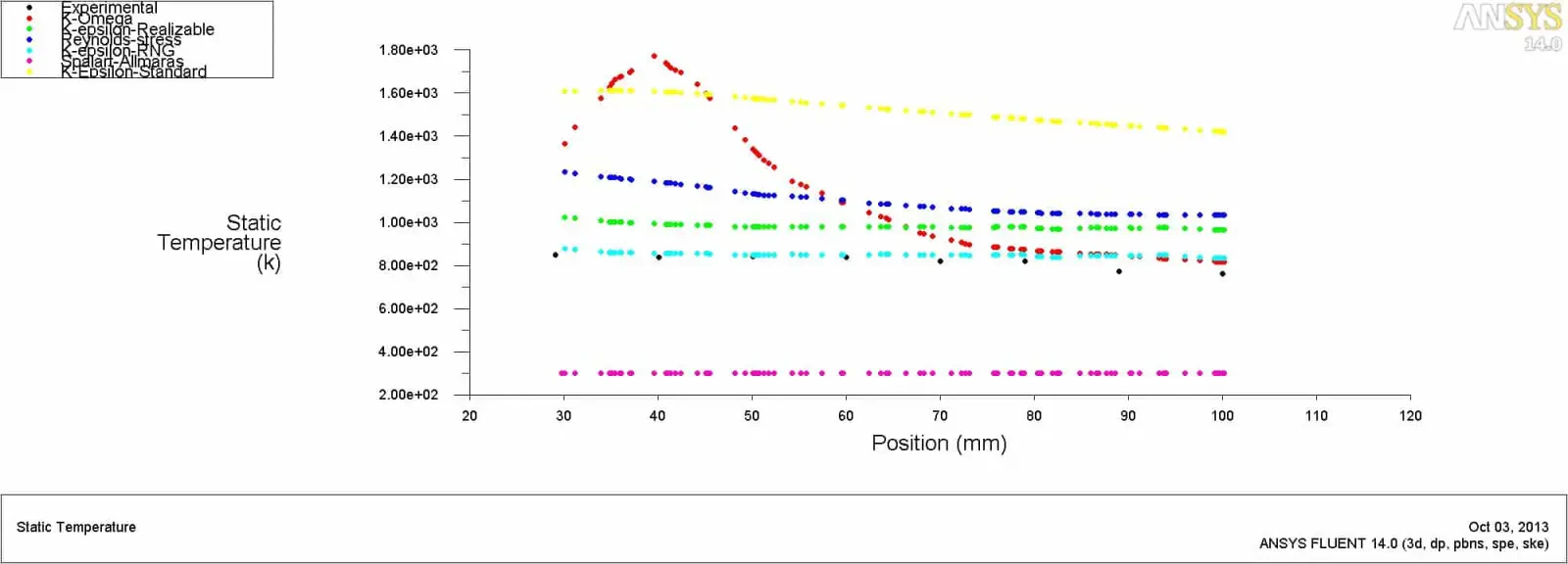
Also, different contours of velocity, pressure, temperature, species mass fraction, etc. are presented.