

UAV & Drone GOLDEN Training Package
Price:
$37,459
$1,799
MR CFD's UAV and Drone CFD Simulation GOLDEN Training Package empowers engineering teams, professors, institutes, and companies with over 50 ANSYS Fluent tutorials spanning beginner to advanced levels, transforming novices into experts in UAV aerodynamics, FSI, static/dynamic stability derivatives, acoustic analysis, and more. 1-year unlimited expert support, 3 months HPC access, and continuous updates backed by 15 years of MR CFD expertise, delivering high ROI and competitive edge in UAV simulation challenges.
Price: $809
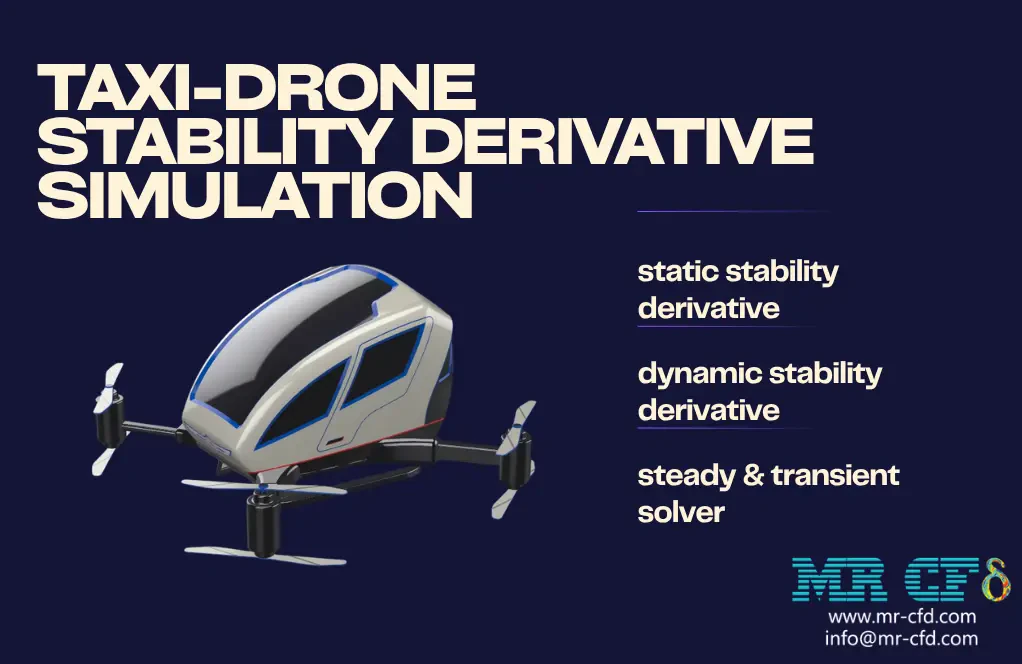
The problem numerically simulates a Taxi-Drone using ANSYS Fluent software. We design the 3-D model with the SpaceClaim software. We mesh the model with Ansys Meshing software. The element number equals 7,518,888 and their type is Tetrahedral. In this simulation, Forced oscillation are used for Stability Derivative modeling.
Price: $649
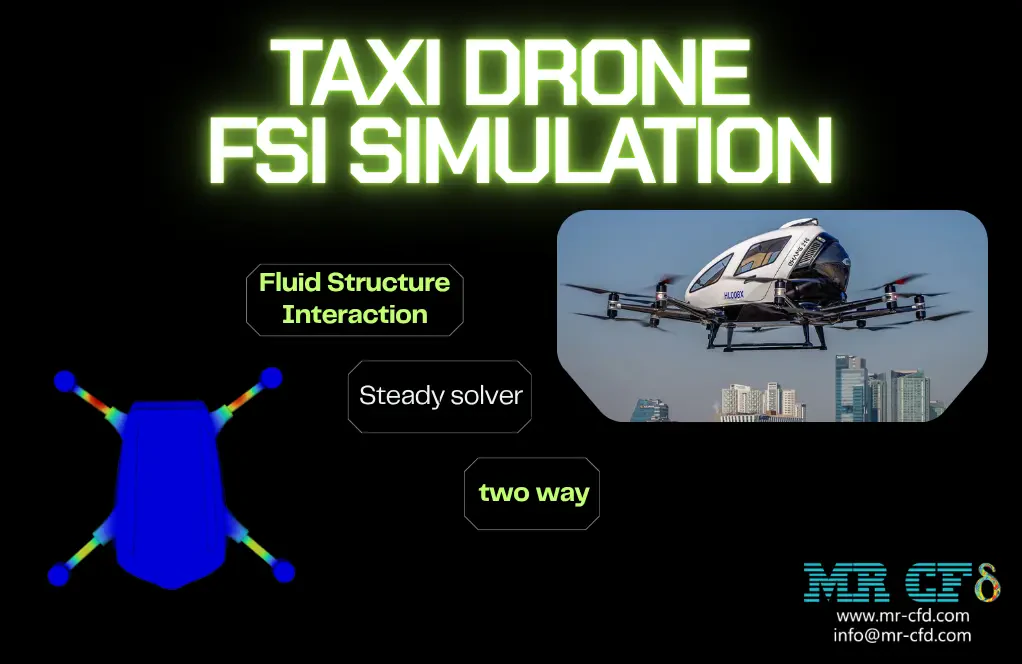
The problem numerically simulates a Taxi Drone using ANSYS Fluent software. We design the 3-D model with the SpaceClaim software. We mesh the model with Ansys Meshing software. The element number equals 9,998,951 and their type is Tetrahedral. In this simulation, Dynamic Mesh is used for FSI modeling.
Price: $809
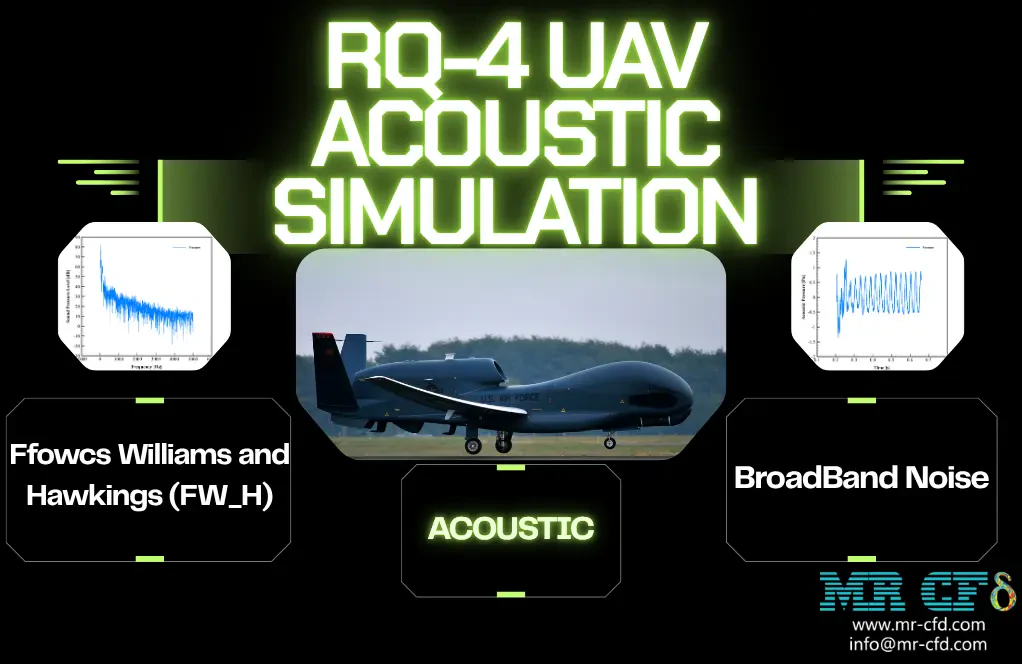
The problem numerically simulates a RQ-4 UAV using ANSYS Fluent software. We design the 3-D model with the SpaceClaim software. We mesh the model with Ansys Meshing software. The element number equals 11,364,707 and their type is Tetrahedral. In this simulation, FW_H and BroadBand Noise are used for acoustic modeling.
Price: $809
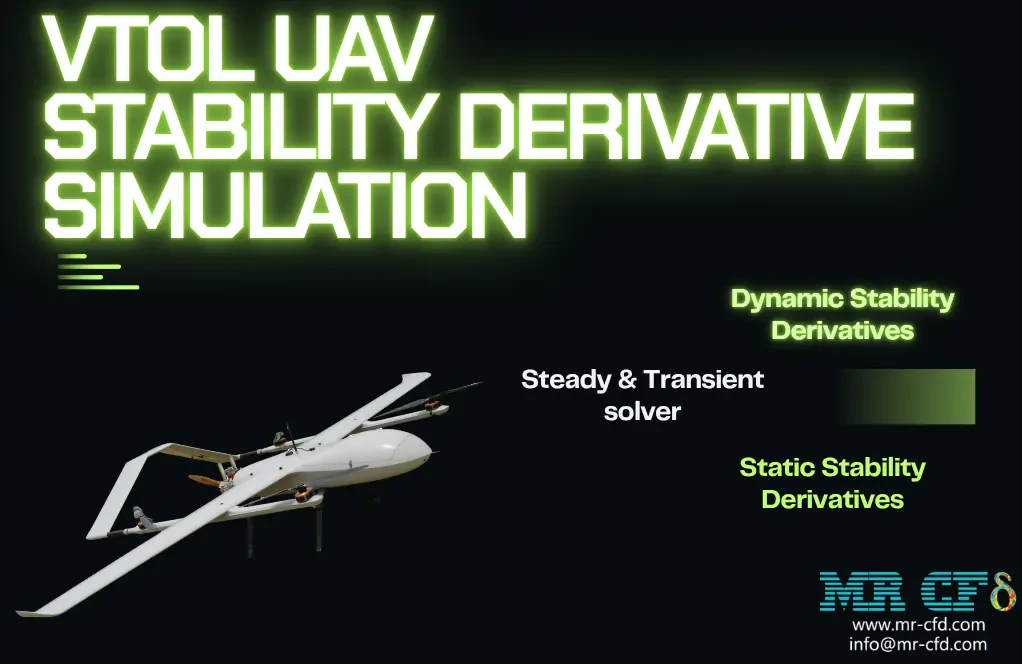
The problem numerically simulates a VTOL UAV using ANSYS Fluent software. We design the 3-D model with the SpaceClaim software. We mesh the model with Ansys Meshing software. The element number equals 4,420,514 and their type is Tetrahedral. In this simulation, Forced oscillation are used for Stability Derivative modeling.
Price: $809
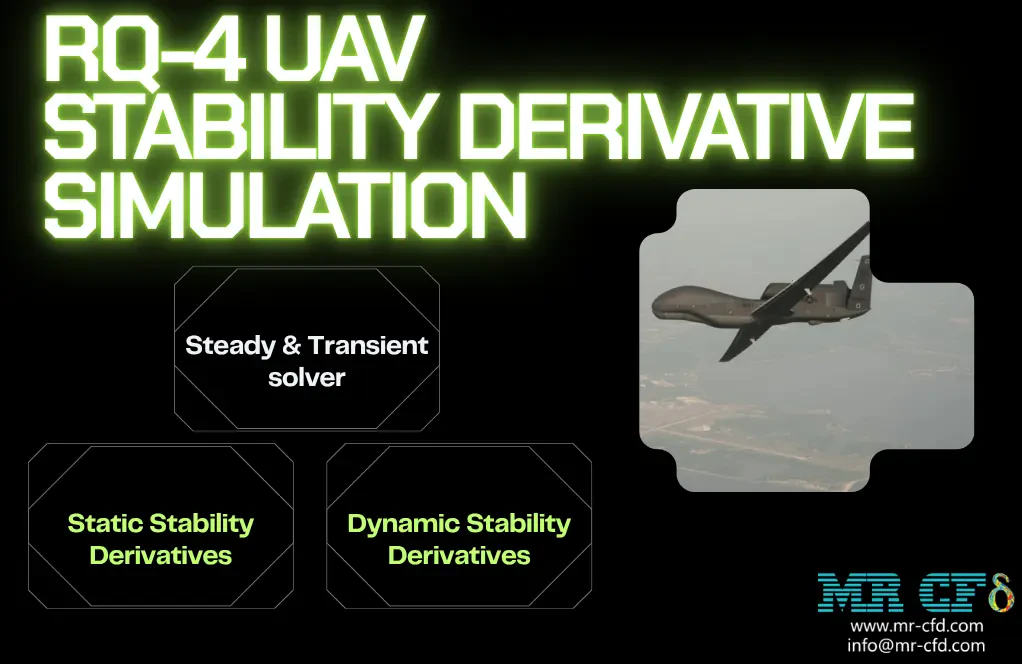
The problem numerically simulates a RQ-4 UAV using ANSYS Fluent software. We design the 3-D model with the SpaceClaim software. We mesh the model with Ansys Meshing software. The element number equals 9,730,964 and their type is Tetrahedral. In this simulation, Forced oscillation are used for Stability Derivative modeling.
Price: $649
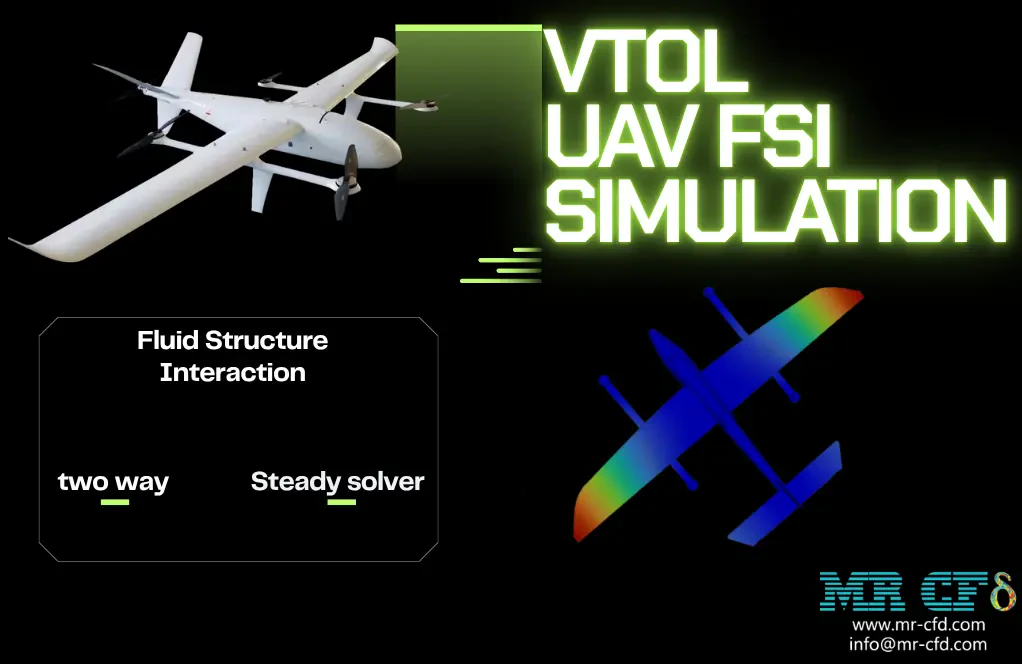
The problem numerically simulates a VTOL UAV using ANSYS Fluent software. We design the 3-D model with the SpaceClaim software. We mesh the model with Ansys Meshing software. The element number equals 2,659,245 and their type is Tetrahedral. In this simulation, Dynamic Mesh is used for FSI modeling.
Price: $649
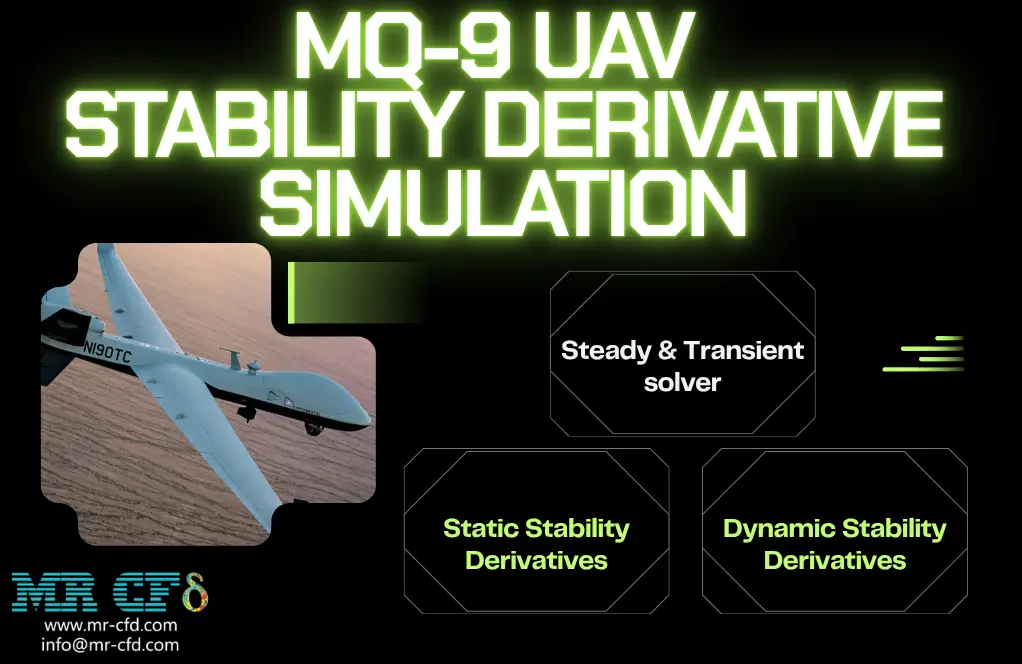
The problem numerically simulates a MQ-9 UAV using ANSYS Fluent software. We design the 3-D model with the SpaceClaim software. We mesh the model with Ansys Meshing software. The element number equals 6,046,061 and their type is Tetrahedral. In this simulation, Forced oscillation are used for Stability Derivative modeling.
Price: $649
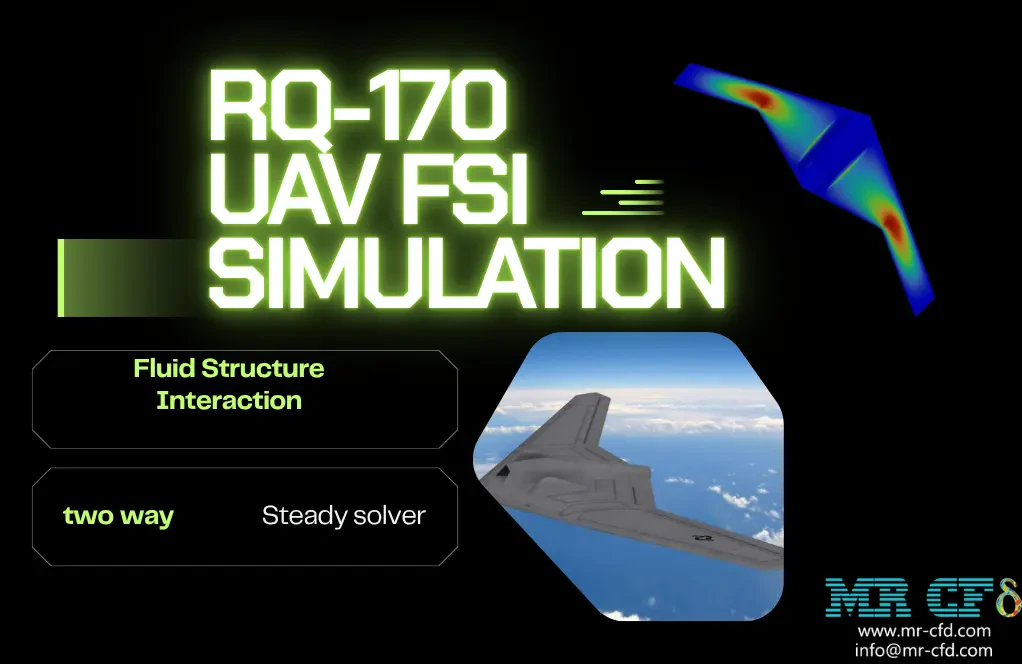
The problem numerically simulates a RQ-170 UAV using ANSYS Fluent software. We design the 3-D model with the SpaceClaim software. We mesh the model with Ansys Meshing software. The element number equals 19,537,805 and their type is Tetrahedral. In this simulation, Dynamic Mesh is used for FSI modeling.
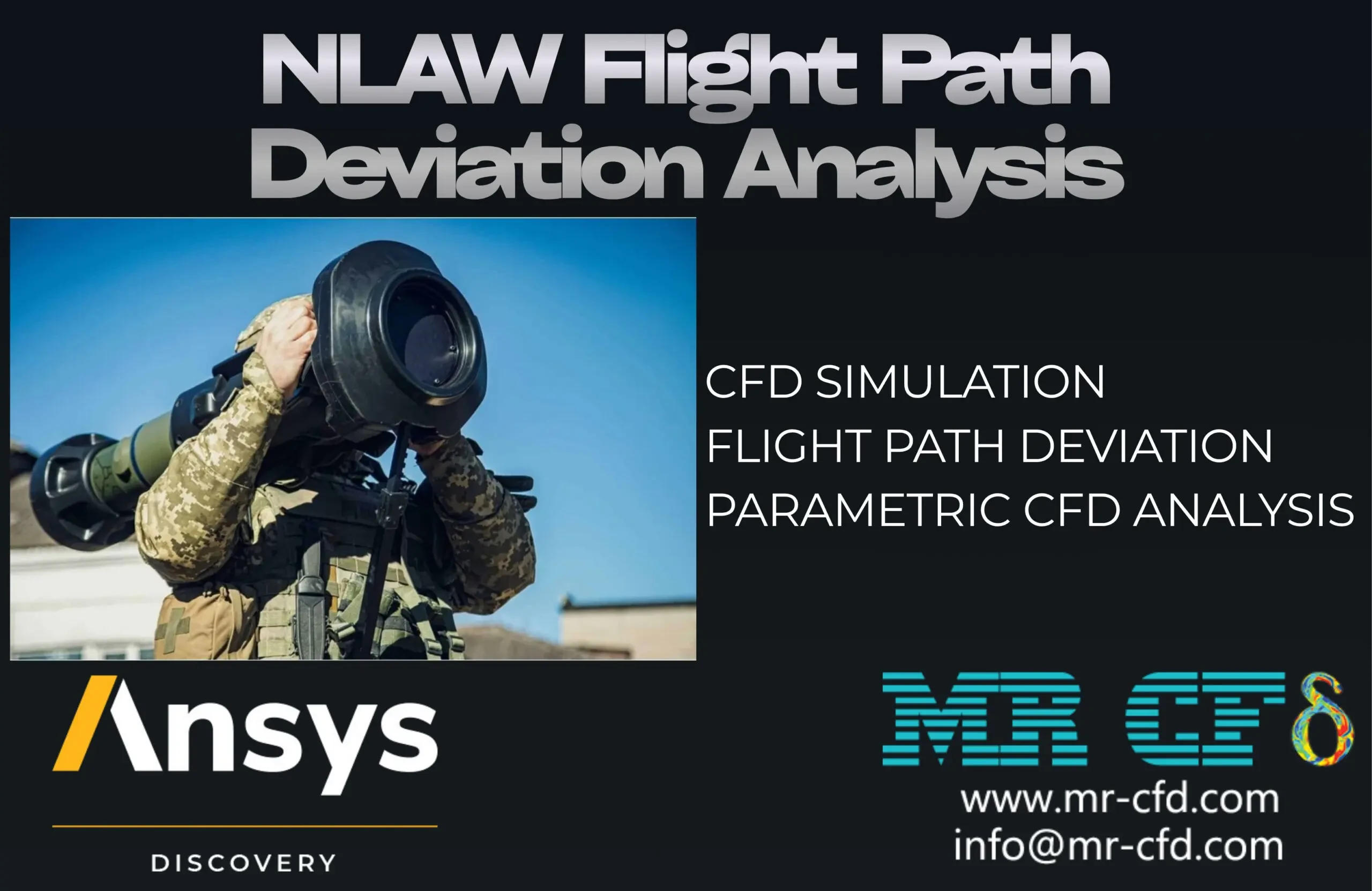
Price: $409
Parametric CFD analysis of NLAW fin angles (1°-25°). 3D flight path deviation from the straight-line trajectory for each fin incidence angle. Pitch and Yaw deviation of NLAW missile.

The Complete UAV and Drone CFD Course: +75 Simulations by ANSYS Fluent is a specialized training solution for engineers, universities, drone companies, aerospace teams, defense research groups, professors, institutes, technical managers, and CFD specialists who need practical simulation capability for unmanned aerial vehicle analysis.
Developed by MR CFD, this course is part of MR CFD’s professional CFD Training online and Complete CFD Courses is designed specifically for UAV and drone engineering. Unlike a general aerodynamics or aerospace course, this complete CFD course focuses on drone platforms, fixed-wing UAVs, quadcopters, VTOL aircraft, military UAV models, stability derivatives, fluid-structure interaction, acoustic analysis, rotor performance, and advanced UAV flight-related CFD simulations.
The course is also offered as the UAV and Drone GOLDEN Training Package, giving buyers access to a dedicated all-in-one UAV simulation library for academic, industrial, and defense-oriented engineering applications.
Why Choose This Complete UAV CFD Course?
This course is built for buyers who need practical UAV simulation readiness, not only general aerodynamic theory. It helps engineering teams, academic departments, aerospace companies, and defense-oriented research groups train users faster, reduce design uncertainty, and standardize CFD workflows across UAV and drone projects.
| Business Need | How This Complete CFD Course Solves It |
| Faster UAV engineering onboarding | New engineers can learn from complete, pre-built drone CFD projects instead of scattered tutorials. |
| Specialized drone simulation focus | The course is dedicated to UAVs, drones, VTOL systems, quadcopters, flying wings, rotors, FSI, acoustics, and stability analysis. |
| Defense and military UAV relevance | Learners study engineering simulations related to ISR UAVs, tactical drone platforms, reconnaissance drones, and military-style unmanned aircraft. |
| Academic teaching support | Professors can use the simulations as practical teaching material for aerospace, mechanical, defense, and UAV engineering programs. |
| Enterprise workflow consistency | Teams can follow proven workflows for UAV aerodynamics, stability derivatives, acoustic analysis, and structural response. |
| Real project readiness | Learners work with applied CFD simulations based on fixed-wing UAVs, quadcopters, VTOL drones, cycloidal rotors, and named drone platforms. |
A Specialized UAV and Drone CFD Course, Not a General Aerospace Bundle
This complete course is intentionally different from broader aerodynamics and aerospace CFD training. General aerospace packages may cover aircraft, nozzles, propulsion, turbomachinery, airfoils, and high-speed flow as wide categories. This course focuses specifically on UAV and drone CFD analysis.
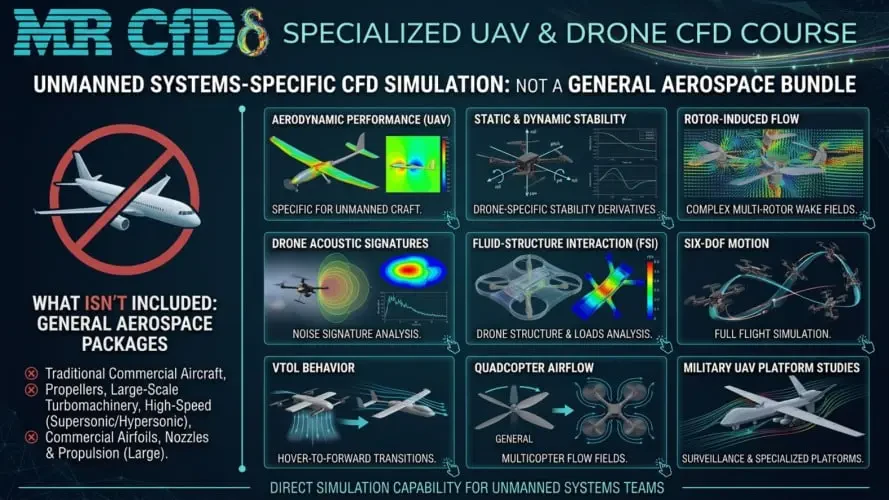
It is built for teams that need direct simulation capability for unmanned aerial vehicles, including aerodynamic performance, static and dynamic stability derivatives, rotor-induced flow, drone acoustic signatures, fluid-structure interaction, six-DOF motion, VTOL behavior, quadcopter airflow, and military UAV platform studies.
| Feature | Complete UAV and Drone CFD Course | General Aerodynamics / Aerospace CFD Course |
| Main focus | UAVs, drones, VTOL aircraft, quadcopters, flying wings, military UAV models, and stability analysis | Broad aerospace topics such as airfoils, aircraft, propulsion, nozzles, turbines, and high-speed flow |
| Best for | UAV engineers, drone companies, defense researchers, aerospace teams, universities, and CFD specialists | General aerospace engineers and aerodynamic design teams |
| Technical depth | Focused UAV aerodynamic analysis, FSI, acoustic analysis, rotor effects, and dynamic stability derivatives | Wider but less specialized coverage across aerospace applications |
| Military relevance | Stronger focus on defense-style UAV platforms, ISR drones, tactical UAV analysis, and unmanned aircraft behavior | Broader aerospace applications with less dedicated UAV specialization |
| Purchase motivation | Build complete drone and UAV CFD capability | Build general aerospace CFD capability |
Complete CFD Training for UAV, Drone, and Defense Engineering Teams
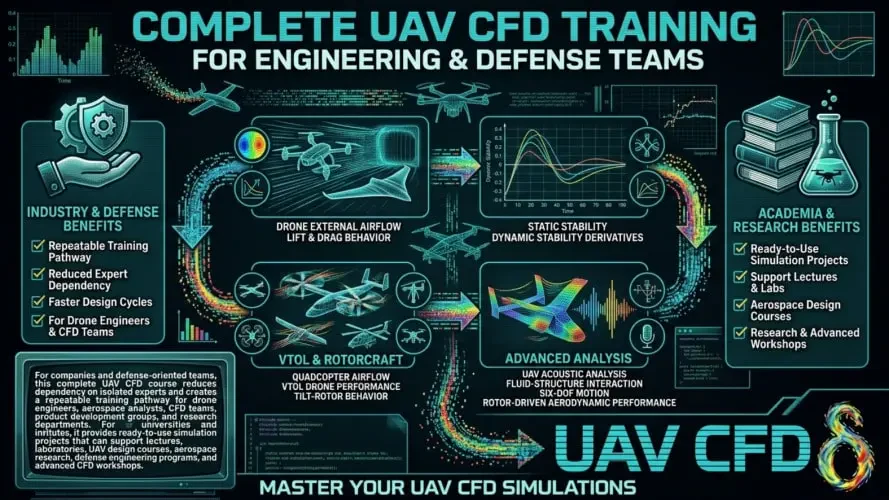
This course gives your organization a structured path to UAV CFD mastery. It supports users who need to simulate drone external airflow, lift and drag behavior, static stability, dynamic stability derivatives, quadcopter airflow, VTOL drone performance, tilt-rotor behavior, flying wing configurations, UAV acoustic analysis, fluid-structure interaction, six-DOF motion, and rotor-driven aerodynamic performance.
For companies and defense-oriented teams, this complete UAV CFD course reduces dependency on isolated experts and creates a repeatable training pathway for drone engineers, aerospace analysts, CFD teams, product development groups, and research departments. For universities and institutes, it provides ready-to-use simulation projects that can support lectures, laboratories, UAV design courses, aerospace research, defense engineering programs, and advanced CFD workshops.
What You Get in This UAV and Drone CFD Course
| Included Asset | Value for the Buyer |
| +75 CFD simulation projects | A specialized UAV and drone CFD library in one complete course package. |
| Step-by-step tutorials | Practical guidance from geometry creation to final post-processing. |
| Complete simulation workflows | Geometry, meshing, solver setup, aerodynamic force analysis, stability evaluation, acoustic results, and engineering interpretation. |
| Advanced UAV case studies | Coverage of fixed-wing UAVs, quadcopters, VTOL drones, military UAV models, FSI, acoustics, stability derivatives, and six-DOF motion. |
| 1 year of technical support | Direct support from MR CFD experts for course users. |
| 3 months of HPC access | Additional computational resources for selected learning and simulation needs. |
| Regular course enhancements | Continued value through updates for emerging UAV and drone simulation fields such as theoretical drone design and advanced unmanned aircraft analysis. |
UAV and Drone CFD Topics Covered in This Complete Course
This complete CFD course covers a focused range of unmanned aircraft simulations, from basic UAV external airflow to advanced military UAV models, stability derivatives, rotor systems, FSI, and acoustic analysis.
| Training Area | Covered Topics |
| UAV external aerodynamics | External airflow around UAV bodies, lift and drag prediction, pressure distribution, wake behavior, and aerodynamic performance analysis. |
| Fixed-wing UAV CFD | Skywalker X8, Skywalker X5, ScanEagle, RQ-11, RQ-7, Bayraktar, flying wing aircraft, and UAV aerodynamic evaluation. |
| Military UAV simulation | RQ-series UAVs, reconnaissance drone platforms, ISR-style UAV analysis, Global Hawk, Bayraktar, Switchblade 300 reference studies, and defense-oriented unmanned aircraft CFD. |
| Quadcopter CFD analysis | Quadcopter aerodynamic analysis, rotor-induced flow, downwash behavior, lift prediction, stability behavior, acoustic analysis, and FSI-related studies. |
| VTOL and tilt-rotor drones | VTOL drone simulations, tilt-rotor drone analysis, taxi drone studies, transition-related aerodynamic behavior, and vertical lift performance. |
| Dynamic stability derivatives | Stability derivative extraction for UAVs, drones, flying wings, quadcopters, and fixed-wing unmanned aircraft. |
| Static stability analysis | Pitching, yawing, and rolling behavior, aerodynamic moment evaluation, center of pressure effects, and stability-related flow interpretation. |
| Fluid-structure interaction | UAV and drone FSI, structural response to aerodynamic loading, wing deformation effects, rotor-related coupling, and flexible component behavior. |
| Acoustic analysis | UAV noise prediction, drone acoustic signatures, quadcopter acoustic behavior, rotor noise, and aeroacoustic post-processing. |
| Cycloidal rotor CFD | Cycloidal rotor performance, geometric effects, 2D and 3D rotor analysis, paper validation, and advanced rotor concepts. |
| Six-DOF and dynamic mesh | Six-DOF motion simulation, dynamic mesh methods, UAV motion response, moving body analysis, and trajectory-related CFD behavior. |
| Agricultural and civil drones | Agricultural drone sprayer analysis, low-altitude drone airflow, high-altitude drone airflow, and mission-oriented aerodynamic studies. |
Advanced UAV CFD Modules Included in this Complete Engineering and Military UAV/Drons Course
This complete course includes advanced simulation categories that help engineers move beyond basic drone airflow analysis and into professional-grade UAV performance evaluation.
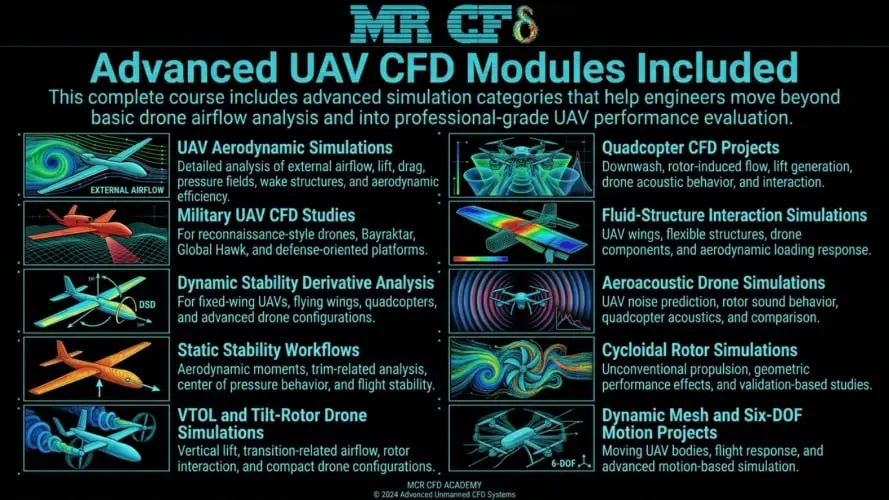
Key advanced modules include:
UAV aerodynamic simulations for external airflow, lift, drag, pressure fields, wake structures, and aerodynamic efficiency.
Military UAV CFD studies for reconnaissance-style drones, RQ-series UAVs, Bayraktar, Global Hawk, and defense-oriented unmanned aircraft platforms.
Dynamic stability derivative analysis for fixed-wing UAVs, flying wings, quadcopters, and advanced drone configurations.
Static stability workflows for aerodynamic moments, trim-related analysis, center of pressure behavior, and flight stability interpretation.
VTOL and tilt-rotor drone simulations for vertical lift, transition-related airflow, rotor interaction, and compact drone configurations.
Quadcopter CFD projects for downwash, rotor-induced flow, lift generation, drone acoustic behavior, and aerodynamic interaction.
Fluid-structure interaction simulations for UAV wings, flexible structures, drone components, and aerodynamic loading response.
Aeroacoustic drone simulations for UAV noise prediction, rotor sound behavior, quadcopter acoustics, and acoustic performance comparison.
Cycloidal rotor simulations for unconventional UAV propulsion, geometric performance effects, and validation-based rotor studies.
Dynamic mesh and six-DOF motion projects for moving UAV bodies, flight response, and advanced motion-based simulation.
Complete UAV CFD Course vs Standard Drone Tutorials
<div class="compare-chart">
| Feature | Complete UAV and Drone CFD Course | Standard Drone CFD Tutorial |
| Main purpose | Comprehensive CFD training for UAV and drone analysis | Single-topic learning for one drone model or workflow |
| Best for | UAV companies, defense teams, universities, professors, aerospace engineers, drone R&D groups, and CFD specialists | Individual learners studying one basic simulation |
| Content depth | +75 applied UAV and drone CFD simulations | Limited number of cases |
| Project variety | Fixed-wing UAVs, military drones, quadcopters, VTOL, tilt-rotors, FSI, acoustics, stability derivatives, and six-DOF motion | Usually limited to external airflow or one rotor case |
| Military relevance | Includes defense-oriented UAV platforms and military-style unmanned aircraft analysis | Usually no dedicated military UAV positioning |
| Business value | Reduces training cost, accelerates onboarding, and standardizes UAV CFD capability | Builds knowledge in a narrow CFD task |
</div>
Who Should Buy This Complete UAV and Drone CFD Course?
This course is ideal for UAV engineers, drone manufacturers, aerospace companies, defense contractors, military research institutes, university professors, aerospace students, CFD specialists, R&D teams, product development groups, technical managers, and advanced engineering practitioners.
It is especially valuable for organizations that want to train multiple users, reduce repeated onboarding, support academic UAV programs, standardize drone CFD workflows, and improve internal simulation capability for unmanned aerial vehicle design and analysis.
Business Benefits of Buying This Complete UAV CFD Course
| ROI Driver | Business Impact |
| Faster UAV onboarding | New engineers become productive sooner on drone and UAV CFD projects. |
| Reduced external training dependency | Teams can learn from a complete internal UAV simulation resource. |
| Better workflow consistency | Engineers follow proven UAV CFD workflows instead of scattered tutorials. |
| Lower project risk | Teams learn from pre-built, practical drone and unmanned aircraft examples. |
| Stronger academic outcomes | Instructors can assign realistic UAV CFD projects for aerodynamics, stability, FSI, and acoustics. |
| Faster design improvement | Teams can evaluate UAV lift, drag, stability, rotor performance, noise, and structural response more efficiently. |
| Higher long-term value | One complete course supports repeated training across departments, students, interns, and new employees. |
Why This Complete CFD Course Is Built for Direct Purchase
When your team needs serious UAV and drone CFD capability, buying isolated tutorials one by one creates gaps, duplicated effort, and inconsistent learning outcomes. This complete course removes that friction by giving you a specialized UAV simulation library in one purchase.
You get practical training built around real unmanned aircraft applications, including fixed-wing UAVs, military UAV platforms, VTOL drones, quadcopters, tilt-rotor drones, cycloidal rotors, dynamic stability derivatives, FSI, acoustic analysis, six-DOF motion, agricultural drones, and low-altitude or high-altitude drone airflow studies. That makes this course a strong choice for buyers who want immediate access to a deep, organized, and commercially valuable UAV CFD learning system.
So...
Invest in the UAV and Drone GOLDEN Training Package: +75 CFD Simulations by ANSYS Fluent and give your team a complete UAV CFD training system built for advanced aerospace, defense, academic, and industrial applications.
Whether you manage a university lab, a drone development company, an aerospace CFD department, a defense research group, a UAV design team, or a technical training center, this course helps you reduce training time, improve simulation quality, and build long-term internal expertise.
Instead of purchasing separate tutorials and managing disconnected learning materials, choose one complete UAV CFD course that delivers depth, technical support, HPC access, and practical project readiness in a single solution.
FAQ for Complete UAV CFD Course
What is included in the Complete UAV and Drone CFD Course?
The course includes +75 CFD simulation projects covering UAV aerodynamics, drone airflow, fixed-wing UAVs, quadcopters, VTOL drones, tilt-rotor drones, military UAV platforms, stability derivatives, FSI, acoustic analysis, cycloidal rotors, and six-DOF motion.
Who is this UAV CFD course designed for?
This course is designed for UAV engineers, drone companies, aerospace teams, defense research groups, CFD specialists, university professors, research institutes, technical managers, and advanced users who need practical drone CFD training.
Is this course different from a general aerodynamics CFD course?
Yes. A general aerodynamics course covers broad topics such as airfoils, aircraft, nozzles, and high-speed flows, while this course focuses specifically on UAVs, drones, VTOL aircraft, quadcopters, military UAV models, stability derivatives, FSI, and acoustic analysis.
Does this course cover military UAV CFD simulation?
Yes. The course includes defense-oriented UAV studies such as RQ-series drones, Bayraktar, Global Hawk, reconnaissance-style UAV platforms, and military unmanned aircraft CFD analysis for engineering and research purposes.
Does this course include drone stability derivative analysis?
Yes. The course covers static and dynamic stability derivatives for UAVs, flying wings, quadcopters, and fixed-wing drone configurations, helping learners evaluate aerodynamic stability behavior.
Are quadcopter and VTOL drone simulations included?
Yes. The course includes quadcopter CFD analysis, VTOL drone simulations, tilt-rotor drone studies, rotor-induced flow, downwash behavior, lift performance, acoustic analysis, and advanced drone configurations.
Does this UAV CFD course include FSI and acoustic analysis?
Yes. The course includes fluid-structure interaction projects for UAV components and aeroacoustic simulations for drone noise prediction, quadcopter sound behavior, rotor noise, and UAV acoustic signatures.
Can universities use this course for UAV engineering education?
Yes. Professors and instructors can use the course as a ready-made library of UAV CFD case studies for lectures, laboratories, assignments, workshops, research projects, and advanced aerospace or defense engineering programs.
Is technical support included after purchasing the course?
Yes. Buyers receive 1 year of non-limited technical support from MR CFD experts, helping learners and teams resolve technical questions related to the course simulations.
Why should I buy this complete UAV CFD course instead of separate drone tutorials?
Buying this complete UAV CFD course gives you a broader, more organized, and more cost-effective training solution. It supports team-wide learning, reduces repeated training costs, and gives access to a specialized UAV and drone CFD simulation library in one purchase.