

UAV External Airflow CFD Simulation, ANSYS Fluent Tutorial
Price: Free
- The problem numerically simulates the airflow around a drone (UAV External Airflow) using ANSYS Fluent software.
- We design the 3-D model by the CATIA software.
- We mesh the model with Gambit software, and the element number equals 3079338.
Description
In this project, the airflow around a drone is simulated (UAV External Airflow) by ANSYS Fluent software.
UAVs can be considered small drones. One of the essential advantages of drones is their remote control capability, which has made them particularly popular in the aviation and military industries. The design of UAVs requires special care and consideration.
Since drone flight is done through remote control commands, there has been much effort to pay special attention to the structural design of these aircraft in terms of aerodynamics. Simulating the airflow around a UAV is crucial to studying aerodynamic forces, stability, and, ultimately, good designs.
Using simulation software such as ANSYS Fluent can significantly reduce the costs of designing, constructing, and testing these complicated structures.
UAV Methodology
Due to the high speed of airflow during flight and the possibility of very high separation in such flows, the standard k-epsilon model using standard wall functions is exploited to analyze the airflow turbulence and better investigate the separation of the flow from the surface.
Considering the high sensitivity in the design of the drone’s body, the initial geometry required for this analysis was generated in CATIA, completed in spaceclaim, and meshed inside Ansys Meshing. The mesh type used for this geometry is unstructured, and the element number is 3,079,338.
UAV Conclusion
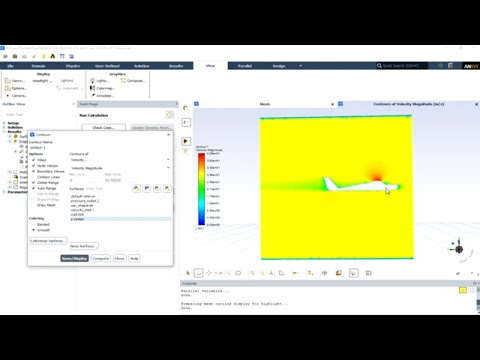
At the end of the solution, we obtain contours of pressure, velocity, streamlines, and velocity vectors. The maximum pressure and velocity occur in the front and at the top of the UAV, respectively.
The maximum velocity is about 43 m/s, while the airflow speed is 30 m/s, which shows the velocity increase due to the UAV structure. Also, vortexes, flow separation, and lots of practical results are extracted and analyzed in this product.