

Wind Driven Rain (1-way Vs. 2-way) DPM, Ansys Fluent CFD Simulation Training
Price: $100
In this project, wind-driven rain has been simulated, and the results of this simulation have been investigated.
Wind Driven Rain (1-way Vs. 2-way) DPM, Ansys Fluent CFD Simulation Training
Price: $100
In this project, wind-driven rain has been simulated, and the results of this simulation have been investigated.

Wind Driven Rain (1-way Vs. 2-way) DPM, Ansys Fluent CFD Simulation Training
Project Description
In the Wind Driven Rain project, numerical simulation of wind-driven rain has been done using Ansys Fluent software. The purpose of this project is to investigate the movement of raindrops in wind conditions of 5 meters per second, which has been done in two ways, one-way DPM and two-way DPM. The diameter of the drops is 0.5 cm but in order to be seen better, they have been scaled in contours and animation.
Geometry & Mesh
The two-dimensional geometry of Wind Driven Rain project has been produced with Spaceclaim software. The length of the computational area is 20 m and its height is 10 m.
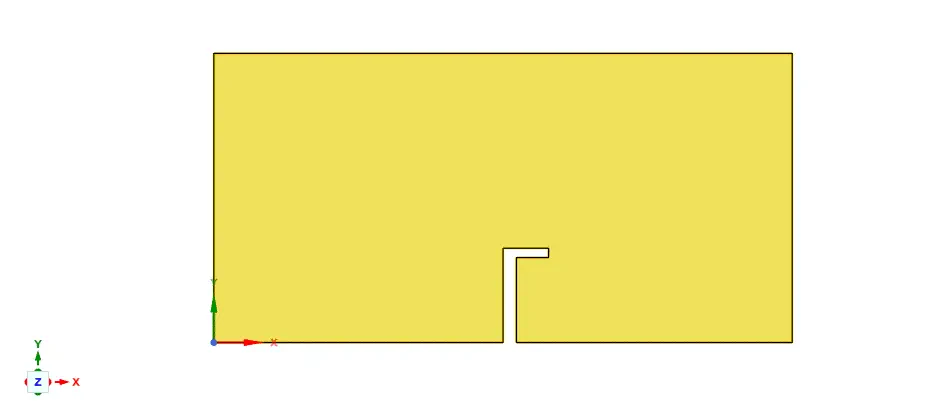
The meshing of this present model has been generated by Ansys Meshing software. The mesh grid is unstructured and the total cell number is 19741.
Wind-Driven Rain CFD Simulation
To simulate the present model, we consider several assumptions:
The solver is pressure-based and transient.
The present simulation is unsteady in terms of time.
The gravity effect is equivalent to -9.81 m.s-1.
Here is a summary of the steps for defining the problem and its solution in the following table:
| Models | |||
| Viscous model | Spalart Allmaras | ||
| Discrete phase | on | ||
| particle treatment | unsteady particle tracking | ||
| material in injection | anthracite | ||
| particle type in injection | inert | ||
| injection type | group | ||
| Boundary conditions | |||
| Inlet | Velocity inlet | ||
| velocity magnitude | 5 m.s-1 | ||
| discrete phase BC type | reflect | ||
| Outlet | Pressure outlet | ||
| gauge pressure | 0 Pascal | ||
| discrete phase BC type | escape | ||
| bottom | Wall | ||
| wall motion | stationary wall | ||
| discrete phase BC type | trap | ||
| Solution Methods | |||
| Pressure-velocity coupling | simple | ||
| Spatial discretization | pressure | second-order | |
| momentum | second-order upwind | ||
| Modified turbulent viscosity | first-order upwind | ||
| Initialization | |||
| Initialization method | hybrid | ||
Wind-Driven Rain Results
According to the animation and speed and pressure counters, it is clear that solving this problem in the form of a one-way coupling was sufficient and there was no need to solve a two-way coupling. We know that in two-way couplings, the momentum effects of particles on the fluid are also calculated. Therefore, it has a much larger computational volume than one-way couplings, and in simulations where the number and size of particles are very large, these effects must be considered.