

Wire Mesh Demister (DDPM), Paper Numerical Validation, ANSYS Fluent CFD Training
Price: $280
The present problem simulates the flow of water vapor passing through a demister containing saline water droplets using ANSYS Fluent software. This simulation is based on the information of a reference article "Eulerian–Lagrangian modeling and computational fluid dynamics simulation of wire mesh demisters in MSF plants," and its results are compared and validated with the results in the article.
Paper Description
The present problem simulates the flow of water vapor passing through a demister containing saline water droplets using ANSYS Fluent software. This simulation is based on the information from a reference article, "Eulerian–Lagrangian modeling and computational fluid dynamics simulation of wire mesh demisters in MSF plants," Its results are compared and validated with the results in the article. This demister is related to a multistage flash (MSF) desalination system. This demister consists of a metal wire mesh set responsible for separating the saltwater droplets in the water vapor stream. Therefore, to define the flow in this modeling, it is necessary to define a multiphase flow model.
In the present simulation, the Eulerian-Lagrangian perspective on computational fluid dynamics (CFD) is used; So that the Eulerian multiphase model is coupled with the dense discrete phase model (DDPM). So a continuous phase is defined, which is related to water vapor, and a discrete phase is defined, related to salt water droplets. Water vapor enters from the bottom of the system along with discrete droplets of salt water and exits the top after passing through the metal wire mesh. This work aims to investigate the amount of pressure drop due to the passage of flow through these wire mesh. Water vapor enters the system with a temperature of 373.15 K and a speed of 2-4 m.s-1.
Paper Description
The saltwater droplets have a density equal to 1300 kg.m-3 and a specific heat capacity equal to 3900 j.kg-1.K-1 and have a diameter equal to 0.00001 m and a temperature equal to 373.15 K and a velocity equal to With 2-4 ms-1 and mass flow equal to 1 * e-50 kg.s-1 enter from the bottom of the system.
Wire Mesh Geometry & Mesh
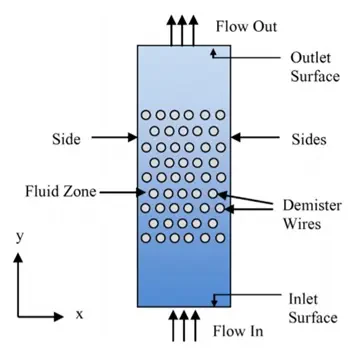
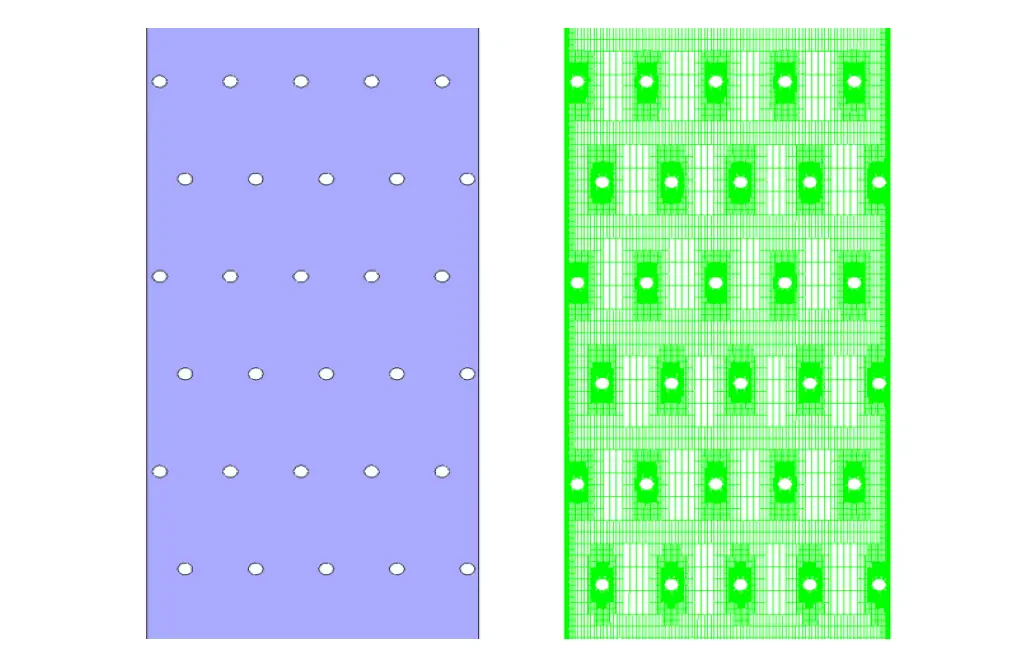
The present model is designed in three dimensions using Design Modeler software. This model includes a three-dimensional chamber that has a height of 0.14 m and has 48 rows of holes as metal wire mesh, in each row, there are 5 holes. Since this model has geometric symmetry, the lateral aspects of the model are defined as symmetry. We carry out the model's meshing using ANSYS Meshing software. The mesh type is structured. The element number is 186933. The following figure shows the Mesh.
Wire Mesh CFD Simulation
We consider several assumptions to simulate the present model:
- We perform a pressure-based solver.
- The simulation is steady.
- The gravity effect on the fluid equals -9.81 m.s-2 along the Y-axis.
The following table represents a summary of the defining steps of the problem and its solution:
| Models | |||
| Viscous | k-epsilon | ||
| k-epsilon model | standard | ||
| near-wall treatment | standard wall function | ||
| Multiphase model | Eulerian | ||
| dense discrete phase model | On | ||
| number of eulerian phases | 1 | ||
| number of discrete phases | 1 | ||
| Discrete Phase Model | Interaction with Continuous Phase | ||
| Energy | On | ||
| Boundary conditions | |||
| Inlet | Velocity Inlet | ||
| discrete phase BC type | escape | ||
| primary phase | velocity magnitude | 2, 3, 4 m.s-1 | |
| temperature | 373.15 K | ||
| Outlet | Pressure Outlet | ||
| discrete phase BC type | escape | ||
| gauge pressure | 0 pascal | ||
| Holes | Wall | ||
| wall motion | stationary wall | ||
| heat flux | 0 W.m-2 | ||
| Mirrors 1, 2, 3, 4 | Symmetry | ||
| Methods | |||
| Pressure-Velocity Coupling | Phase Coupled SIMPLE | ||
| pressure | PRESTO | ||
| momentum | first-order upwind | ||
| turbulent kinetic energy | first-order upwind | ||
| turbulent dissipation rate | first-order upwind | ||
| energy | first-order upwind | ||
| Initialization | |||
| Initialization methods | Standard | ||
| gauge pressure | 0 pascal | ||
| primary phase | y-velocity | 2, 3, 4 m.s-1 | |
| temperature | 373.15 K | ||
| discrete phase | y-velocity | 2, 3, 4 m.s-1 | |
| temperature | 373.15 K | ||
| the volume fraction of discrete phase | 0.00001 | ||
Paper Validation
The validation of the present paper is based on the diagram in Figure 6 of the mentioned article. This graph is related to the changes in the amount of pressure drop between the bottom and top of the demister at different values of the inlet steam velocity. This diagram is related to a situation where the diameter of metal wires equals 0.24 mm. The amount of pressure drop in each inlet steam velocity value is obtained and compared with the results in the article and validated.
| Pressure Drop (Pascal) | ||||
| Present Simulation | El-Dessoulky et al (2000) | CFD Predictions (reference paper) | Experimental Data | |
| 54.13 | 66.56 | 62.89 | 65.27 | Velocity = 2 m.s-1 |
| 88.19 | 92.48 | 80.82 | 84.27 | Velocity = 3 m.s-1 |
| 130.42 | 116.24 | 102.85 | 103.93 | Velocity = 4 m.s-1 |
Results
At the end of the solution process, two-dimensional contours related to temperature, velocity, and volume fraction of each continuous (water vapor) and discrete (saline water droplets) phase are obtained. These contours correspond to a state where the incoming steam velocity's value equals 2 m.s-1. As can be seen from the pictures, as the steam flows upwards, the number of discrete droplets of saline water dissolved in the steam decreases.