

Moving Mesh (Mesh Motion) Online Courses
Here's every CFD online course related to Moving Mesh (Mesh Motion) category.
Price: $99
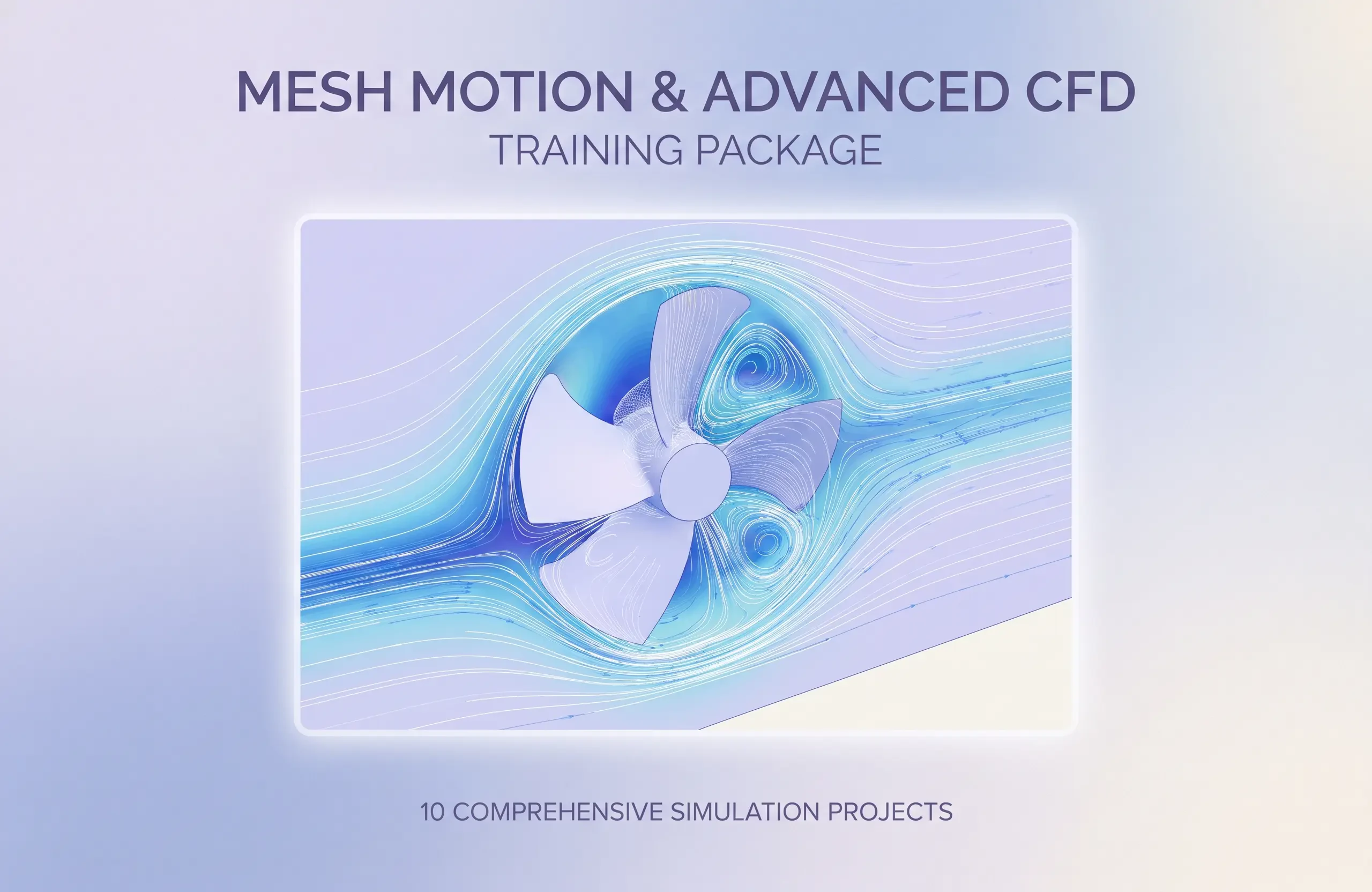
Advance your mesh motion CFD skills with this 10-project ANSYS Fluent training package — covering vertical axis wind turbine configurations, water-based rotating machinery, and industrial mixing applications.
Mesh Motion: Intermediate CFD Training Package
Intermediate
Price: $79
Build intermediate-level expertise in mesh motion CFD with this 10-project ANSYS Fluent training package — covering vertical axis wind turbine aerodynamics, rotating turbomachinery, acoustic and jet applications, and particle-laden mixing driven by prescribed mesh motion.
Price: $29
Mesh Motion: Beginner CFD Training Package is a ten-project introduction to rotating-machinery simulation in ANSYS Fluent using the Mesh Motion (moving/sliding mesh) approach. Starting from a simple mixing tank and building through propellers, rotors, pumps, and turbines up to a stirred bioreactor, it gives newcomers a hands-on, application-driven foundation in the CFD techniques behind modern rotating-equipment engineering — one real engineering case at a time.
Price: $49
The final step in the series, this course covers the most demanding version of each project — high-speed and reacting flows, fluid-structure interaction, UDFs, and moving geometry — the kind of coupled, multi-physics problems most CFD engineers never get past. It's built for those who want to solve undefined, real-world problems and defend their results with confidence.
Build Real-World CFD Skills with ANSYS Fluent
Intermediate
Price: $29
Building on the fundamentals, this course tackles harder, more realistic versions of the same 16 engineering fields and flow models, introducing multi-phase interactions, transient behavior, and more demanding boundary conditions. You'll leave with the skills to handle real project complexity, not just tutorial-scale problems.
Price: $9
This course takes you from zero to your first working simulations in ANSYS Fluent, covering foundational projects across 16 engineering fields — aerospace, biomedical, chemical, HVAC, marine, renewable energy, and more — alongside core flow models and Fluent modules. By the end, you'll be comfortable setting up, running, and interpreting basic CFD simulations on your own.
Rotary Equipment GOLDEN Training Package
Beginner, Intermediate, Advanced
Price: $2,589
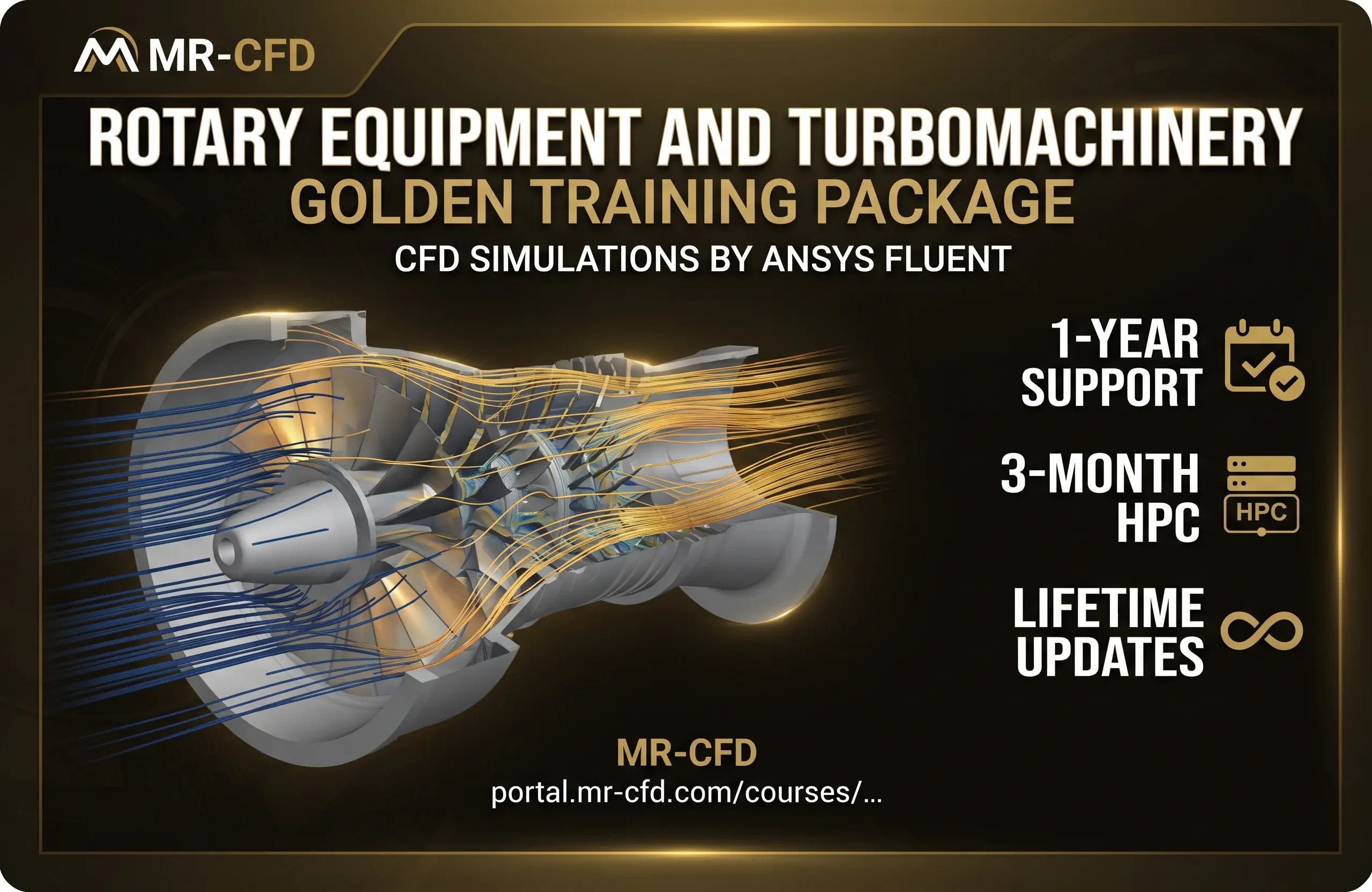
MR CFD's Rotary Equipment & Turbomachinery CFD Simulation GOLDEN Training Package offers 160+ ANSYS Fluent tutorials on pumps, compressors, turbines (gas, water, wind), fans, mixers, and rotary dryers—ideal for professors, managers, and companies upskilling teams in turbomachinery design. Practical exercises and case studies rooted in real-world +160 pre-simulated Rotary Equipment and Turbomachinery projects. Step-by-step tutorials from geometry creation, meshing, solving, and advanced post-processing. While you obtain the Golden Package, you will receive non-limited 1-year technical support from MR CFD experts. By purchasing this Golden package, you can benefit from our 3-month HPC.
Price: $56
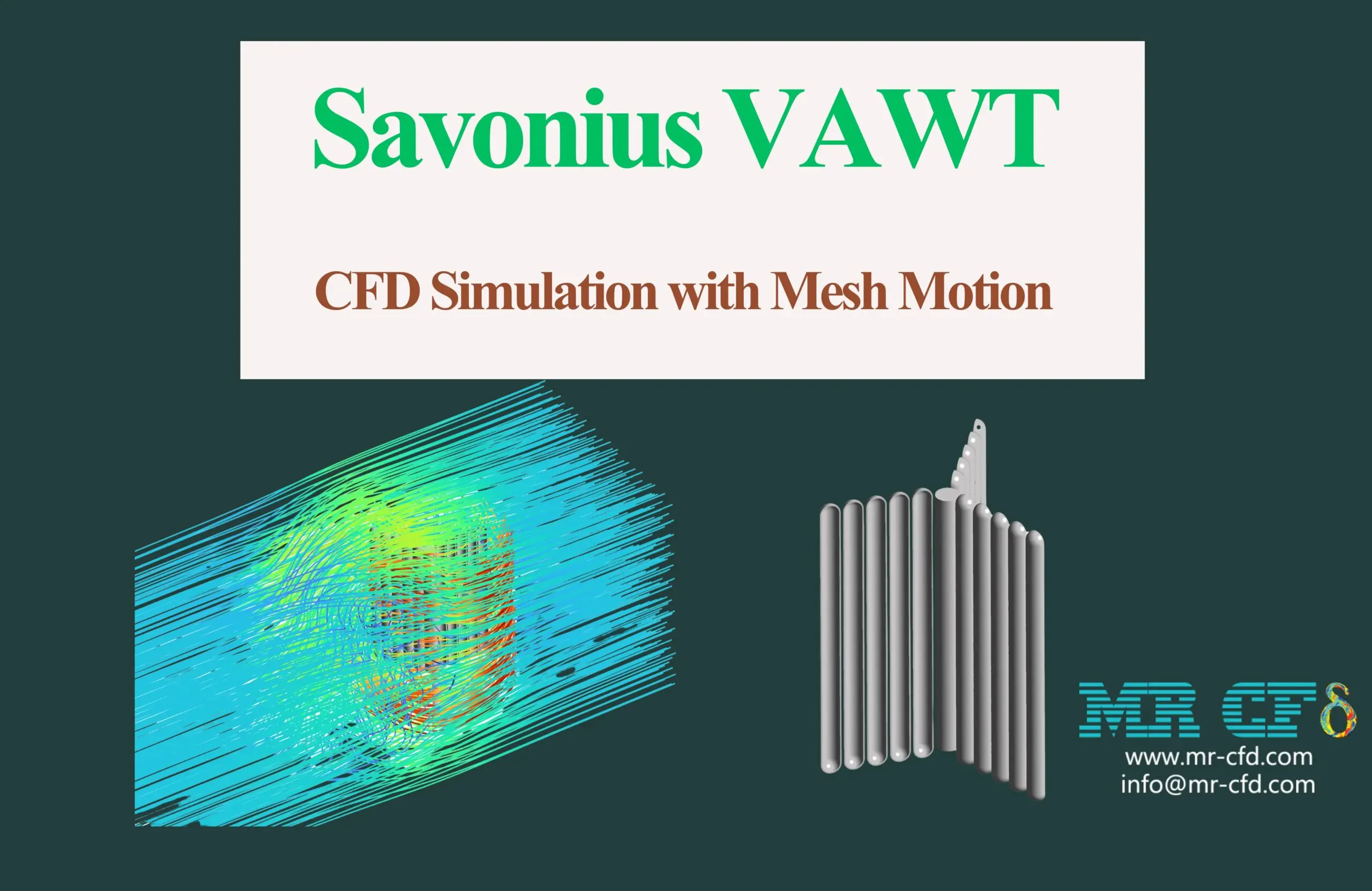
This study presents a CFD analysis of a Savonius VAWT using mesh motion in ANSYS Fluent to examine aerodynamic performance and flow characteristics. The rotor geometry was modeled in DesignModeler and meshed with a non-conformal, unstructured grid containing about 5.5 million cells for accurate flow resolution. A transient, pressure-based solver with the RNG k-ε turbulence model was applied; air was used as the working fluid, with rotating and stationary flow zones defined. The simulation revealed pressure variations, wake formation, and vortex structures around the blades, highlighting key aerodynamic behaviors of the Savonius VAWT.
Price: $80
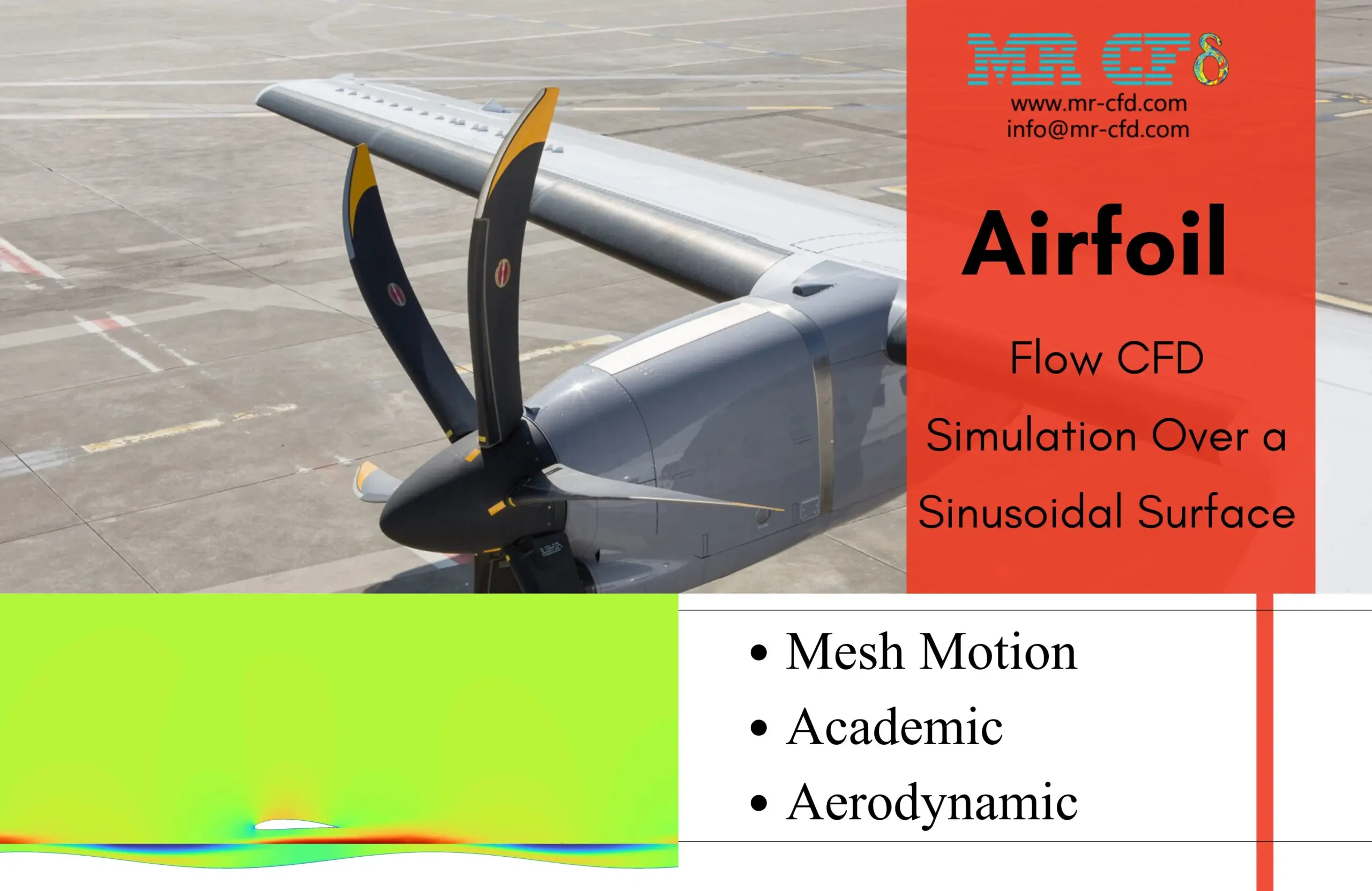
This simulation studies airflow around an airfoil placed above a sinusoidal wall using mesh motion in ANSYS Fluent to analyze aerodynamic effects. The 2D model includes an airfoil over a wavy bottom surface, divided into stationary and moving zones, with a structured refined mesh near the airfoil and wall. A transient pressure-based solver with the k–ω SST turbulence model was applied using a 55 m/s inlet velocity and mesh motion of 56 m/s for the moving zone. Velocity contours show accelerated flow over the airfoil’s upper surface, while pressure contours indicate low pressure above and high pressure below, confirming lift generation influenced by the wavy boundary.