

Free CFD Online Courses
Here's every free CFD simulation course that can give you a taste of what MR CFD has to offer.
Discretization Methods in CFD
Beginner, Intermediate, Advanced
Price: Free
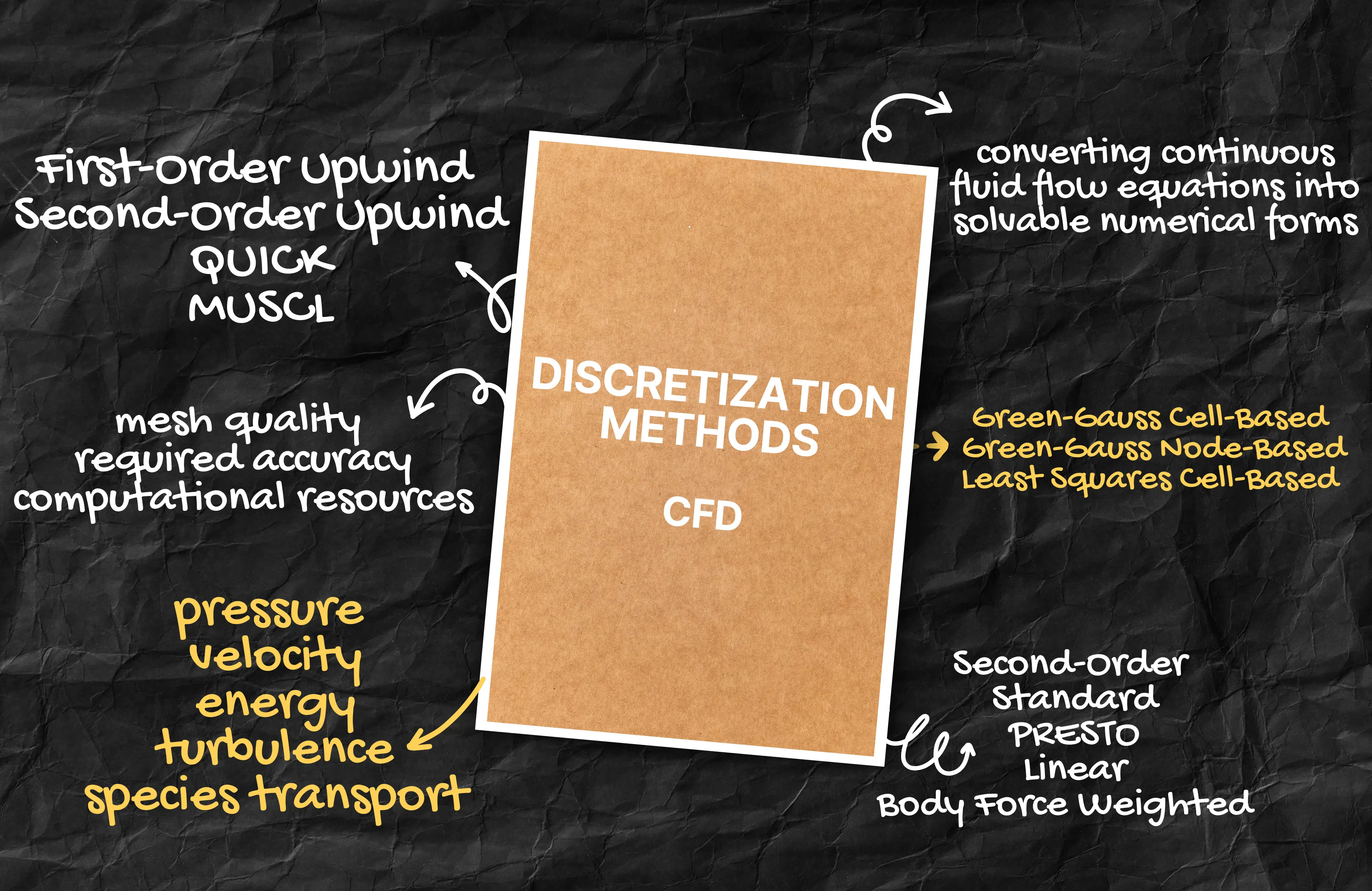
Discretization methods in ANSYS Fluent are crucial techniques for converting continuous fluid flow equations into solvable numerical forms. Three main gradient calculation methods are available: Green-Gauss Cell-Based, Green-Gauss Node-Based, and Least Squares Cell-Based. Pressure discretization offers five options: Second-Order, Standard, PRESTO, Linear, and Body Force Weighted schemes. Momentum discretization includes First-Order Upwind, Second-Order Upwind, QUICK, and MUSCL schemes. Choice of method depends on mesh quality, required accuracy, and available computational resources. These methods apply to various parameters including pressure, velocity, energy, turbulence, and species transport equations.
Solvers and Pressure-Velocity in CFD: Part 2
Beginner, Intermediate, Advanced
Price: Free
Comprehensive exploration of density-based solver methods in CFD, focusing on mathematical foundations and practical implementations. Detailed explanation of fundamental equations including continuity, momentum, and energy equations with their complete derivations. In-depth coverage of time-derivative preconditioning and its importance in handling low Mach number flows. Comparison between AUSM and Roe schemes, including both explicit and implicit formulations. Practical guidelines for implementation in ANSYS Fluent, including time step selection and stability considerations. Advanced numerical techniques for pressure-velocity coupling, with emphasis on matrix formulation and eigenvalue calculations.
Solvers and Pressure-Velocity in CFD: Part 1
Intermediate
Price: Free
Comprehensive exploration of ANSYS Fluent solver types and pressure-velocity coupling methods. Detailed coverage of pressure-based and density-based solvers, including SIMPLE, SIMPLEC, PISO, and COUPLED algorithms. In-depth analysis of mathematical formulations and practical implementations in fluid flow simulations. Essential guide for CFD engineers, graduate students, and researchers with basic CFD knowledge. Focuses on effective numerical simulation techniques and method selection criteria. Includes practical comparisons and recommendations for different simulation scenarios.
Finite Volume Method (FVM) in CFD
Intermediate
Price: Free
Comprehensive educational material covering Finite Volume Method (FVM) in CFD through three practical examples: 1D heat transfer in a rod, cooling of a fin, and 2D channel flow. Presents step-by-step explanations of mathematical derivations, discretization methods, and numerical solutions using FVM principles. Includes detailed boundary conditions, grid generation techniques, and implementation strategies with MATLAB code examples. Demonstrates progression from simple to complex problems, comparing numerical results with analytical solutions. Serves as a foundation for understanding advanced CFD concepts and Fluent software applications. Designed for CFD students and engineering professionals, featuring practical implementations and visual result interpretations.
Computational Fluid Dynamics (CFD): Introduction
Beginner, Intermediate, Advanced
Price: Free
This is the first session of a Computational Fluid Dynamics (CFD) course, focusing on equations and numerical methods for discretization and solving them in detail. The course is designed by the Mister CFD team to help students and engineers understand the numerical techniques used in software like Ansys Fluent, rather than focusing on fundamental coding. It introduces CFD as a method for solving nonlinear partial differential equations (Navier-Stokes equations) through numerical techniques, since general analytical solutions aren’t available. The document covers three main numerical methods: Finite Difference Method (FDM), Finite Volume Method (FVM), and Finite Element Method (FEM), with their advantages and limitations. It explains different types of Partial Differential Equations (PDEs) including their classifications based on order, linearity, and behavior (Elliptic, Parabolic, and Hyperbolic). The content concludes with detailed explanations of conservation equations, numerical errors in CFD, and the importance of Taylor series in discretization processes.
Introduction to CFD Course with ANSYS Fluent [Free]
Beginner, Intermediate, Advanced
Price: Free
If you need Beginner Step for CFD Coruse with ANSYS Fluent, follow this course: Beginner CFD Course . This comprehensive 12-session program by MR CFD blends theoretical foundations with practical ANSYS Fluent applications. Structured Curriculum: The first seven sessions build a strong theoretical framework (CFD fundamentals, Finite Volume Method, solver algorithms), while the final five focus on hands-on practical simulations (2D/3D flows, heat transfer, airfoil, and pipe studies). Professional Mastery: Designed for engineers, researchers, and students, it equips you with end-to-end CFD skills—from mesh generation to result validation—to solve complex fluid dynamics and heat transfer challenges.
Battery Model Introduction
Intermediate
Price: Free
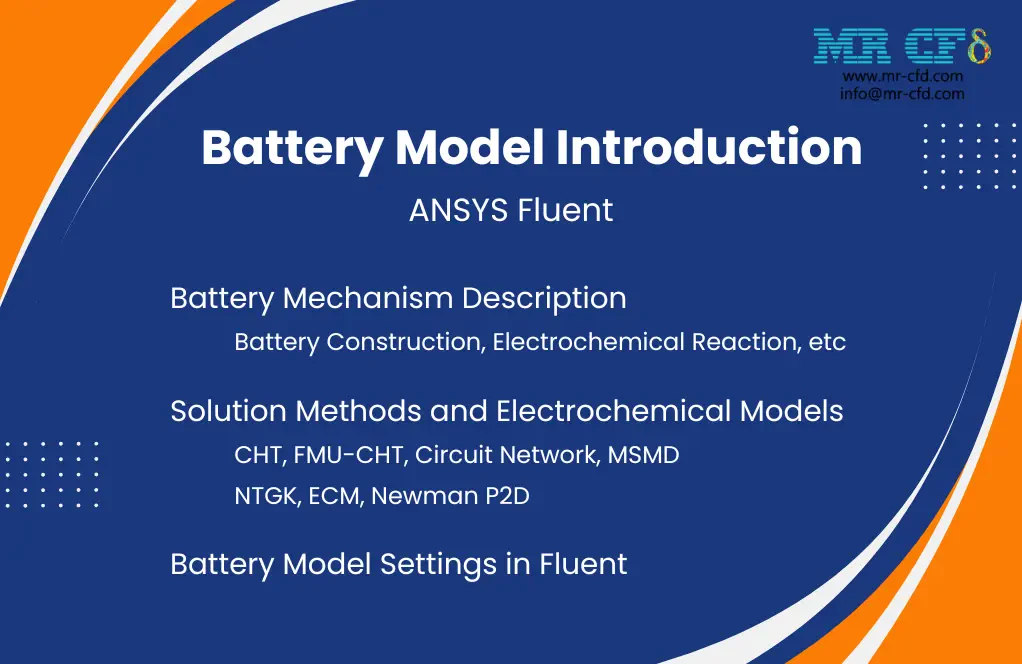
Introduction to the Battery Model in ANSYS Fluent software Introduction to the Battery System Operation Introduction to the Solution Methods (CHT, FMU-CHT, Circuit Network, MSMD) Introduction to the Electrochemistry Models (NTGK, ECM, Newman P2D) Introduction to the Battery Model Settings
Design Modeler Training Course
Beginner, Intermediate, Advanced
Price: Free
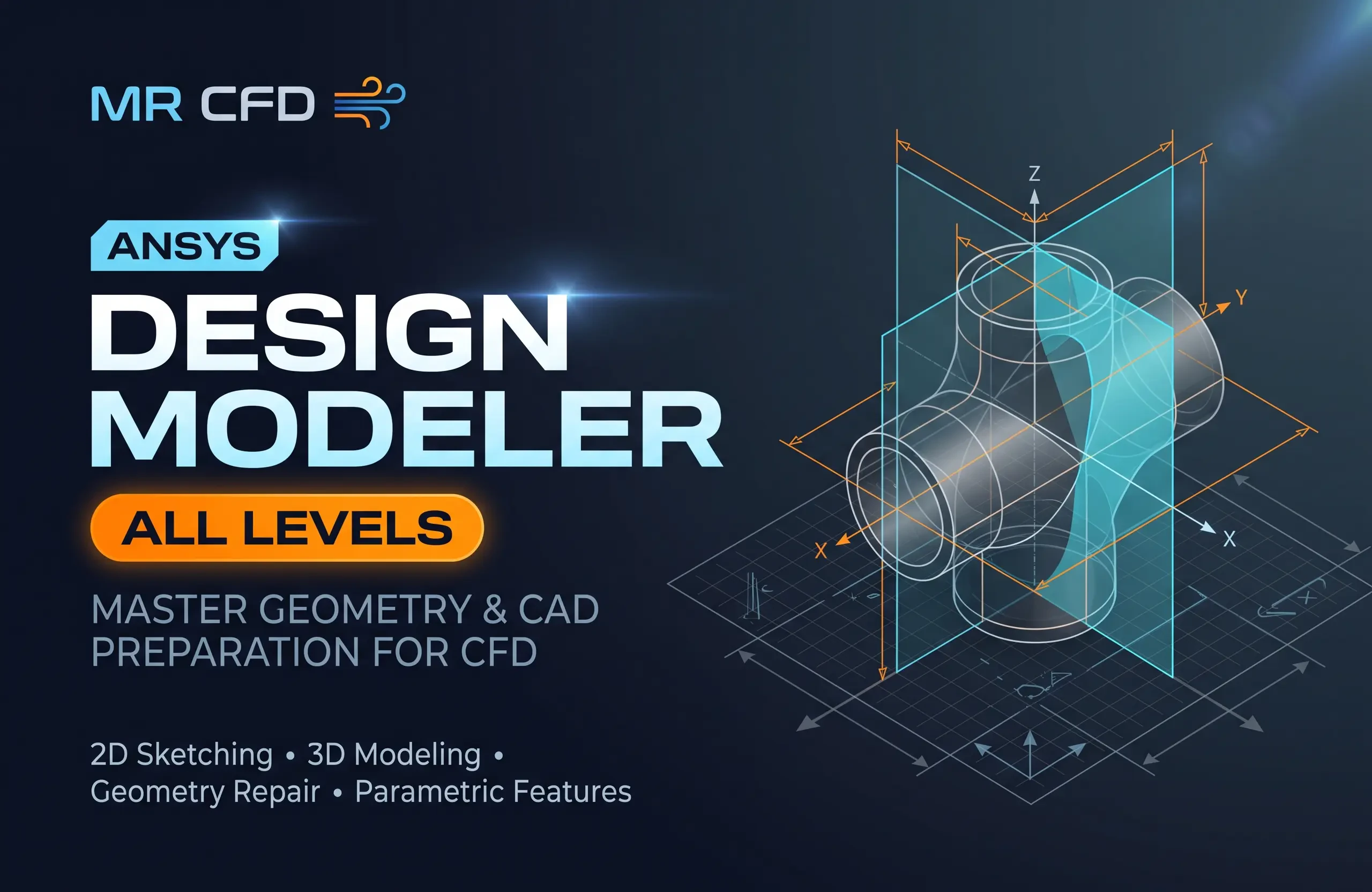
In this course, you will thoroughly learn how to design a 3D model. In addition, how to draw two-dimensional sketches is fully explained. Geometry drawing tools are fully introduced in Design Modeler software. At the end of the course, you will be able to model a complex three-dimensional geometry with the tools in this software. This Course is presented so that it is as practical as possible so that the graduates after the end of the Course can work well with this software to produce the geometries required for CFD works.
ANSYS Meshing Training Course
Beginner, Intermediate, Advanced
Price: Free
In this course, you will thoroughly learn how to mesh a 2D/3D geometry model to be used for your CFD/structural simulation stage. Namely, different types of mesh/grids including, unstructured, hybrid, structured, and multiple ways how to carry each out are illustrated. You will be first familiarized with different types of mesh and the geometries over which these specific mesh types are applied. Then building upon that knowledge, we will teach you the tricks and tips on how to create the mentioned mesh or grids. This Course is presented so that it is as practical as possible so that the graduates after the end of the Course can work well with this software to generate high-quality mesh for the geometries required for CFD works.