

CFD Intermediate Courses
Here's every CFD online course in the Intermediate level.
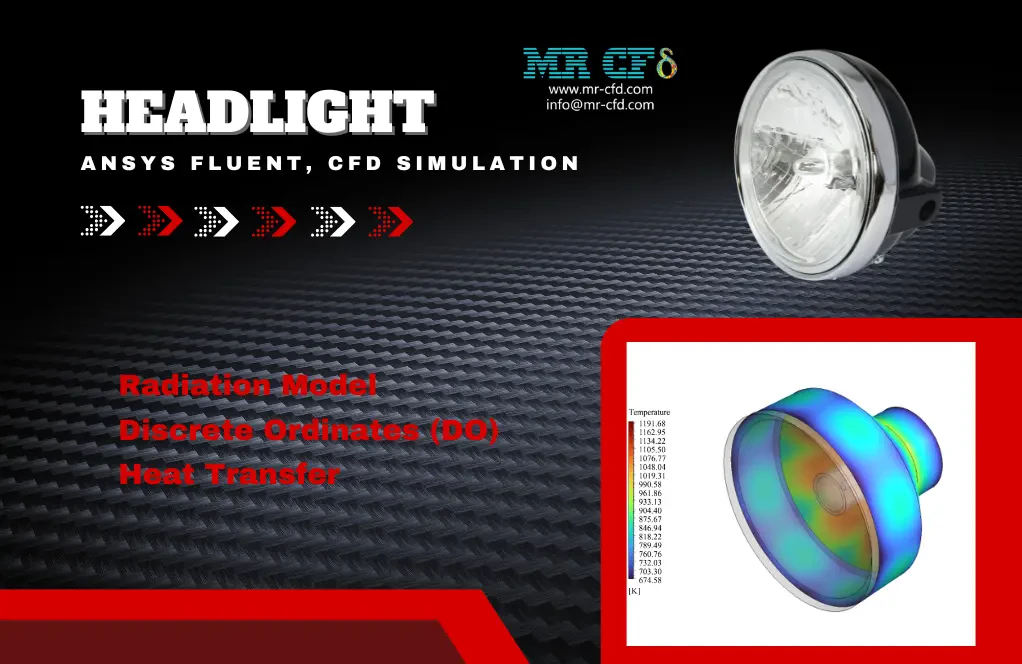
Headlight, Radiation, ANSYS Fluent CFD Simulation
Intermediate
Price: $120
This product numerically simulates the Headlight using ANSYS Fluent software. We design the 3D model with Design Modeler software. We mesh the model with ANSYS Meshing software, and the element number equals 1322000. We use the Discrete Ordinates (DO) Radiation Model to define radiation heat transfer.
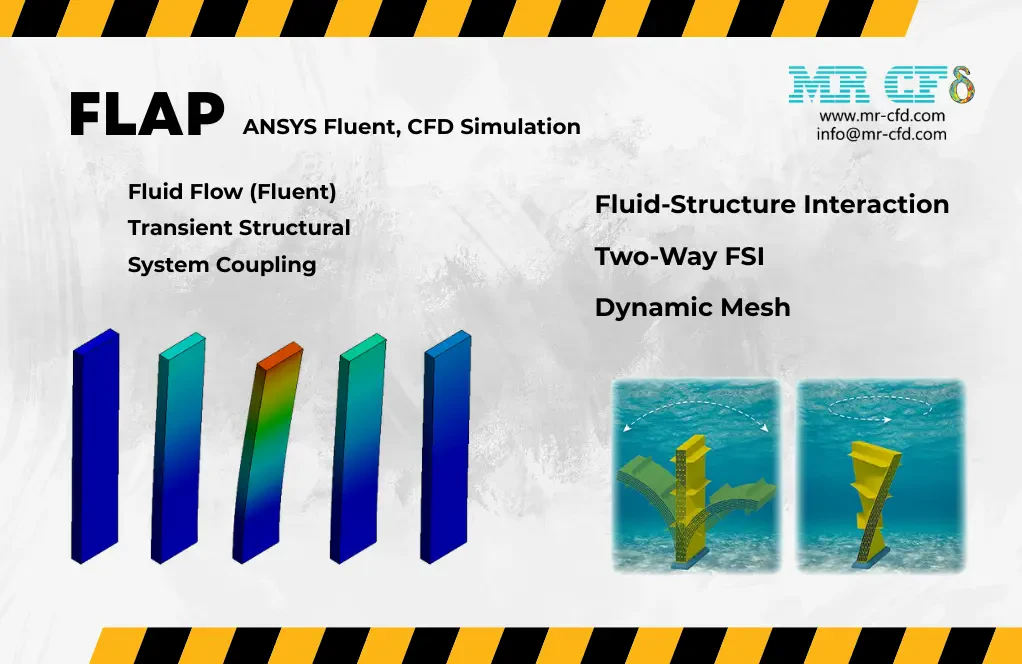
Flap, Two-way FSI, ANSYS Fluent CFD Simulation
Intermediate, Advanced
Price: $210
This product numerically simulates a Flap motion or deformation using ANSYS software. This project is implemented as a Fluid-Structure Interaction (FSI) approach. We perform the Fluid simulation in ANSYS Fluent and the Solid simulation in ANSYS Transient Structural. The System Coupling is used to define Data Transfer between fluid and structural calculations. We use a 2-Way FSI for data transfer in both from fluid to solid and from solid to fluid. We design the 3-D model in the Design Modeler software and mesh it in the ANSYS Meshing software. We use the Dynamic Mesh option to account for fluid domain deformation. The run calculation is in an Unsteady State (transient).
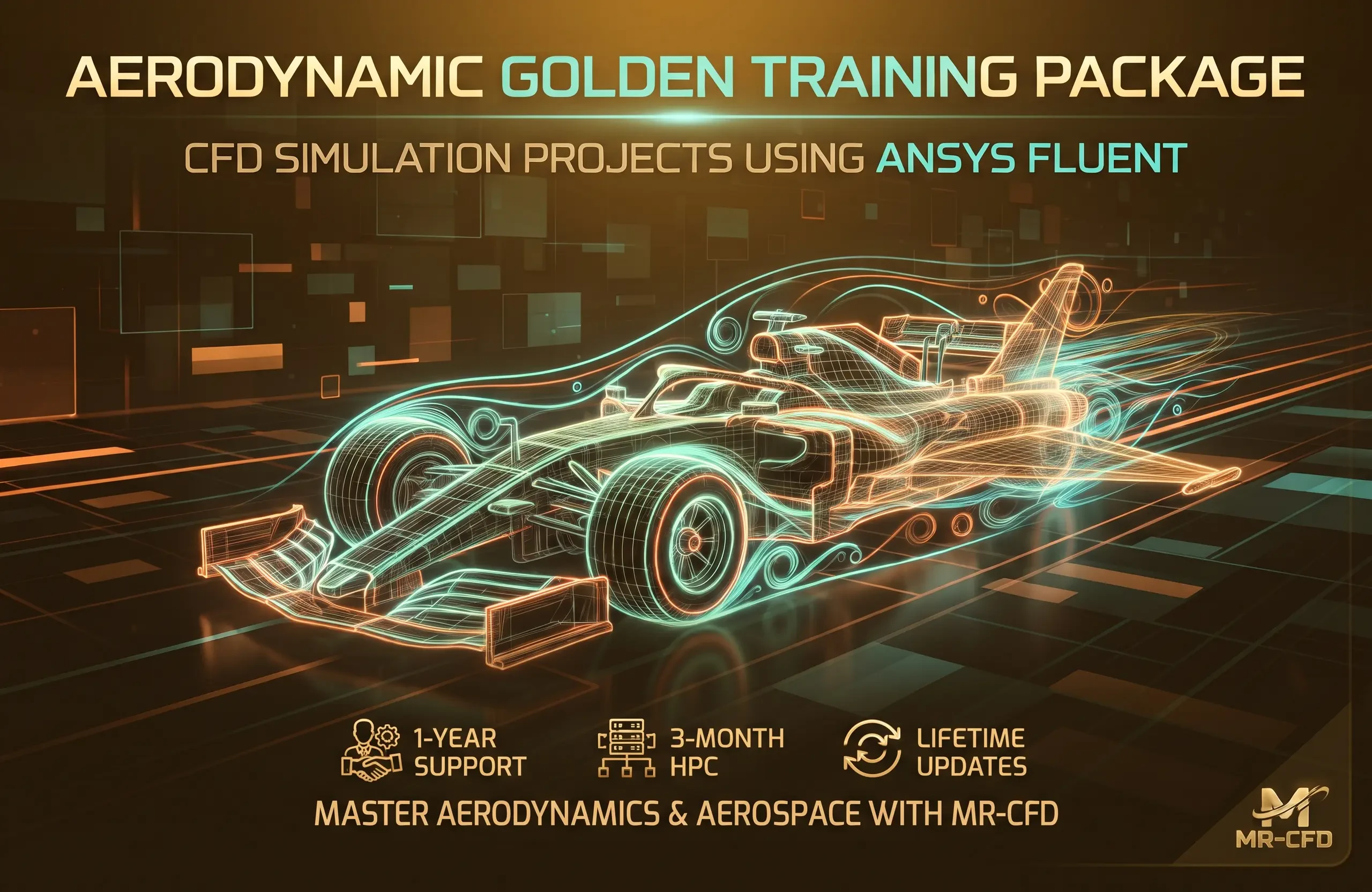
Aerodynamic & Aerospace GOLDEN Training Course
Beginner, Intermediate, Advanced
Price: $3,379
The Aerodynamic and Aerospace GOLDEN Training Package delivers over 200 ANSYS Fluent tutorials, transforming teams into experts with instant project readiness. Tailored for professors, CEOs, and firms, it covers airfoils, aircraft, compressors, engines, dynamic mesh, rockets like VA-111 Shkval, UAVs, wind turbines, and advanced phenomena from shocks to aeroelasticity. Includes step-by-step exercises, 1-year support, 3-month HPC, lifetime updates, and 15 years of MR CFD expertise for stress-free onboarding and competitive edge.
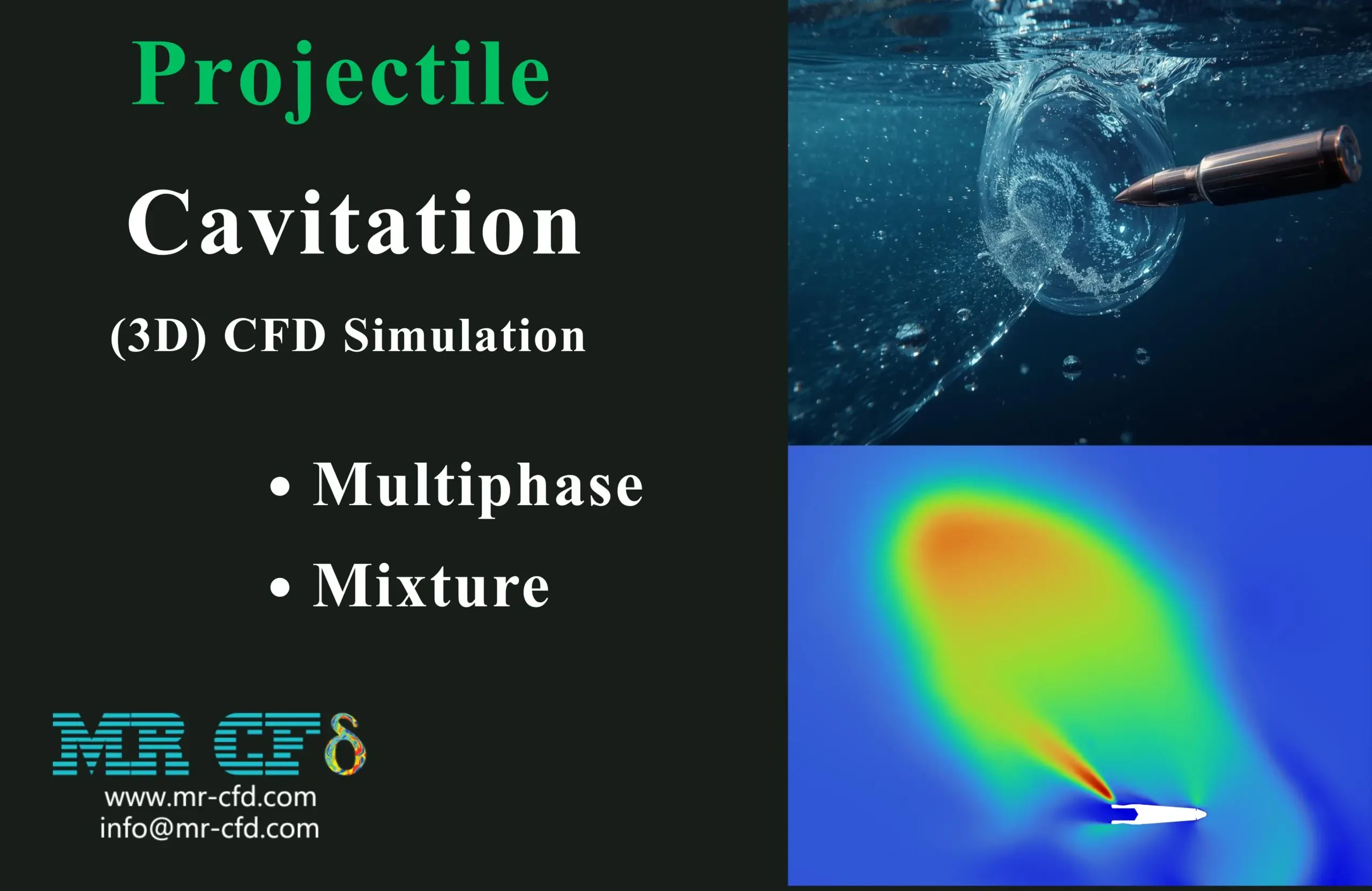
Projectile Cavitation (3D) CFD Simulation
Intermediate, Advanced
Price: $140
The projectile cavitation study investigates the formation and development of a vapor cavity around a projectile 3D transient CFD of a projectile moving obliquely in water using ANSYS Fluent, with mixture cavitation and realizable Two inlet velocities (10 and 20 m/s) are applied to study cavitation inception and development. At 10 m/s the vapor cavity forms only locally and collapses quickly, so cavitation disappears. At 20 m/s a large, stable cavity develops around the projectile and extends into the wake.
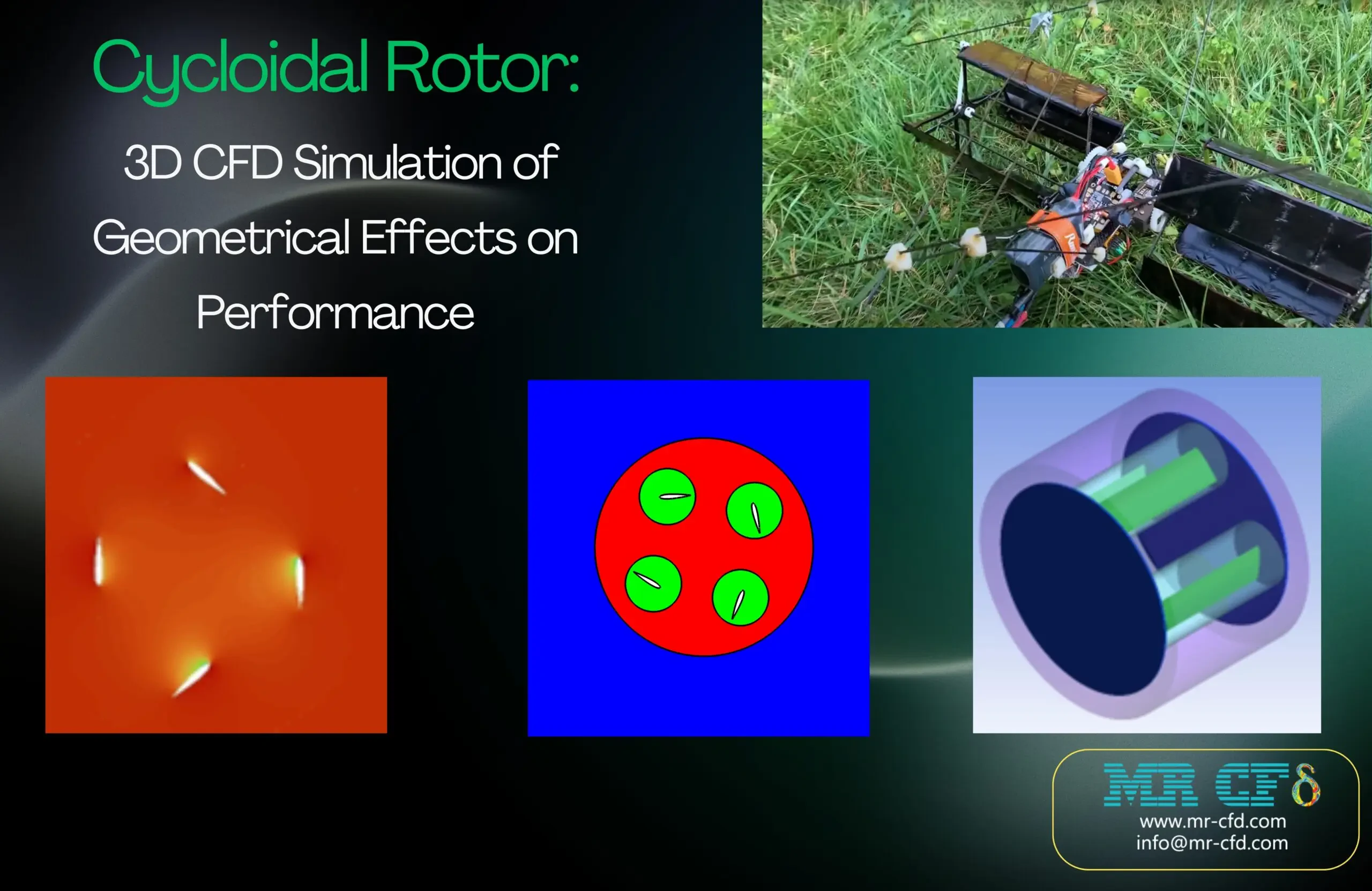
Cycloidal Rotor: 3D CFD Simulation of Geometrical Effects on Performance
Intermediate, Advanced
Price: $319
The 3D cycloidal rotor CFD simulation models a pitching four-blade rotor to analyze flow behavior and aerodynamic performance. The rotor produces lift by dynamically adjusting blade pitch while rotating, enabling multidirectional thrust. Three disc configurations were tested to assess their effect on efficiency. Results highlight how disc presence alters thrust and torque characteristics, providing insights for design optimization.
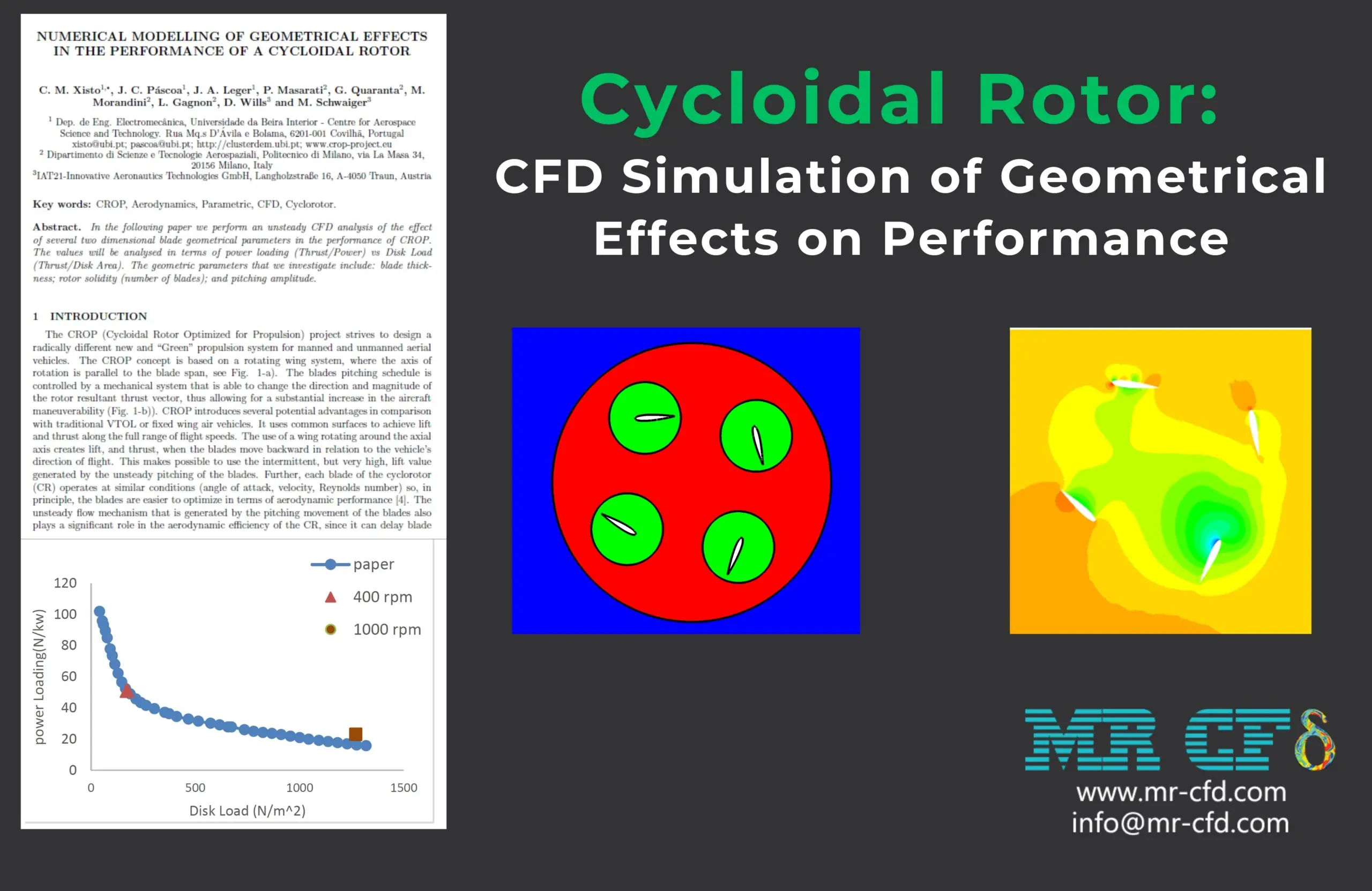
Cycloidal Rotor: 2D CFD Simulation of Geometrical Effects on Performance; Paper Validation
Intermediate
Price: $649
This project presents a three-dimensional transient CFD simulation of a four-blade cycloidal rotor using ANSYS Fluent with a moving mesh approach. The rotor uses NACA 0015 blades with prescribed pitching motion, and the flow is modeled with the SST k-omega turbulence model in an unstructured mesh domain. Aerodynamic loads, disk loading, and power loading are computed from the transient solution and compared with the article “Numerical Modelling of Geometrical Effects in the Performance of a Cycloidal Rotor.” The close agreement between the numerical results and the published data confirms the validity of the geometry, mesh, and solver settings used in this study.
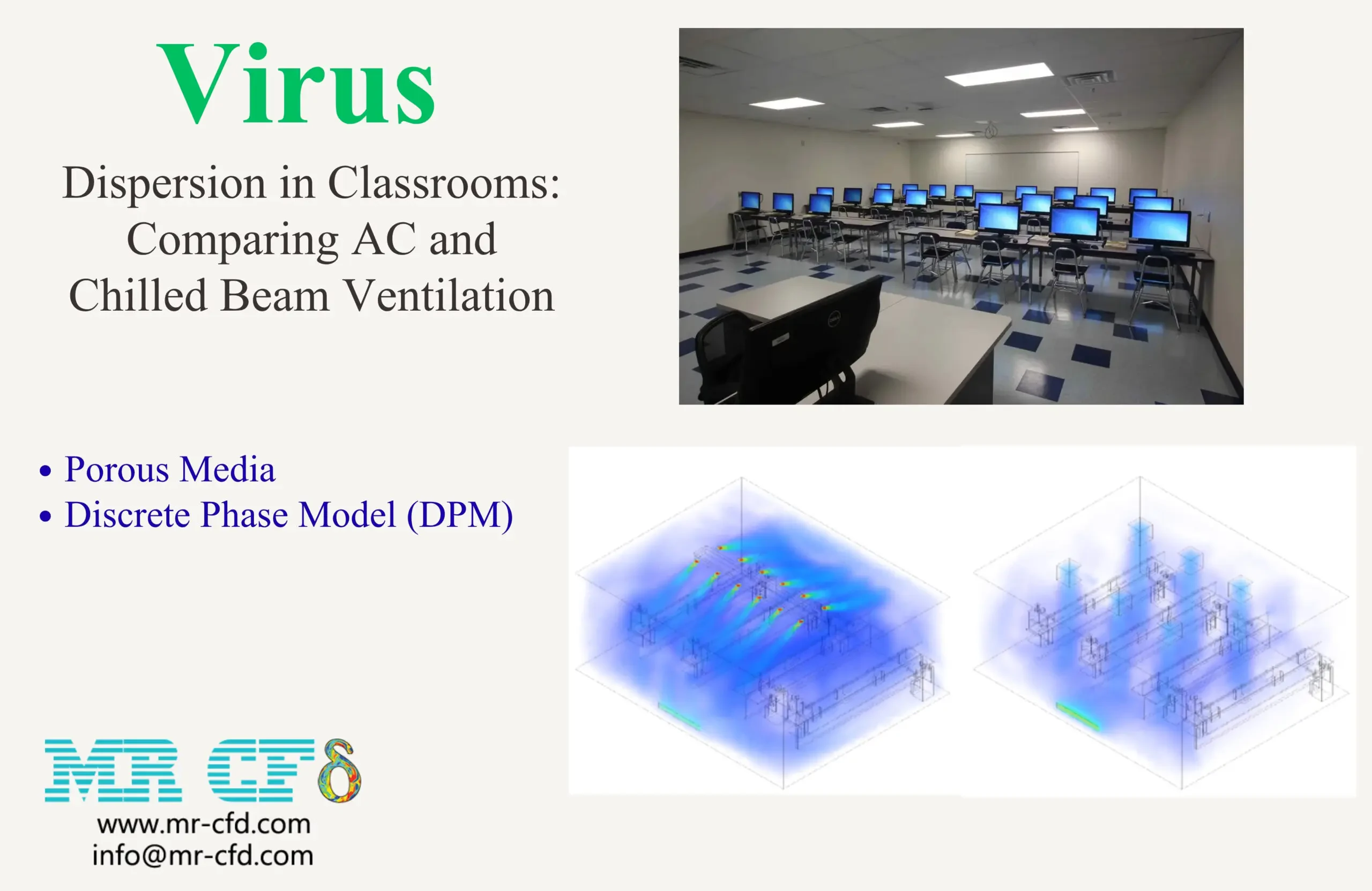
Virus dispersion in classrooms: CFD simulation comparing AC and chilled beam ventilation
Intermediate, Advanced
Price: $240
ANSYS CFD study of virus transport and comfort in a 10×8 m classroom comparing AC and chilled beam ventilation. Room with desks, eight occupants, AC louvers vs. chilled-beam inlets; unstructured mesh refined near jets, walls, and bodies. Steady pressure-based RANS (realizable k-ε), energy on with buoyancy; virus tracked via DPM; appropriate velocity-inlet and pressure-outlet BCs. AC removes particles faster but shows uneven temperatures, while chilled beams improve thermal uniformity with broader mixing that disperses particles more widely.
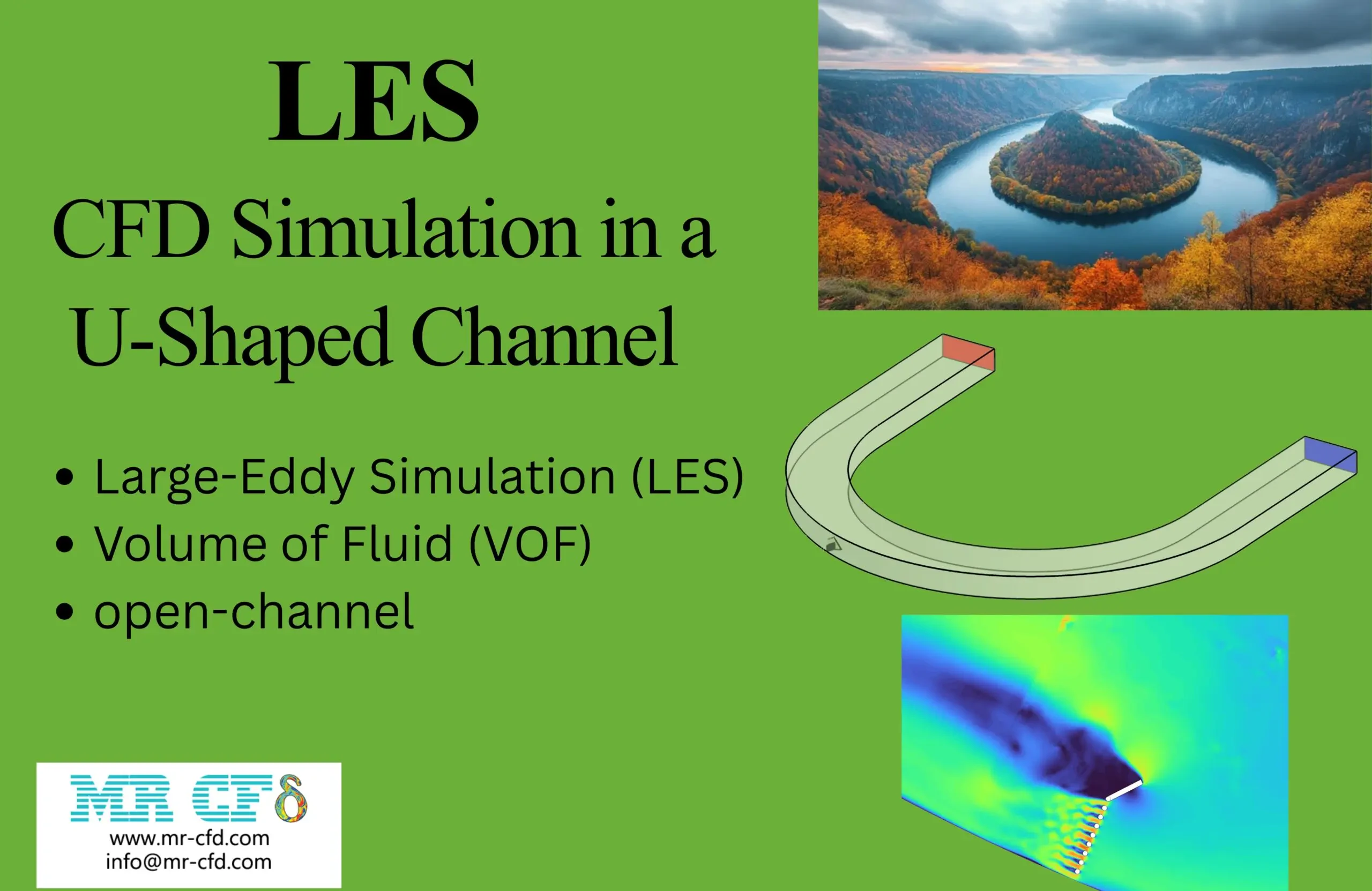
LES using open-channel in VOF for Multiphase Flow in a U-Shaped Channel
Intermediate, Advanced
Price: $240
LES–VOF simulation of multiphase open-channel flow in a U-shaped channel using ANSYS Fluent. Geometry built in DesignModeler; hexa-dominant ANSYS Meshing with local refinement near the baffle, cylinder array, bend walls, and free surface. Open-channel VOF captures the air–water free surface; LES resolves unsteady vortices (Δt = 0.01 s). Results show interface deformation, outer-wall acceleration, inner-wall separation, and vortex shedding past baffle/cylinders.
Price: $56
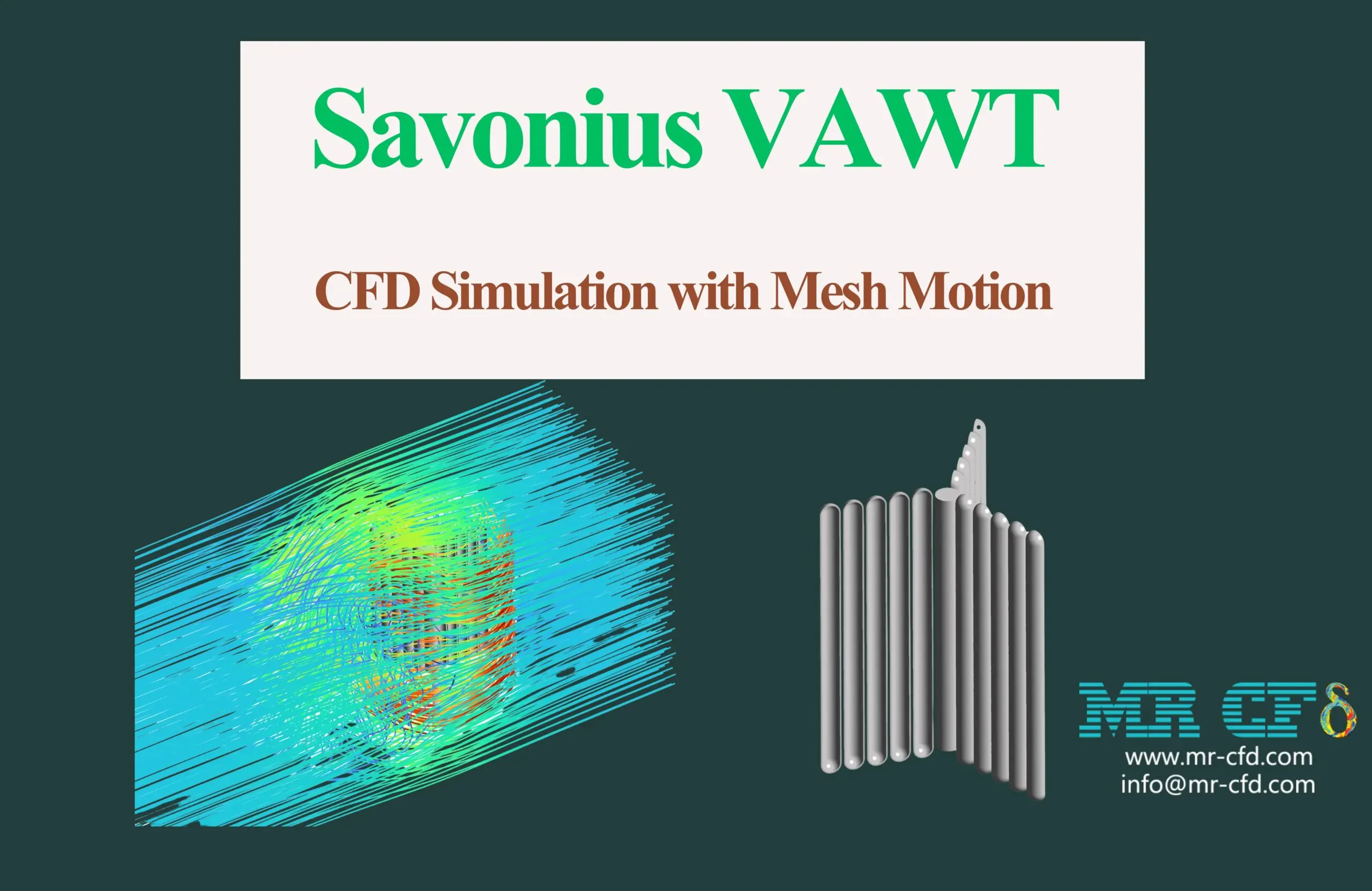
This study presents a CFD analysis of a Savonius VAWT using mesh motion in ANSYS Fluent to examine aerodynamic performance and flow characteristics. The rotor geometry was modeled in DesignModeler and meshed with a non-conformal, unstructured grid containing about 5.5 million cells for accurate flow resolution. A transient, pressure-based solver with the RNG k-ε turbulence model was applied; air was used as the working fluid, with rotating and stationary flow zones defined. The simulation revealed pressure variations, wake formation, and vortex structures around the blades, highlighting key aerodynamic behaviors of the Savonius VAWT.