

Drone (UAV) Aerodynamic Design | Drone CFD Simulation Course
Price: Free
End-to-End UAV Design: Master the complete UAV design methodology, from initial mission analysis to preliminary drone design.
Industry-Standard CFD Tools: Gain hands-on expertise with Ansys Fluent and AVL for high-fidelity aerodynamic simulation.
Performance & Stability Analysis: Evaluate drone aerodynamics, flight stability, and overall performance through project-driven CFD training.
Drone (UAV) Aerodynamic Design | Drone CFD Simulation Course
Price: Free
End-to-End UAV Design: Master the complete UAV design methodology, from initial mission analysis to preliminary drone design.
Industry-Standard CFD Tools: Gain hands-on expertise with Ansys Fluent and AVL for high-fidelity aerodynamic simulation.
Performance & Stability Analysis: Evaluate drone aerodynamics, flight stability, and overall performance through project-driven CFD training.
-
Section 1
Foundations of UAVs
$1,999-
Course Introduction & Philosophy. Definitions: UAS, UAV, Drone, RPAS. Anatomy of a Drone: Airframe, Propulsion, Avionics, GCS, Link. Historical Context & Modern Applications.
Lesson 1 21m 47s Free Lesson
-
-
Section 2
The Design Process
$3,499-
The Systems Engineering Approach. From Mission Statement to Design Requirements. Key Performance Parameters (KPPs): Range, Endurance, Payload, Speed. Design Trade-offs and Constraints (cost, regulations).
Lesson 1 35m 34s Free Lesson
-
-
Section 3
Configuration Selection
$4,699-
In-depth comparison: Fixed-Wing, Rotary-Wing (Multirotors), Hybrid VTOL. Pros, Cons, and Mission Suitability of each. Introduction to Initial Sizing Concepts.
Lesson 1 47m 5s Free Lesson
-
-
Section 4
Aerodynamics for UAVs
$4,799-
Review of Aerodynamic Fundamentals. Low Reynolds Number Flight. Airfoil Selection for UAVs: Databases and critieria (L/D max, gentle stall). Introduction to Lifting Line and Vortex Lattice Theory (the basis of AVL).
Lesson 1 48m 58s Free Lesson
-
-
Section 5
Initial Sizing
$7,599-
Weight Estimation: Empty, Payload, Fuel/Battery. The Master Equation: W₀ = Wₛtructure + Wₚayload + Wₑnergy. Estimating Wing Loading (W/S) from stall, climb, cruise. Estimating Thrust-to-Weight (T/W) from climb and cruise.
Lesson 1 1h 16s Free Lesson
-
-
Section 6
Stability & Control I
$8,999-
Concepts of Static and Dynamic Stability. Longitudinal Stability: The Neutral Point, Static Margin. The role of the tail (horizontal stabilizer). Introduction to Stability Derivatives (Cₘᵅ, Cₙᵝ, Cₗᵝ).
Lesson 1 41m 23s Free Lesson
-
-
Section 7
Stability & Control II
-
Session 7
Lateral-Directional Stability: Dihedral effect, Dutch Roll. Vertical Tail Sizing for Directional Stability. Control Derivatives and Introduction to Control Surfaces.
Lesson 1 Coming Soon
-
-
Section 8
High-Fidelity Analysis: CFD I
-
Session 8
Introduction to CFD: Navier-Stokes Equations, Turbulence Modeling overview. The CFD Workflow: Geometry -> Meshing -> Solving -> Post-Processing. Meshing for External Aerodynamics.
Lesson 1 Coming Soon
-
-
Section 9
High-Fidelity Analysis: CFD II
-
Session 9
Setting Boundary Conditions and Solver Parameters. Analyzing Results: Pressure Contours, Streamlines, Coefficient Convergence. Validating Low-Fidelity (AVL) vs. High-Fidelity (CFD) results.
Lesson 1 Coming Soon
-
-
Section 10
Propulsion & Systems
-
Session 10
Electric Propulsion Systems: Batteries, Motors, Propellers. Matching Propellers to Motors and Airframes. Introduction to Autopilots and Flight Control Systems.
Lesson 1 Coming Soon
-
-
Section 11
Design Iteration & Refinement
-
Session 11
Using analysis results (AVL, CFD) to refine the design. Dealing with real-world problems: addressing instability, high drag, etc. Finalizing performance predictions (Range, Endurance).
Lesson 1 Coming Soon
-
UAV Aerodynamic Design & UAV CFD Simulation Course | Drone Analysis Training (in Ansys Fluent)
Designing a drone that actually flies — safely, efficiently, and within mission constraints — demands far more than off-the-shelf components and intuition. Every aerodynamic surface, every gram of structural weight, and every degree of stability margin must be quantified, validated, and justified through rigorous engineering analysis. The Ansys Fluent UAV Aerodynamic Design and CFD Simulation Course, developed by MR CFD, delivers exactly that: a structured, project-driven training program that takes engineers from mission profile definition through preliminary design review, using the same computational tools deployed in professional aerospace practice — AVL, XFLR5, and Ansys Fluent CFD.
This course is part of the advanced engineering training ecosystem available at the CFD online Course. It is purpose-built for aerospace engineers, mechanical engineers, graduate researchers, and UAV development professionals who need to master the complete drone aerodynamic analysis and CFD validation workflow — from vortex lattice method (VLM) stability analysis to high-fidelity RANS-based Ansys Fluent simulation that validates and refines conceptual designs before physical prototyping.
Why Low-Fidelity UAV Design Tools Alone Cannot Deliver Engineering Confidence
The fundamental problem in UAV aerodynamic design is the fidelity gap. Conceptual design tools — including panel methods, empirical correlations, and vortex lattice methods — are fast and useful for exploring the design space, but they carry inherent physical limitations. AVL and XFLR5 cannot resolve viscous boundary layer effects, flow separation near the leading edge, propeller-induced flow asymmetry, or nonlinear aerodynamic behavior at high angles of attack. For UAVs operating at low-to-moderate Reynolds numbers (10⁴ to 10⁶) — where laminar-turbulent transition strongly influences drag and stall behavior — these tools systematically underpredict drag and mislocate the stall angle.
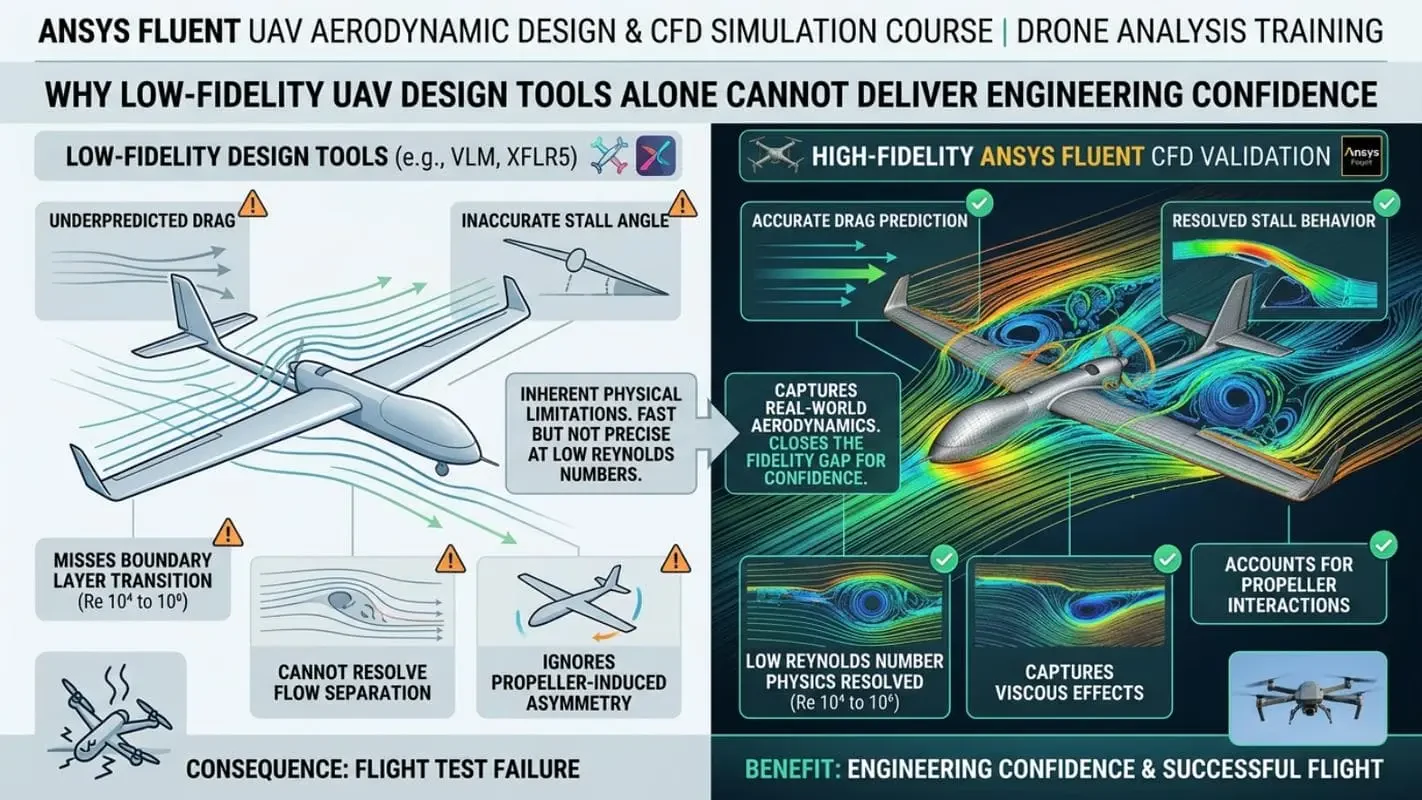
The consequence is a design that passes low-fidelity analysis but fails in flight testing — an expensive, time-consuming, and potentially dangerous outcome. Engineers who can close this fidelity gap by executing high-fidelity Ansys Fluent CFD validation of their VLM-based UAV designs are in active demand across defense contractors, commercial drone manufacturers, and aerospace research institutions. This course builds precisely that capability.
Technical Core Competencies & Aerodynamic Solver Mastery for UAV CFD Analysis
Technical Simulation Skills:
Translating a UAV mission profile into quantifiable design requirements and constraints
Performing initial sizing for maximum takeoff weight (MTOW), wing loading (W/S), and thrust-to-weight ratio (T/W)
Executing vortex lattice method (VLM) analysis in AVL for full-configuration aerodynamics and stability derivatives
Conducting 2D airfoil polar analysis in XFLR5 for airfoil selection and wing design
Setting up and running high-fidelity Ansys Fluent CFD simulations for aerodynamic coefficient prediction
Interpreting lift coefficient (CL), drag coefficient (CD), and pitching moment coefficient (Cm) outputs
Computing static margin and neutral point for longitudinal static stability assessment
Ansys Fluent Solver Settings:
Pressure-based coupled solver for incompressible low-speed UAV flow regimes
k-omega SST turbulence model for accurate boundary layer and flow separation prediction
Far-field boundary condition setup for external aerodynamic simulations
Angle of attack sweep automation for aerodynamic polar generation
Density-based solver configuration for high-speed or compressible UAV regimes
Meshing Strategies:
CAD geometry preparation in SpaceClaim for clean, simulation-ready UAV surfaces
Boundary layer inflation mesh for accurate wall shear stress and skin friction drag prediction
Structured far-field domain sizing for external aerodynamic simulations
Surface mesh refinement at leading edges, wing tips, and control surface hinge lines
Validation & Verification Skills:
Cross-validation of Ansys Fluent CFD results against AVL VLM predictions
Grid independence study methodology for aerodynamic coefficient convergence
Benchmarking against published UAV aerodynamic datasets and wind tunnel data
Comprehensive UAV Design Simulation Projects & Engineering Milestones
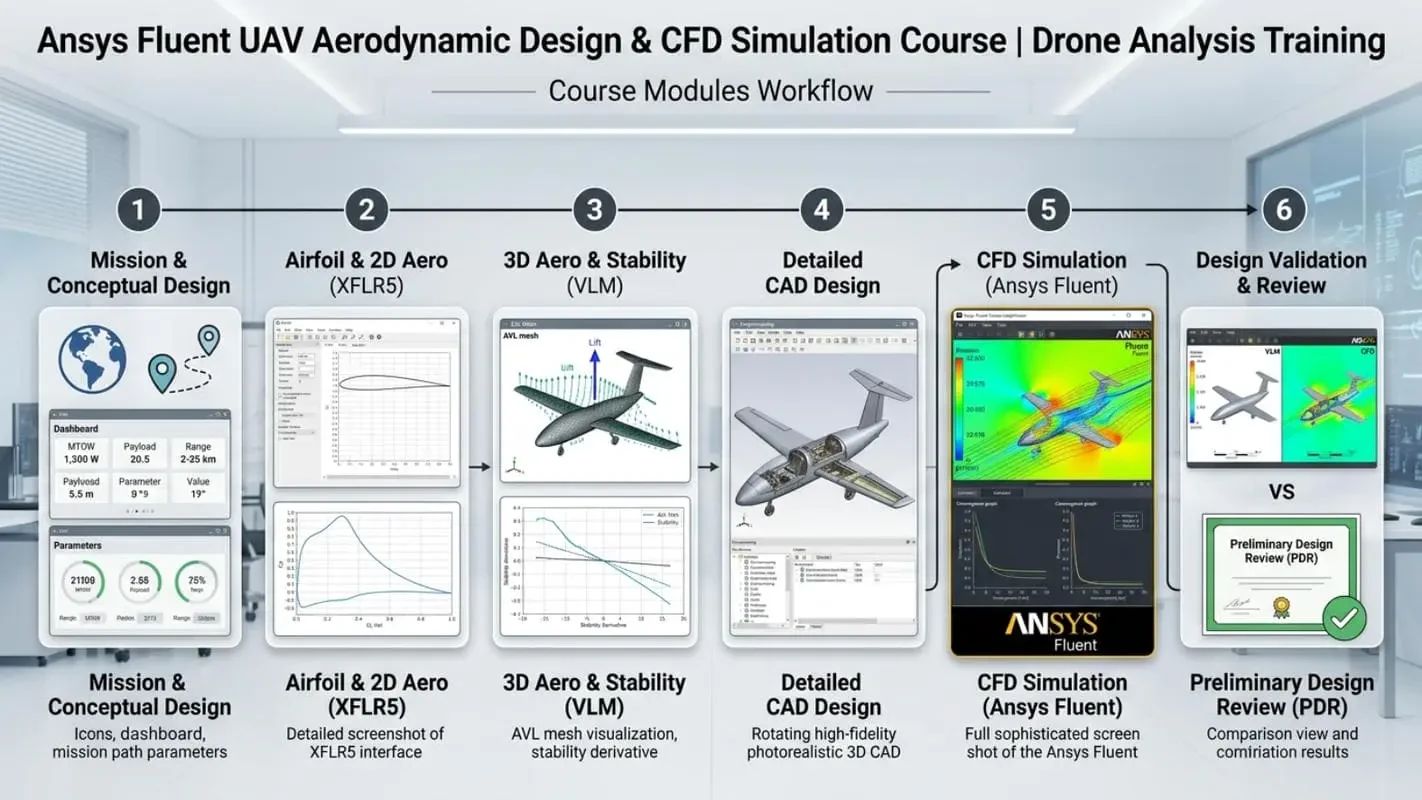
Course Modules at a Glance
Mission profile analysis and UAV design requirement formulation
UAV configuration evaluation and selection methodology
Initial sizing: MTOW, wing loading, and power/thrust estimation
Airfoil selection and 2D polar analysis using XFLR5
Full-configuration VLM aerodynamic analysis using AVL
Static stability and control derivative computation
CAD geometry creation for CFD pre-processing
High-fidelity Ansys Fluent CFD setup and aerodynamic simulation
CFD-to-VLM cross-validation and design refinement
Preliminary design review (PDR) synthesis and technical communication
Mission Profile Deconstruction: From Operational Need to UAV Design Requirements
Every successful UAV design begins not with geometry but with a mission. This foundational milestone trains engineers to deconstruct an operational need — surveillance range, payload capacity, endurance, cruise altitude, and environmental constraints — into a formal, quantifiable set of design requirements and constraints. Learners apply constraint analysis to map the feasible design space in terms of wing loading (W/S) and thrust-to-weight ratio (T/W), and use mission segment weight fraction analysis to estimate energy consumption and maximum takeoff weight (MTOW). This rigorous requirements-driven approach is the standard methodology in professional aerospace preliminary design and ensures that every subsequent analysis decision is traceable to a mission objective.
UAV Configuration Selection and Initial Sizing Methodology
With requirements established, engineers must evaluate and select from a range of UAV configurations — fixed-wing, flying wing, multi-rotor, tandem wing, and hybrid designs — each with distinct aerodynamic, stability, and control trade-offs. This milestone applies aerodynamic efficiency metrics, structural considerations, and mission suitability criteria to justify a configuration selection.
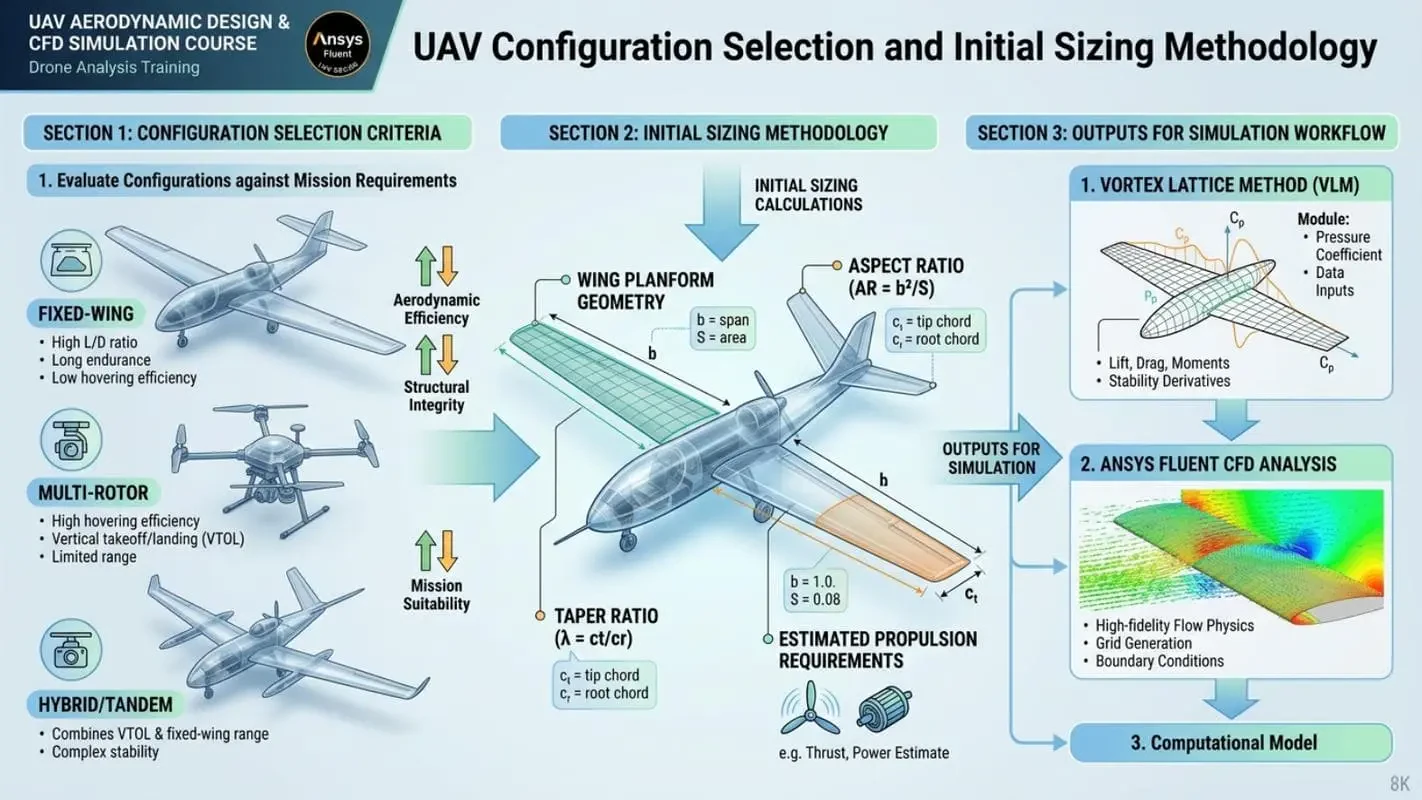
Learners then execute initial sizing calculations to define wing planform geometry, aspect ratio, taper ratio, and estimated propulsion requirements. These outputs serve as the direct inputs to the vortex lattice method (VLM) and Ansys Fluent CFD analysis phases, establishing a clear and traceable design chain from mission need to computational model.
Airfoil Selection and 2D Polar Analysis Using XFLR5
The aerodynamic efficiency of a UAV wing is fundamentally determined by airfoil geometry. This milestone uses XFLR5 to perform 2D airfoil polar analysis — computing lift, drag, and pitching moment coefficients as a function of angle of attack across the relevant Reynolds number regime of the UAV mission.
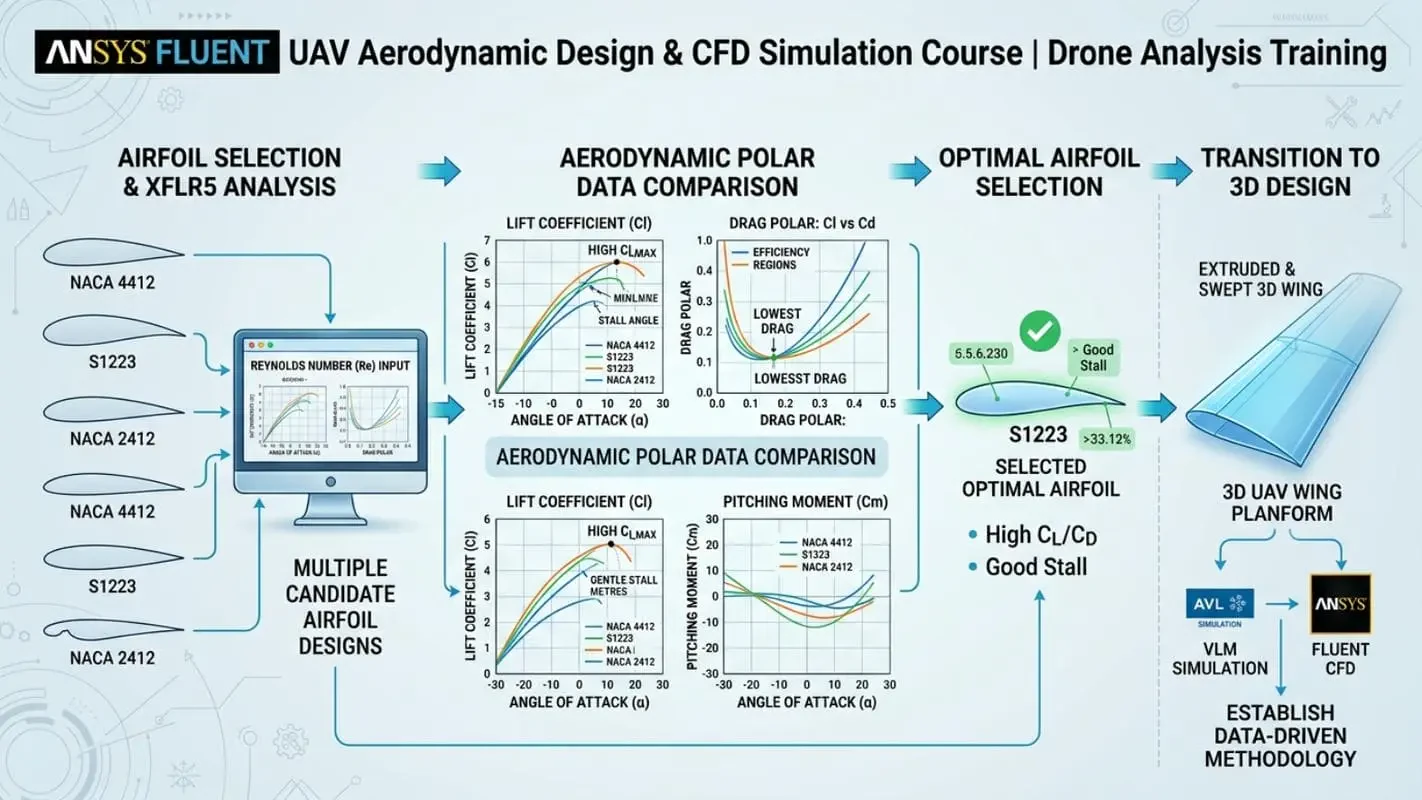
Learners evaluate multiple candidate airfoils, compare CL-alpha curves, drag polars, and stall characteristics, and select the optimal airfoil for the design mission. The selected airfoil geometry is then extruded and swept to create the 3D wing planform used in subsequent AVL VLM and Ansys Fluent CFD simulations — establishing a rigorous, data-driven airfoil selection methodology that mirrors professional aerospace practice.
Full-Configuration Aerodynamic and Stability Analysis Using AVL (Vortex Lattice Method)
AVL (Athena Vortex Lattice) applies the Vortex Lattice Method (VLM) to the complete UAV configuration — fuselage, wing, tail surfaces, and control surfaces — to rapidly generate aerodynamic coefficient databases and static stability derivatives. This milestone trains engineers to build the AVL geometric model, define vortex lattice panel distributions, run angle of attack sweeps, and extract key outputs including CL, CD_induced, Cm, and stability derivatives (Cm_alpha, CL_alpha, Cn_beta). The static margin and neutral point location are computed to verify longitudinal and directional static stability.
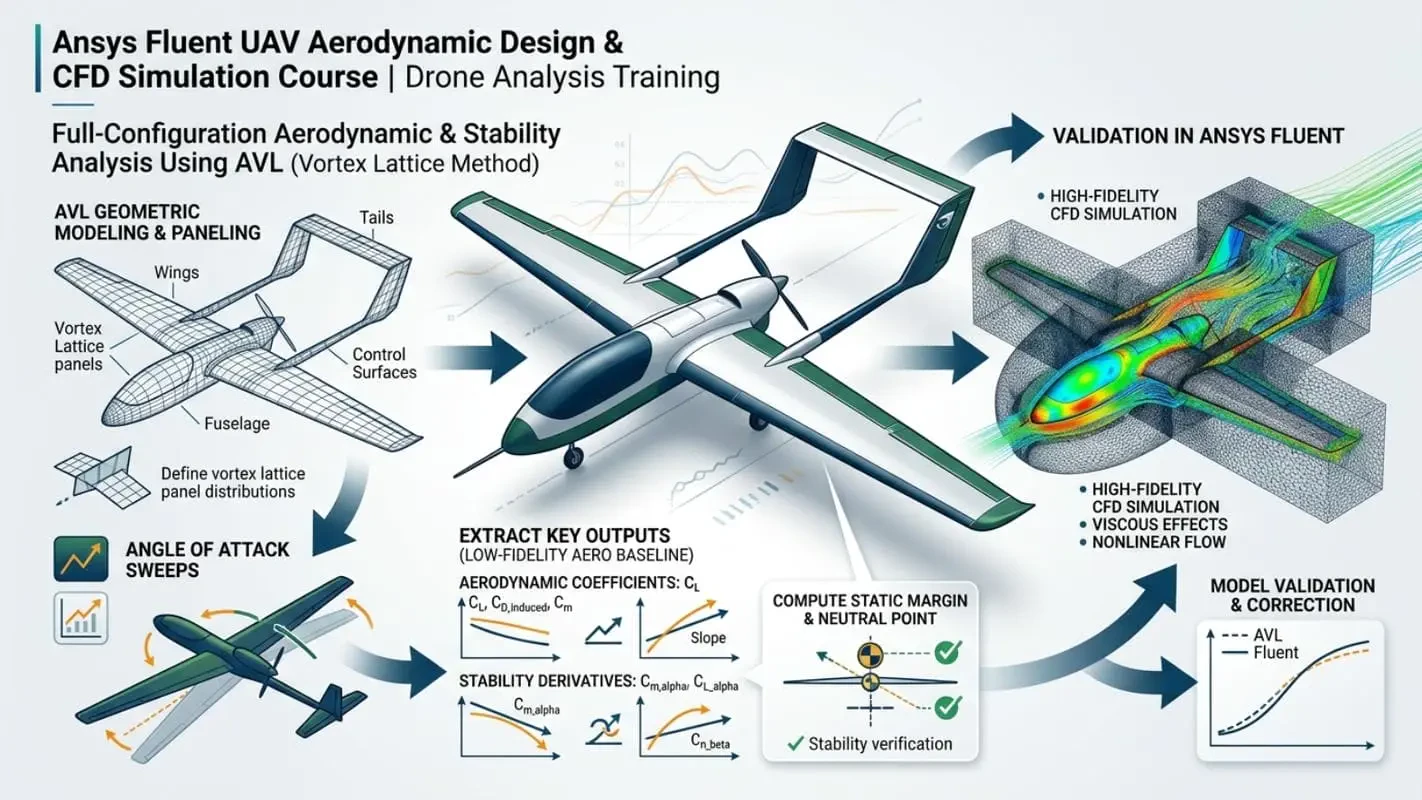
AVL results form the low-fidelity aerodynamic baseline that Ansys Fluent high-fidelity CFD will subsequently validate and correct for viscous and nonlinear effects.
High-Fidelity UAV Aerodynamic CFD Simulation Using Ansys Fluent
This is the technical centerpiece of the course. Learners execute a complete Ansys Fluent CFD simulation workflow for the finalized UAV geometry — from CAD preparation in SpaceClaim through meshing, solver configuration, and post-processing. The k-omega SST turbulence model is selected for its proven accuracy in predicting boundary layer transition, flow separation, and wing stall at UAV-relevant Reynolds numbers.
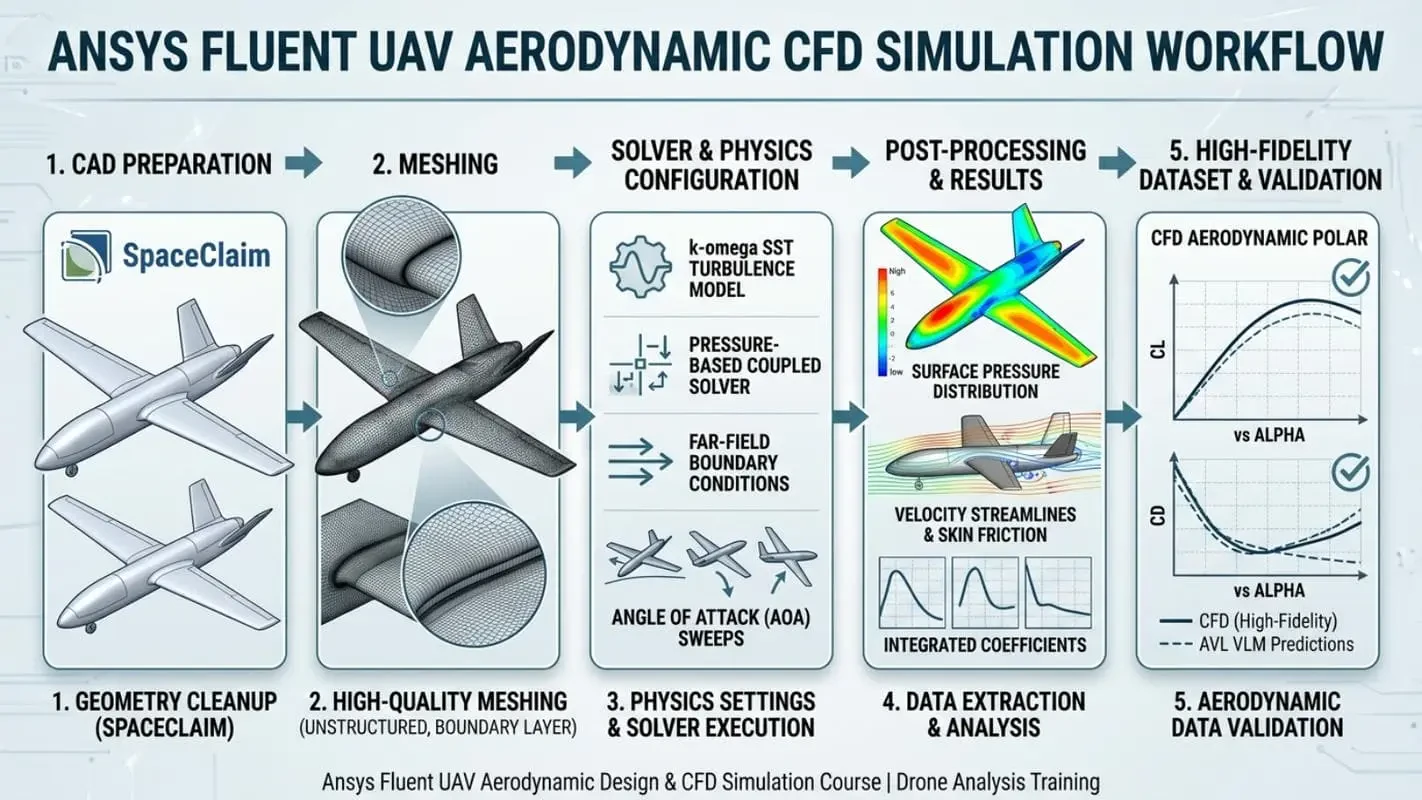
The pressure-based coupled solver is configured with appropriate far-field boundary conditions, and angle of attack sweeps are executed to generate a complete CFD aerodynamic polar. Learners extract surface pressure distributions, skin friction lines, velocity streamlines, and integrated CL, CD, and Cm values — producing the high-fidelity aerodynamic dataset that validates and refines the AVL VLM predictions.
CFD-to-VLM Cross-Validation and Iterative Design Refinement
Generating CFD results is only half the engineering task — interpreting them to improve the design is where professional value is created. This milestone trains engineers to systematically compare Ansys Fluent CFD outputs against AVL VLM predictions, identify discrepancies attributable to viscous effects, flow separation, or geometric simplifications, and translate those findings into targeted design modifications.
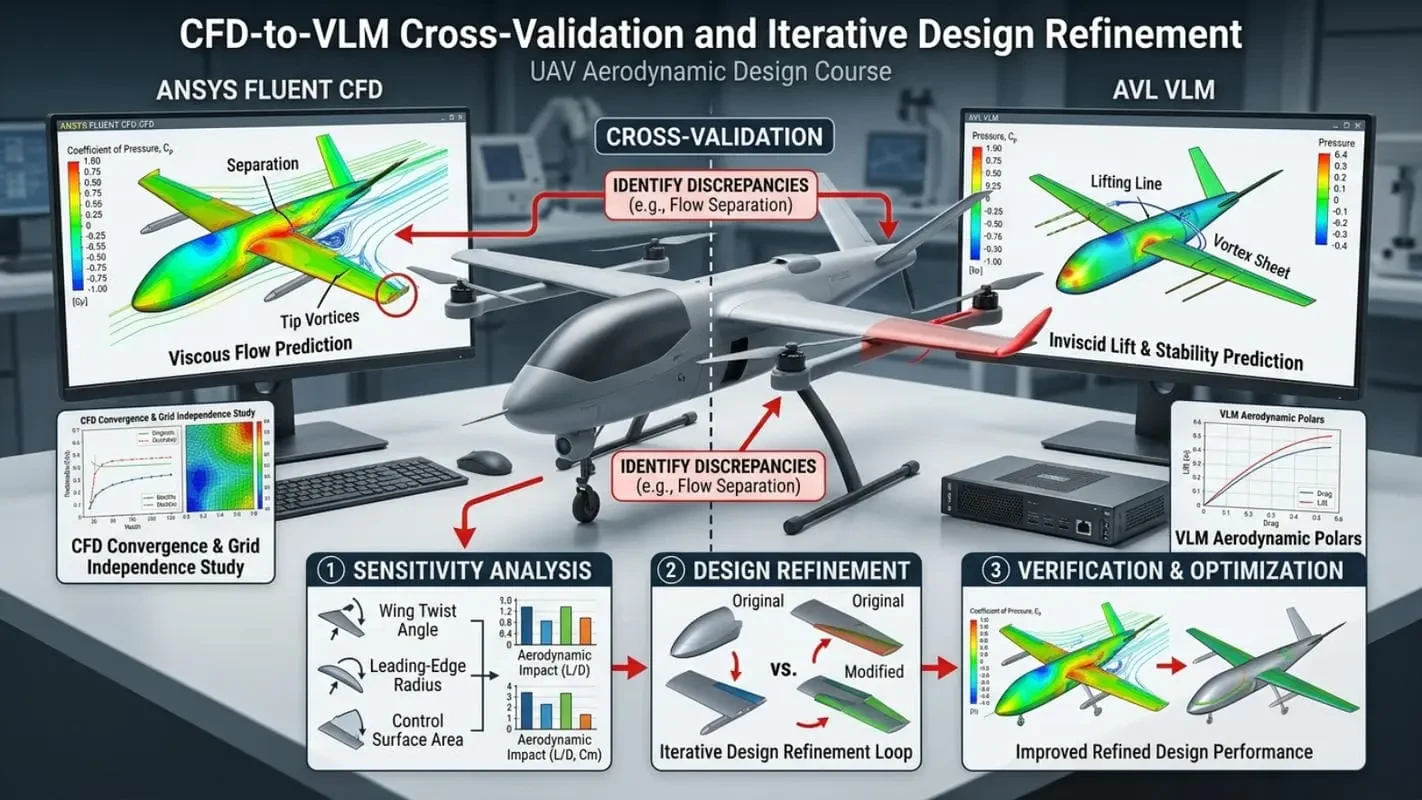
Learners apply grid independence studies to verify CFD solution quality and use sensitivity analysis to quantify the impact of geometric changes — wing twist, leading-edge radius, control surface sizing — on aerodynamic performance and stability. This iterative CFD-driven design refinement process is the defining methodology of modern simulation-driven UAV development.
Preliminary Design Review (PDR) Synthesis and Technical Communication
The final milestone integrates all analysis outputs — mission requirements, sizing calculations, VLM stability analysis, and Ansys Fluent CFD validation — into a coherent Preliminary Design Review (PDR) package. Learners synthesize quantitative results into engineering narratives, justify design choices with computational evidence, and present trade-off analyses in the format expected by professional aerospace teams and academic review panels.
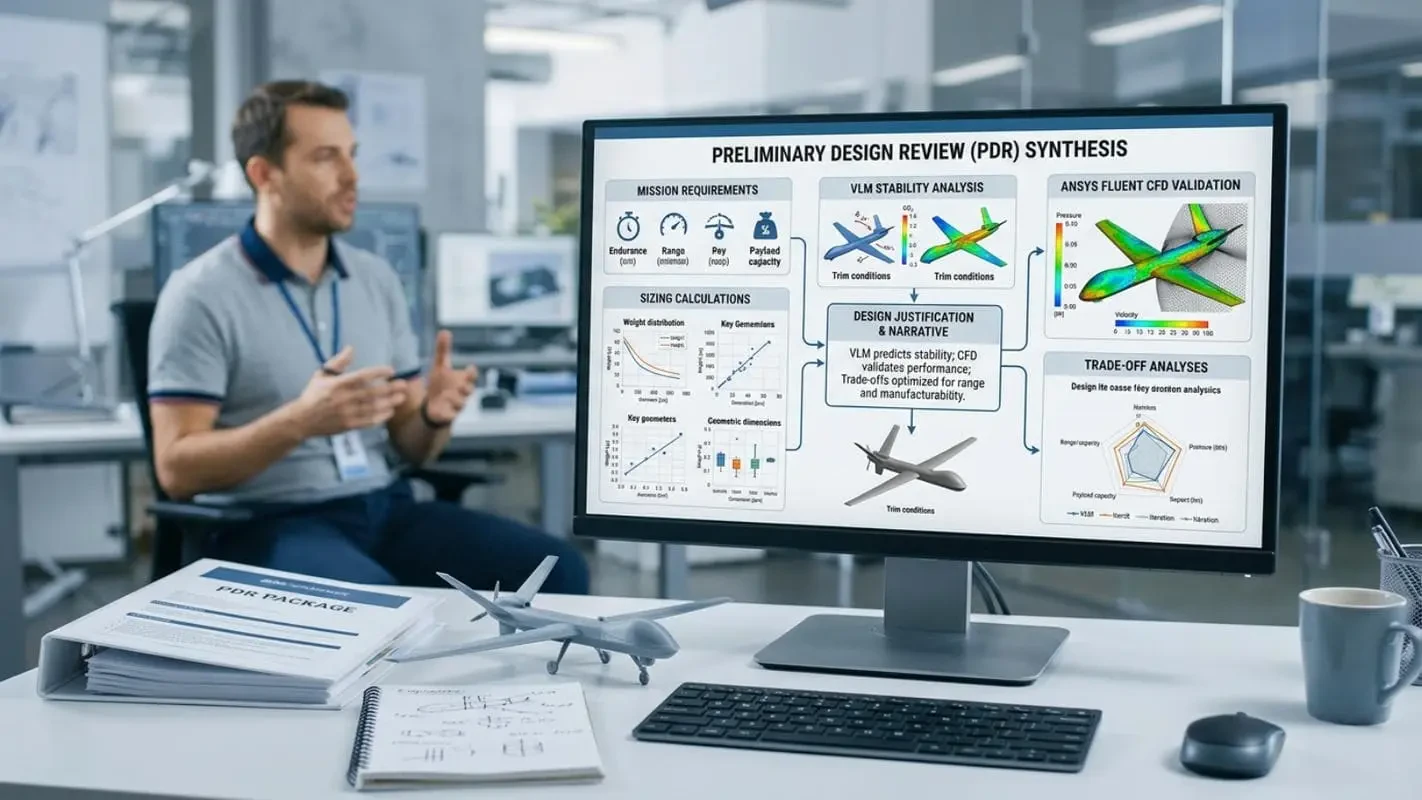
This milestone develops the critical skill of technical communication — translating simulation data into actionable engineering decisions — which is as essential to career success as the simulation competency itself.
Professional UAV Design & CFD Engineering Workflow: Pre-Processing to Post-Processing
Workflow Stage | Tool / Environment | Key Technical Tasks |
|---|---|---|
Mission Analysis & Sizing | Python / MATLAB / Spreadsheet | Constraint analysis, weight fraction estimation, wing loading (W/S) and T/W design point selection |
Airfoil Analysis | XFLR5 | 2D polar generation, Reynolds number sweep, CL-CD curve comparison, airfoil selection |
VLM Aerodynamic Analysis | AVL (Vortex Lattice Method) | Full-configuration geometry modeling, stability derivative computation, angle of attack sweep, static margin verification |
CAD & Geometry Preparation | Ansys SpaceClaim / CATIA | 3D UAV surface modeling, geometry cleanup, fluid domain extraction, named selection assignment |
Meshing Strategy | Ansys Meshing | Boundary layer inflation, far-field domain sizing, leading-edge surface refinement, mesh quality verification |
CFD Solver Configuration | Ansys Fluent | Pressure-based coupled solver, k-omega SST turbulence model, far-field boundary conditions, AoA sweep automation |
Post-Processing & Validation | Ansys CFD-Post | Surface pressure contours, skin friction lines, velocity streamlines, integrated CL, CD, Cm extraction, VLM cross-validation |
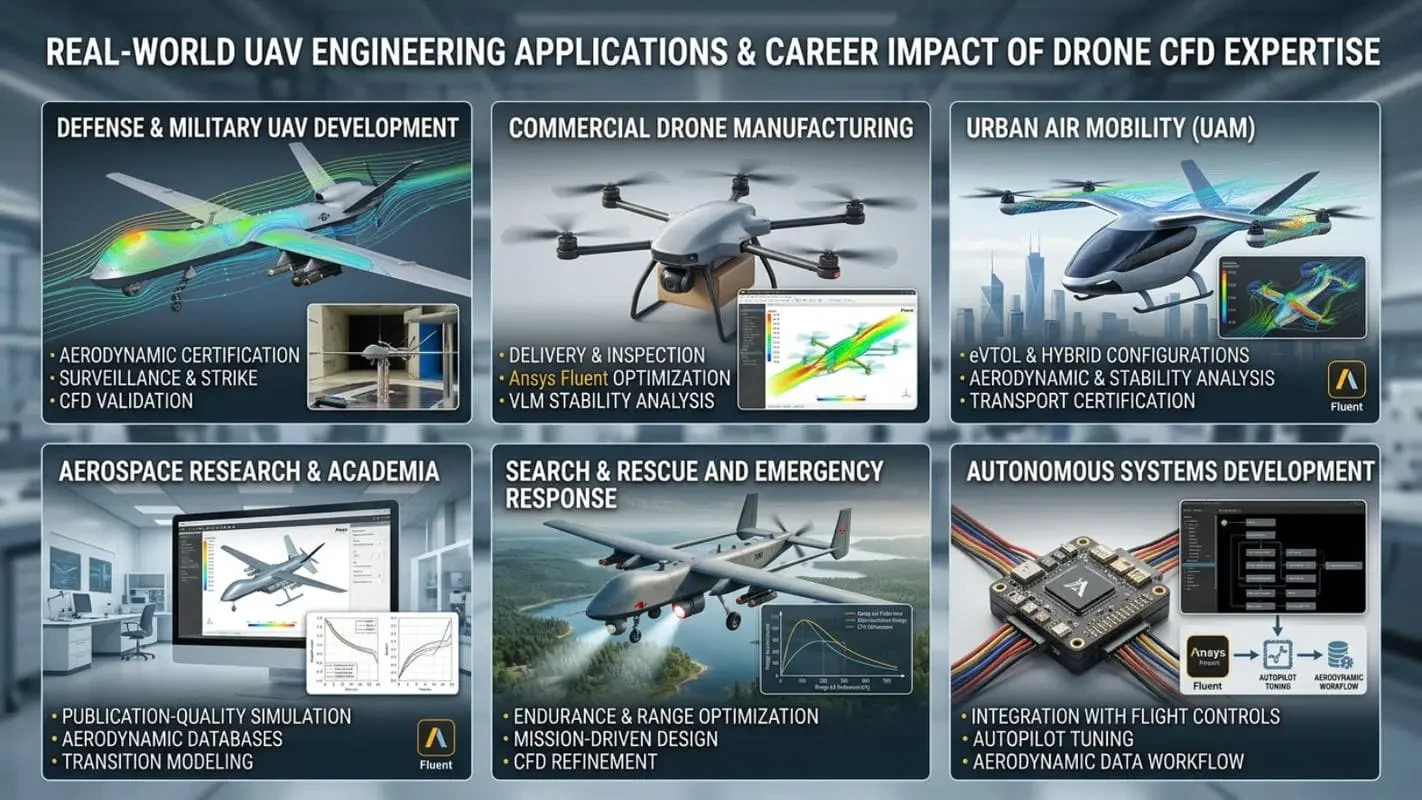
Real-World UAV Engineering Applications & Career Impact of Drone CFD Expertise
Defense & Military UAV Development: Aerodynamic certification of surveillance, reconnaissance, and strike drone configurations using high-fidelity CFD validation alongside wind tunnel testing
Commercial Drone Manufacturing: Performance optimization of delivery, inspection, and agricultural UAVs through Ansys Fluent aerodynamic simulation and VLM stability analysis
Urban Air Mobility (UAM): Aerodynamic and stability analysis of eVTOL and hybrid UAV configurations for urban transport certification
Aerospace Research & Academia: Publication-quality drone CFD simulation for aerodynamic coefficient databases, transition modeling, and configuration trade studies
Search & Rescue and Emergency Response: Endurance and range optimization of UAV platforms through mission-driven aerodynamic design and CFD refinement
Autonomous Systems Development: Integration of aerodynamic performance data from Ansys Fluent into flight control system design and autopilot tuning workflows
Target Audience: Who Should Enroll in This UAV Aerodynamic Design and CFD Training
Aerospace Engineering Students & Graduate Researchers pursuing UAV design projects, theses, or research publications requiring validated CFD aerodynamic analysis
UAV Design Engineers & Aerodynamicists working in commercial or defense drone development who need to integrate Ansys Fluent high-fidelity CFD into their design workflow
Mechanical Engineers Transitioning to Aerospace who require structured training in UAV aerodynamic design methodology and computational aerodynamics tools
CFD Analysts with general simulation experience who want to specialize in external aerodynamics and drone simulation using Ansys Fluent
R&D Engineers at UAV manufacturers, aerospace OEMs, or research institutions who need to validate VLM-based designs with production-grade CFD
Hobbyist Designers and Startup Engineers with technical backgrounds seeking to professionalize their drone design process using industry-standard computational tools
Recommended prerequisites include introductory aerodynamics knowledge and basic familiarity with Ansys Fluent. Engineers new to Ansys Fluent should first complete the Ansys Fluent Beginner Course to establish essential solver literacy before engaging with UAV-specific CFD workflows.
The MR CFD Authority: Production-Grade UAV Simulation Training Standards
MR CFD brings over 15 years of combined consulting and training expertise in Ansys Fluent CFD simulation across aerospace, energy, marine, and industrial engineering domains. The UAV Aerodynamic Design and CFD Course is built to the same engineering standards applied in active CFD consulting engagements — where drone aerodynamic analysis, stability validation, and Ansys Fluent CFD workflows are delivered to aerospace clients with exacting accuracy requirements.
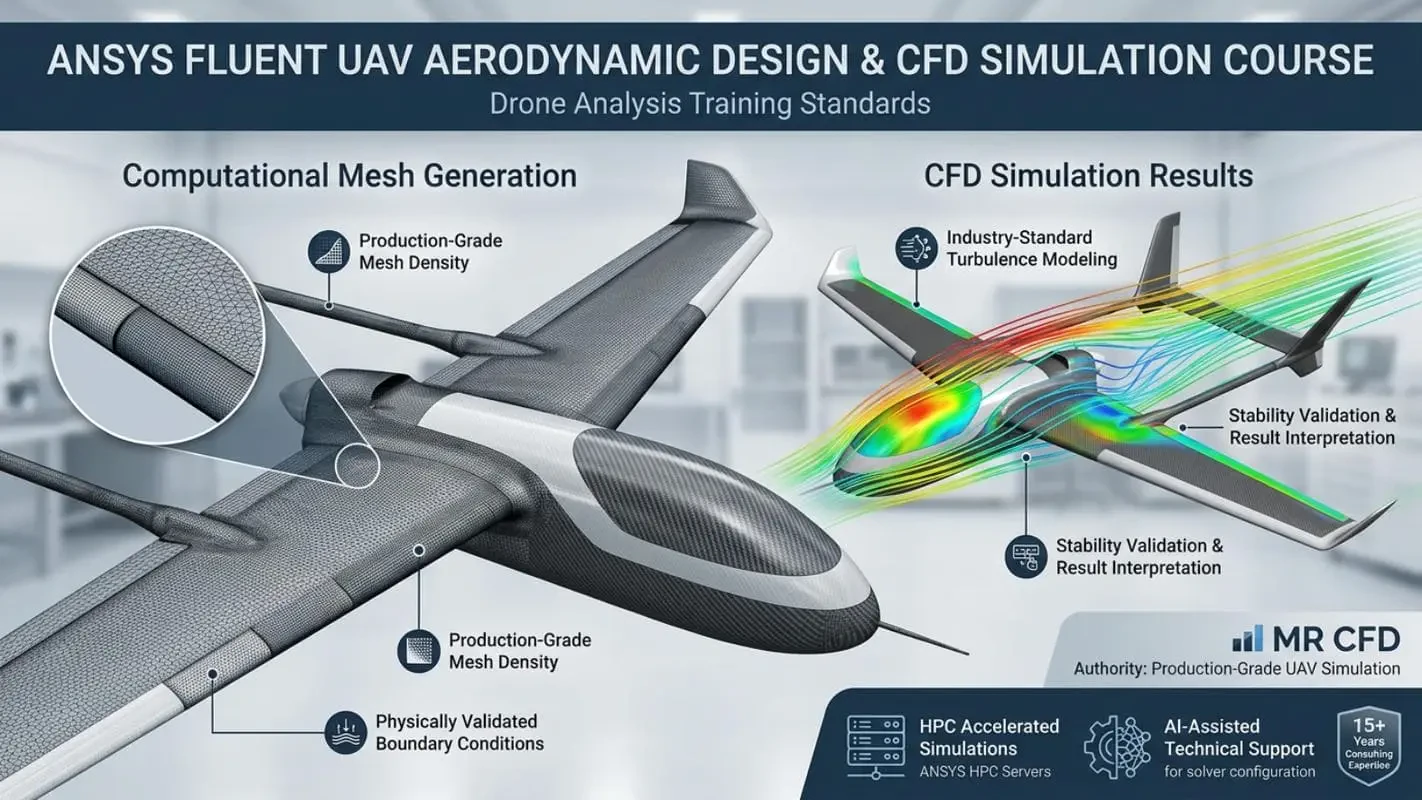
Every simulation project uses production-grade mesh densities, physically validated boundary conditions, and industry-standard turbulence modeling protocols. AI-assisted technical support provides rapid, context-aware guidance on solver configuration, meshing strategy, and aerodynamic result interpretation. For computationally demanding high-fidelity UAV CFD simulations — particularly full-configuration angle-of-attack sweeps and high-resolution boundary layer meshes — MR CFD’s ANSYS HPC Servers provide the parallel computing infrastructure to execute simulations efficiently without hardware limitations. Engineers seeking applied project experience in real aerospace engineering contexts can extend their learning through the CFD Internship.
Educational Progression & Next Steps in Your UAV CFD and Aerospace Engineering Career
The Ansys Fluent UAV Aerodynamic Design and CFD Simulation Course sits at the intersection of the intermediate and advanced tiers of the MR CFD structured learning pathway. Engineers who require foundational Ansys Fluent competency — geometry preparation, meshing, boundary condition setup, and basic post-processing — should first complete the Ansys Fluent Intermediate Course, which builds the solver proficiency needed to engage productively with external aerodynamic CFD workflows. For engineers ready to push into the highest levels of simulation capability, the Ansys Fluent Expert Course covers advanced turbulence modeling, UDF programming, and complex multiphysics simulations that complement UAV aerodynamic expertise.
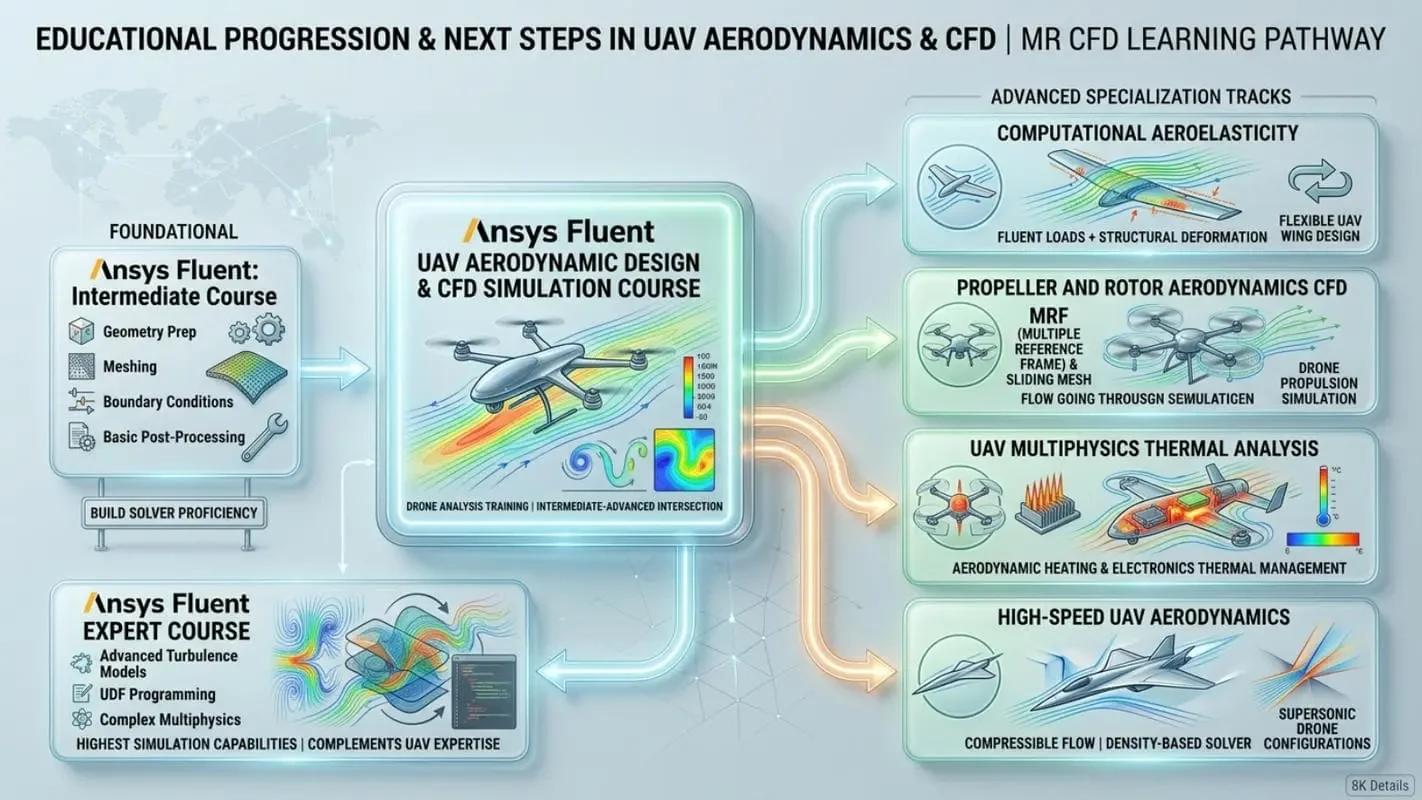
Recommended advanced specialization tracks following this course include:
Computational Aeroelasticity — coupling Ansys Fluent aerodynamic loads with structural deformation analysis for flexible UAV wing design
Propeller and Rotor Aerodynamics CFD — applying MRF (Multiple Reference Frame) and sliding mesh models to drone propulsion system simulation
UAV Multiphysics Thermal Analysis — integrating aerodynamic heating and electronics thermal management into drone CFD workflows
High-Speed UAV Aerodynamics — extending to compressible flow regimes using the density-based solver in Ansys Fluent for supersonic drone configurations
Enroll Now & Accelerate Your UAV Aerodynamic Design and CFD Engineering Career
The ability to design a UAV with engineering rigor — translating a mission need into a validated aerodynamic configuration using AVL, XFLR5, and Ansys Fluent CFD — is a defining competency for the next generation of aerospace engineers. This course delivers that competency through a structured, project-driven curriculum that mirrors professional aerospace design practice at every stage.
You will leave this course able to perform UAV initial sizing, execute vortex lattice method stability analysis, configure and run high-fidelity Ansys Fluent CFD simulations, cross-validate results across fidelity levels, and synthesize all findings into a professional Preliminary Design Review package. These are the exact capabilities demanded by aerospace employers, UAV manufacturers, and research institutions worldwide. Explore all available training programs at the Ansys Fluent full Courses collection hub and enroll in the UAV Aerodynamic Design and CFD Simulation Course today — build the aerospace simulation expertise that the drone industry demands.
UAV aerodynamic design analysis in Ansys Fluent involves using computational fluid dynamics (CFD) to predict lift, drag, pitching moment coefficients, and flow behavior around an unmanned aerial vehicle (UAV) geometry. The workflow begins with CAD geometry preparation, followed by structured meshing with boundary layer inflation, and solver configuration using the k-omega SST turbulence model and pressure-based coupled solver. CFD results are used to validate and refine lower-fidelity models generated by tools such as AVL and XFLR5, producing a high-confidence aerodynamic dataset for the design team.
The Vortex Lattice Method (VLM) is a low-fidelity, computationally efficient aerodynamic analysis technique that models a wing or full aircraft configuration as a series of discrete vortex panels. In UAV design, tools like AVL (Athena Vortex Lattice) apply VLM to rapidly predict aerodynamic coefficients — including lift, induced drag, and stability derivatives such as pitching moment and static margin — across a range of angles of attack. VLM results guide configuration selection and initial sizing before higher-fidelity Ansys Fluent CFD simulations are used for validation and refinement.
Ansys Fluent is used for high-fidelity CFD validation of UAV aerodynamic performance by solving the Reynolds-Averaged Navier-Stokes (RANS) equations over a detailed 3D drone geometry. The simulation captures viscous effects, boundary layer separation, and nonlinear aerodynamic behavior that low-fidelity tools like AVL and XFLR5 cannot resolve. Key outputs — lift coefficient (CL), drag coefficient (CD), and pitching moment coefficient (Cm) — are compared against VLM predictions to identify discrepancies and refine the design before physical prototyping.
Static stability analysis in UAV design determines whether an aircraft will naturally return to its trimmed flight condition after a small disturbance. The key parameter is the static margin — the distance between the center of gravity (CG) and the neutral point (NP), expressed as a fraction of mean aerodynamic chord. A positive static margin indicates longitudinal static stability. Tools like AVL compute stability derivatives (e.g., Cm_alpha) across a range of configurations, while Ansys Fluent CFD provides high-fidelity validation of these derivatives for the finalized UAV geometry.
UAV initial sizing translates mission requirements — range, endurance, payload, cruise altitude — into quantitative design parameters including maximum takeoff weight (MTOW), wing loading (W/S), thrust-to-weight ratio (T/W), and wing planform geometry. This process uses constraint analysis to define a feasible design space, followed by mission segment weight fraction analysis to estimate fuel or battery consumption. The sizing outputs directly define the geometry used in subsequent vortex lattice method (VLM) and Ansys Fluent CFD aerodynamic analyses.
The k-omega SST (Shear Stress Transport) turbulence model is the recommended choice for UAV CFD simulation in Ansys Fluent. It combines the near-wall accuracy of the k-omega model — critical for resolving boundary layer behavior on wing surfaces — with the free-stream robustness of the k-epsilon model in regions away from walls. For UAVs operating at low-to-moderate Reynolds numbers (10⁴ to 10⁶), the k-omega SST model accurately predicts laminar-turbulent transition zones, flow separation, and stall onset — all essential for reliable aerodynamic coefficient prediction.
A comprehensive UAV aerodynamic design and CFD course integrates multiple industry-standard tools across fidelity levels. XFLR5 is used for 2D airfoil polar analysis and initial wing design. AVL (Athena Vortex Lattice) applies the Vortex Lattice Method for full-configuration aerodynamic and stability analysis. CAD software (e.g., SpaceClaim or CATIA) generates the 3D UAV geometry for CFD. Ansys Fluent then performs high-fidelity RANS-based CFD simulation for validation and design refinement. This multi-tool workflow mirrors professional aerospace engineering practice in both industry and research environments.
Proficiency in UAV aerodynamic design and Ansys Fluent CFD simulation opens high-demand career pathways in aerospace engineering, defense, autonomous systems, and UAV manufacturing. Roles include Aerodynamic Design Engineer, CFD Analyst, UAV Systems Engineer, and Flight Dynamics Specialist at organizations ranging from defense contractors and aerospace OEMs to commercial drone manufacturers and research institutions. Engineers who can bridge low-fidelity design tools (AVL, XFLR5) with high-fidelity CFD validation (Ansys Fluent) are particularly valued in integrated design teams where simulation-driven development is the standard workflow.