


Become an Expert ANSYS Fluent User — Ep 02
Chemical Reactions: Non-Premixed Combustion
- Lesson
- 02
- Run Time
- 15m 10s
- Published
- Jun 12, 2026
- Category
- ANSYS Fluent
- Course Progress
- 0%
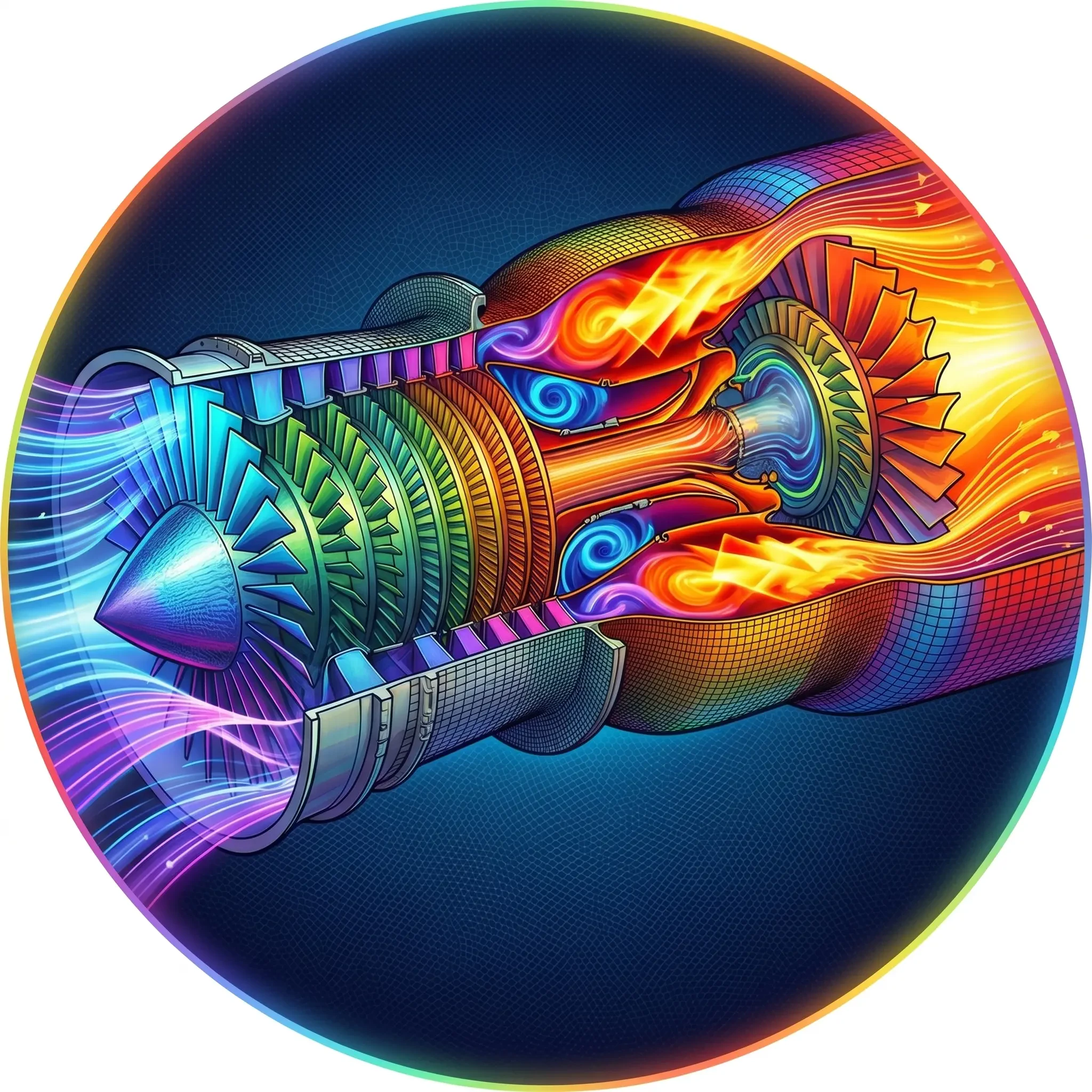
This project simulates non-premixed combustion in a 2-D combustion chamber, where air and hydrocarbon fuel enter through two separate inlets and react to release the fuel's chemical energy as heat. It's a foundational study in reacting-flow CFD — the configuration that describes most real burners, furnaces, and gas-turbine combustors, where fuel and oxidizer are deliberately kept apart until they meet in the reaction zone.
The key modeling choice is the non-premixed (mixture-fraction) approach within Fluent's Species Transport framework. Instead of tracking every reaction rate directly, the model solves transport equations for the mixture fraction — the local mass fraction originating from the fuel stream — and reads the resulting species and temperatures from pre-computed chemistry. This is what makes non-premixed combustion both efficient and stable: the chemistry is folded into the mixture fraction, so you model the mixing and let the thermochemistry follow. By definition, fuel and oxidizer enter through independent paths and do not premix before reaching the chamber.
Setup: an air stream (N₂ at mass fraction 0.767, O₂ at 0.233) enters at 300 K and 1.19 kg/s, while a pure CH₄ (methane) stream enters at 300 K and 0.019 kg/s through a separate inlet. Geometry is built in Design Modeler and meshed in ANSYS Meshing as an unstructured mesh (11,202 cells).
What the results show: contours of pressure, temperature, velocity, and density, plus mass-fraction fields for O₂, CH₄, H₂O, CO₂, N₂, CO, and C₂H₆, along with in-chamber pathlines. The fields confirm a properly anchored combustion reaction: methane and air react where the streams meet, consuming reactants and producing CO₂, H₂O, and intermediates like CO — and the temperature field maps the flame and hot-product zone exactly where the mixture fraction is near stoichiometric.
You'll learn to: set up Species Transport with the non-premixed mixture-fraction model, define separate fuel and oxidizer inlets with realistic compositions and flow rates, and read flame structure and product formation from temperature and species contours.