


Become an Expert ANSYS Fluent User — Ep 02
Combustion: Gas Turbine Combustion Chamber
- Lesson
- 02
- Run Time
- 30m 29s
- Published
- Jun 14, 2026
- Category
- ANSYS Fluent
- Course Progress
- 0%
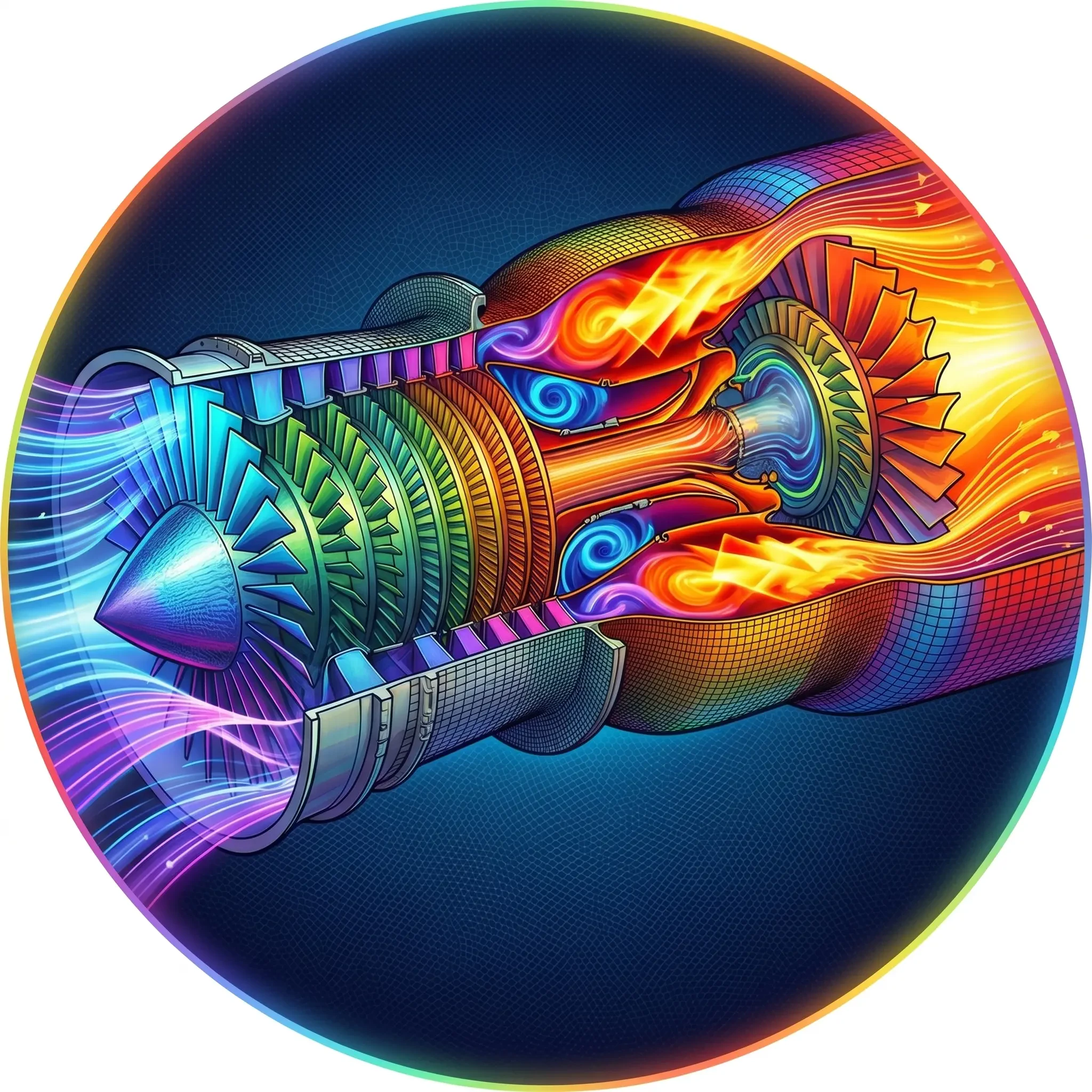
This tutorial presents a CFD analysis of a 2-D gas turbine combustion chamber using ANSYS Fluent.
A gas turbine is a rotating machine driven by the energy released during combustion. It consists of three main components: a compressor that pressurizes incoming air, a combustion chamber where fuel and air mix and ignite, and a turbine that converts the energy of the hot, expanding gases into mechanical work. Part of this mechanical output drives the compressor itself, while the remainder powers the generator in turbo-generator setups, provides thrust in turbojet and turbofan engines, or serves other applications depending on the turbine's design.
The fuel delivery system is one of the most actively developed areas of gas turbine design, with injectors playing a central role in achieving efficient combustion. This project models the combustion of a methane-air mixture inside the chamber, with methane and oxygen entering at velocities of 128.9304 m/s and 12.0396 m/s, and temperatures of 286 K and 109 K, respectively. The resulting mixture ignites, releasing energy and generating heat throughout the domain.
The geometry was created in Design Modeler and discretized using ANSYS Meshing, producing a structured mesh of 197,006 cells.
Methodology
Since the simulation involves multiple chemical species, the Species Transport model is employed to solve the transport equations for each species, while a volumetric reaction defines the combustion process. The Eddy-Dissipation model captures the interaction between turbulence and chemical kinetics, and the real gas equation accounts for density variations of the vapor phase with temperature.
Results
The simulation outputs contours of temperature, velocity, pressure, and species mass fractions throughout the combustion chamber, confirming that the combustion reaction proceeds as expected. Concentrations of the oxidizer and fuel are highest near the inlet and decrease progressively as they are consumed in the reaction, while combustion products such as H₂O and CO start at zero and increase steadily along the chamber. As the reaction is exothermic, it releases substantial heat, driving a marked rise in chamber temperature.