

Icing in ANSYS Fluent
Price: $499
Master the icing process with our “Icing: All Levels” CFD course using ANSYS Fluent. From basics to advanced, learn to perform procedures of Icing simulation by ANSYS Fluent (setting Fluent launcher on the Enterprise level and selecting the icing solver). This course equips you with the essential skills to model icing phenomena under supercooled atmospheric conditions using CFD. This study has applications, particularly in aerodynamic engineering. Ideal for beginners and experts alike, this course enhances your capabilities in Icing analysis for cutting-edge research and industrial applications.
Icing in ANSYS Fluent
Price: $499
Master the icing process with our “Icing: All Levels” CFD course using ANSYS Fluent. From basics to advanced, learn to perform procedures of Icing simulation by ANSYS Fluent (setting Fluent launcher on the Enterprise level and selecting the icing solver). This course equips you with the essential skills to model icing phenomena under supercooled atmospheric conditions using CFD. This study has applications, particularly in aerodynamic engineering. Ideal for beginners and experts alike, this course enhances your capabilities in Icing analysis for cutting-edge research and industrial applications.
-
These concepts help users to perform icing simulations in ANSYS Fluent.There are three main aspects of in-flight icing simulation. To achieve each of the three steps, simulations and calculations are performed sequentially in the three relevant solvers:AirflowParticlesIce AccretionAirflow simulation is performed in ANSYS Fluent software at the Premium level to model the initial fluid flow before defining the icing process. Meanwhile, particles and ice calculations are performed in ANSYS Fluent software with the icing solver option at the Enterprise level to simulate the final icing process.In particle simulation, the focus is on selecting the type of particles to prepare for the icing procedure. Types of particles required for icing include:DropletsIce CrystalsVaporIn ice simulation, the focus is on selecting the physical model of ice to describe the ice accretion process. Types of required ice models include:GlazeRimeWater Film
Lesson 1 6m 12s -
DescriptionIn this project, we present a numerical simulation of the Icing process on an Airfoil using ANSYS Fluent software. We have modeled a 3D airfoil, considering the surrounding airflow as the computational domain.Icing DefinitionIcing is the production process of forming an ice layer on flying objects. This icing phenomenon is caused by the impingement and freezing of supercooled droplets or the accumulation of ice crystals onto air vehicles flying in cold airflow.MethodologyWe carried out the icing simulation in three principal steps (with corresponding appropriate solvers) in ANSYS Fluent software:Airflow SimulationParticles CalculationIce Accretion SimulationAirflow Solver:We simulate the traditional airflow (without icing) around the airfoil to provide a basic analysis from an aerodynamic point of view.Particles Solver:We set Fluent launcher to the Enterprise level to use the Icing solver in ANSYS Fluent. Then, we import the initial solution data obtained from the airflow simulation.In the present project, we only model Droplets as the particle type required for preparing the icing process. These supercooled water droplets exist in liquid form at lower ambient temperatures.Ice Accretion Solver:After the particle calculations are complete, it is time for the final calculations to simulate icing.In the present project, we define the Glaze model as the physical model described the icing condition. This is the most comprehensive model that can operate above and below freezing temperatures.ConclusionWe represent the final results in two sections (airflow simulation and icing simulation):We obtained contours related to the distribution of the velocity, pressure, and temperature. These velocity and pressure distributions around the airfoil confirm the reasonable behavior of the airfoil from an aerodynamic approach.We obtained the distribution contours corresponding to the various icing variables, including ice thickness, ice film thickness, and ice growth. In addition, since we have modeled the droplet particle type, we obtained the distribution contours for ice concentration and ice collection. These resulting distributions confirm the ice generation on the airfoil concentrated on the attack edge, where the initial impingement of the airflow containing water supercooled droplets occurs.
Lesson 2 15m 41s -
DescriptionIn this project, we present a numerical simulation of the Icing process on an Aircraft using ANSYS Fluent software. We have modeled an aircraft containing two warm nacelles. Note that we design the half of the aircraft body and consider the surrounding airflow as the computational domain.Icing DefinitionIcing is the production process of forming an ice layer on flying objects. This icing phenomenon is caused by the impingement and freezing of supercooled droplets or the accumulation of ice crystals onto air vehicles flying in cold airflow.MethodologyWe carried out the icing simulation in three principal steps (with corresponding appropriate solvers) in ANSYS Fluent software:Airflow SimulationParticles CalculationIce Accretion SimulationAirflow Solver:We simulate the traditional airflow (without icing) around the aircraft to provide a basic analysis from an aerodynamic point of view.Particles Solver:We set Fluent launcher to the Enterprise level to use the Icing solver in ANSYS Fluent. Then, we import the initial solution data obtained from the airflow simulation.In the present project, we model both Droplets and Crystals as the particle type required for preparing the icing process. The droplets refer to supercooled water droplets that exist in liquid form at lower ambient temperatures. However, the ice crystals refer to the solid particles suspended in the airflow.Ice Accretion Solver:After the particle calculations are complete, it is time for the final calculations to simulate icing.In the present project, we define the Glaze model as the physical model described the icing condition. This is the most comprehensive model that can operate above and below freezing temperatures.ConclusionWe represent the final results in two sections (airflow simulation and icing simulation):We obtained contours related to the distribution of the velocity, pressure, and temperature. These velocity and pressure distributions around the aircraft body and its components (like wings and nacelles) confirm the reasonable behavior of the aircraft from an aerodynamic approach.We obtained the distribution contours corresponding to the various icing variables, including ice thickness, ice film thickness, and ice growth. In addition, since we have modeled the droplet and crystal particle types, we obtained the distribution contours for droplet concentration, droplet collection, crystal concentration, and crystal collection. These resulting distributions confirm the ice generation on the aircraft concentrated on the different parts of the aircraft, such as the nose and tail, the leading edge of the wing, and the engine nacelles.
Lesson 3 17m 52s
Fluent Icing CFD Course | ANSYS Fluent Ice Accretion Simulation Training
The accumulation of ice on aerodynamic surfaces poses a catastrophic threat to flight safety, making aircraft icing CFD simulation an indispensable competency in modern aerospace engineering. The Aircraft Icing CFD Course offered by MR CFD provides a rigorous, production-grade pathway to mastering the ANSYS Fluent icing solver. By enrolling in our specialized CFD Online Courses, engineers transition from basic fluid dynamics to executing complex multiphase icing simulation workflows. This training equips you to predict aerodynamic performance degradation due to icing, validate anti-icing and de-icing systems, and ensure structural integrity under severe supercooled atmospheric conditions.
The Critical Role of Aerodynamic Icing Analysis in Flight Safety and UAV Design
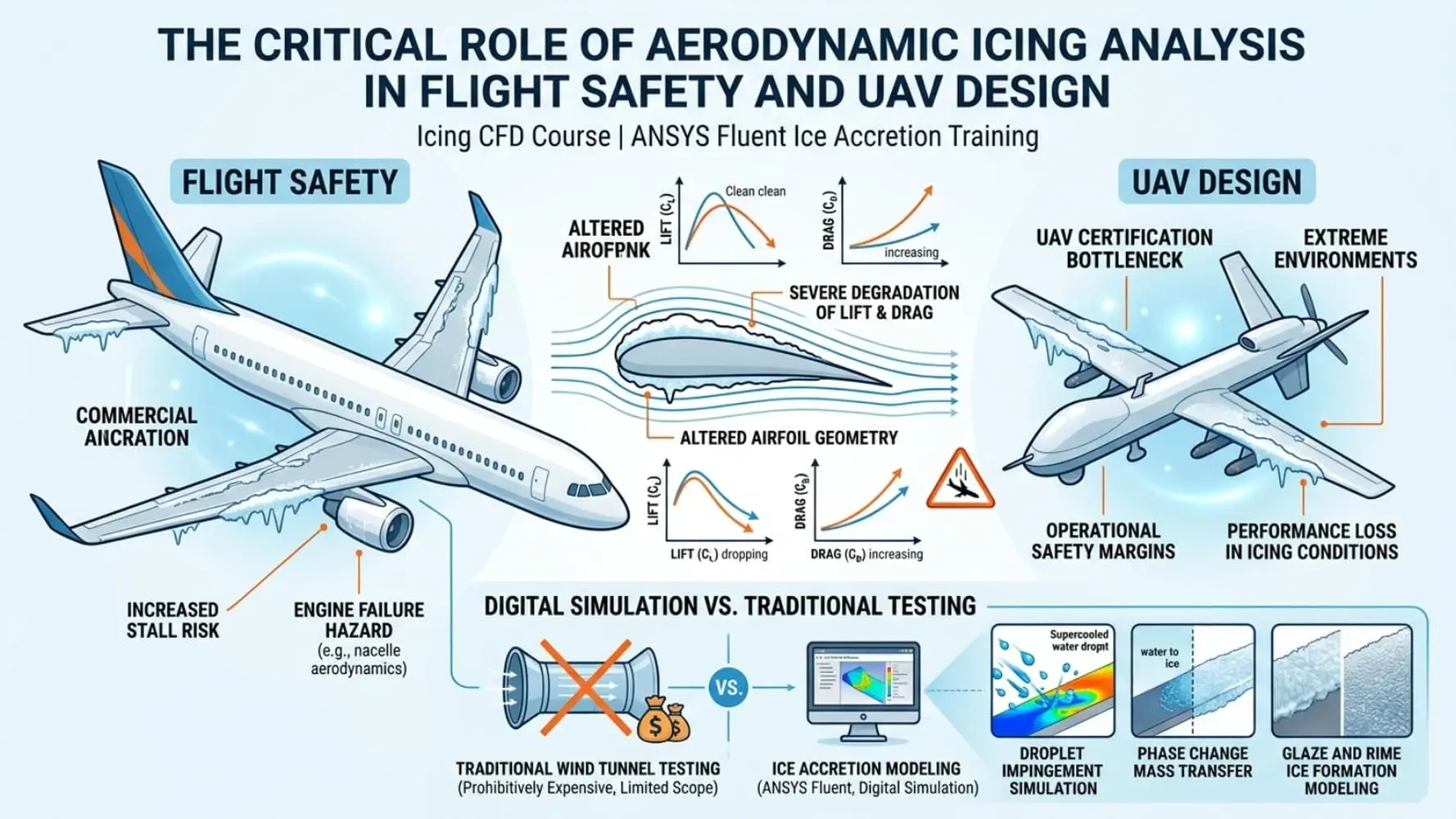
As aviation pushes into extreme environments, aerodynamic icing analysis has become a primary bottleneck in aircraft and UAV certification. Ice accretion alters the airfoil geometry, severely degrading lift and drag coefficients and potentially leading to stall or engine failure. Traditional wind tunnel testing is prohibitively expensive and limited in scope. Consequently, the industry relies heavily on ice accretion modeling to simulate supercooled atmospheric conditions digitally. Mastering droplet impingement simulation and phase change mass transfer allows engineers to predict glaze and rime ice formation modeling accurately, ensuring that nacelle aerodynamics and wing profiles maintain operational safety margins before physical prototypes are ever built.
Technical Core Competencies in Ice Accretion Modeling and Multiphase Workflows
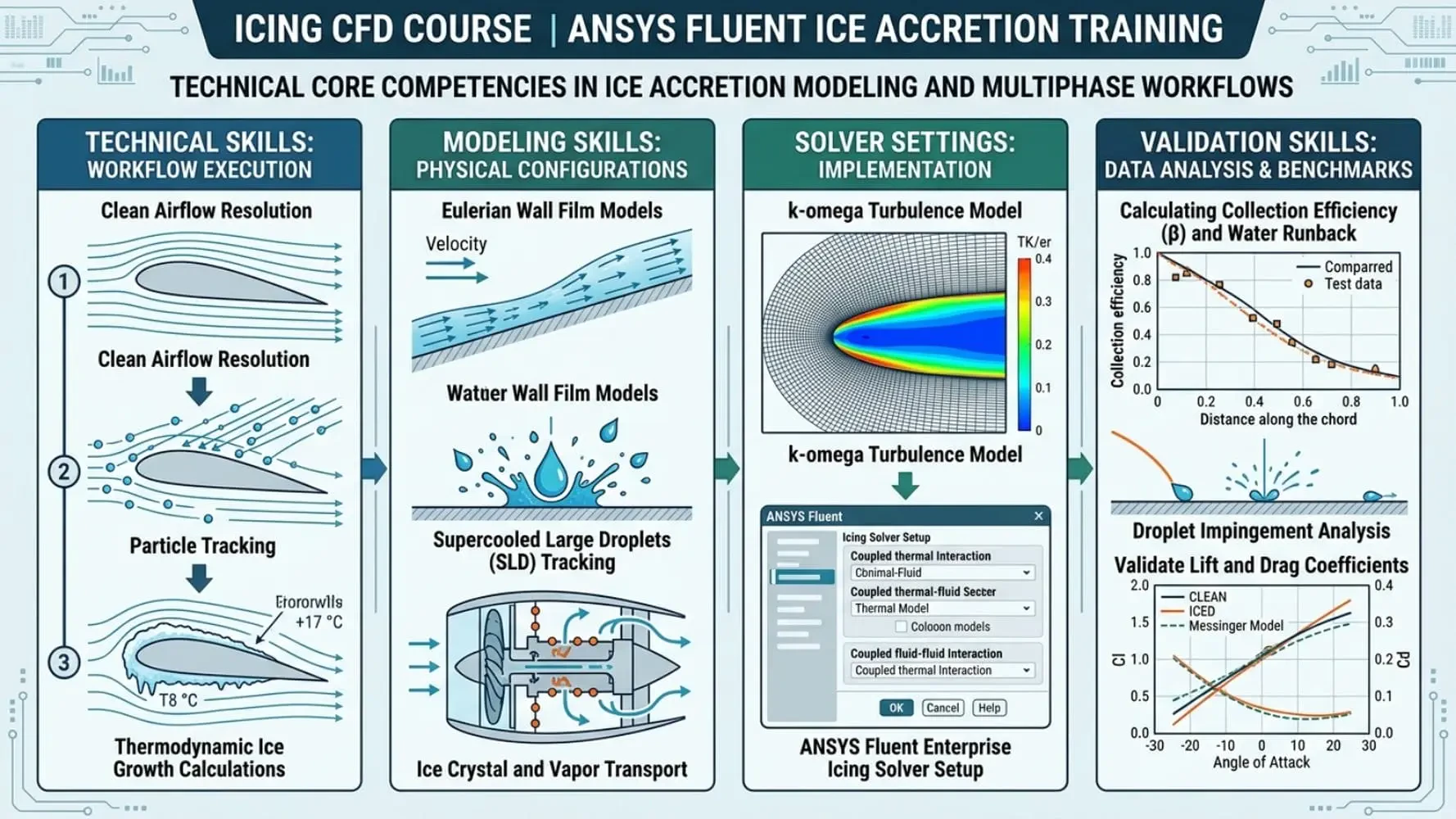
Technical Skills: Execution of the three-step icing simulation workflow, encompassing clean airflow resolution, particle tracking, and thermodynamic ice growth calculations.
Modeling Skills: Configuration of Eulerian wall film models, supercooled large droplets (SLD) tracking, and ice crystal and vapor transport simulation for internal engine components.
Solver Settings: Implementation of the k-omega turbulence model for precise boundary layer mesh resolution, and ANSYS Fluent Enterprise icing solver setup for coupled thermal-fluid interactions.
Validation Skills: Calculating collection efficiency, performing droplet impingement and water runback analysis, and validating lift and drag coefficients against empirical Messinger model benchmarks.
Comprehensive Course Modules & Simulated Icing Projects
Airflow Resolution and Boundary Layer Mesh Generation
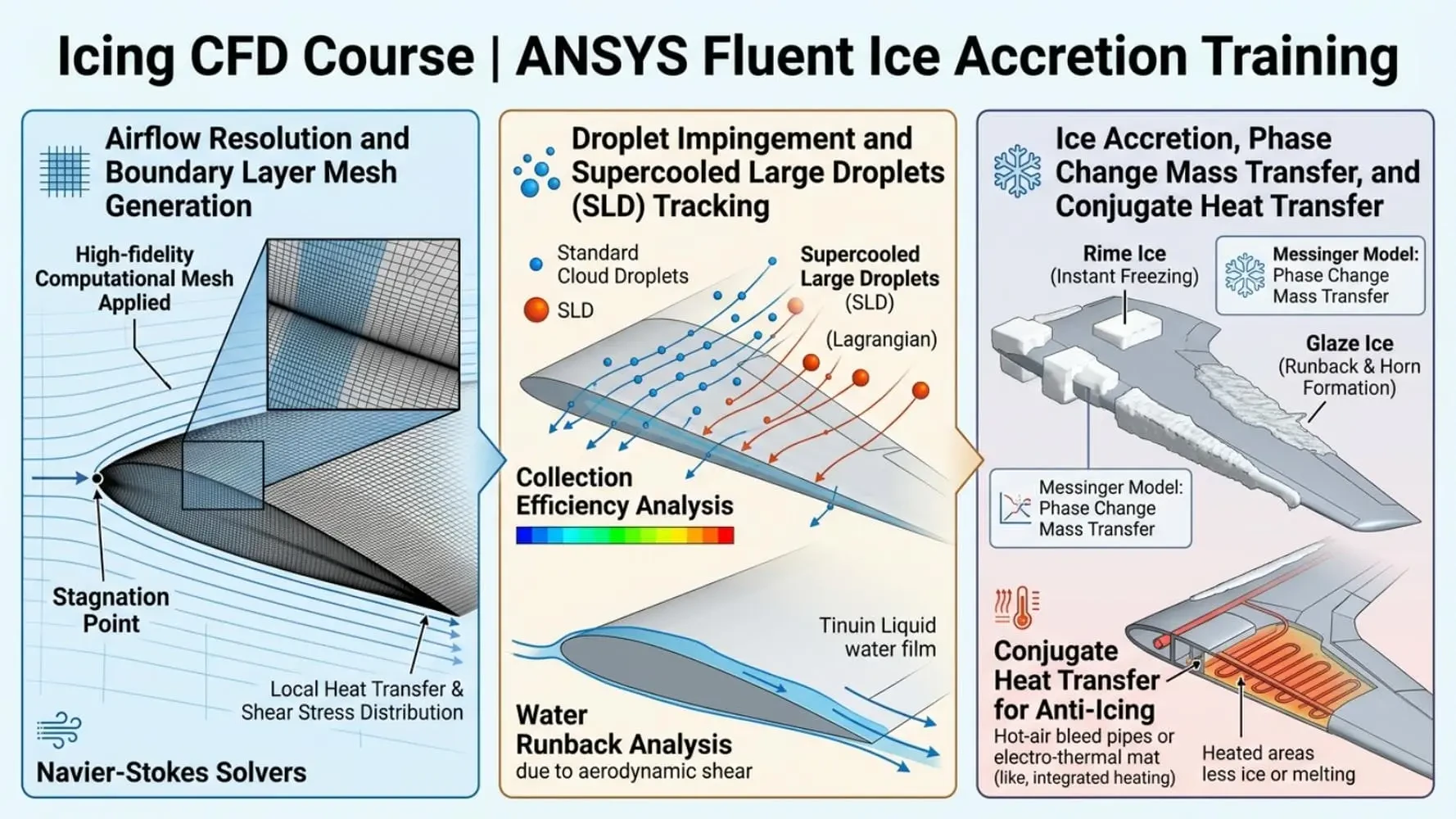
The foundation of any aircraft icing simulation in ANSYS Fluent begins with resolving the clean aerodynamic field. You will learn to solve the Navier-Stokes equations using high-fidelity boundary layer mesh techniques to capture the stagnation point and shear stress distributions accurately. This step is critical, as the local heat transfer and pressure gradients directly dictate the subsequent droplet impingement simulation and overall aerodynamic icing analysis.
Droplet Impingement and Supercooled Large Droplets (SLD) Tracking
This module focuses on modeling supercooled large droplets in CFD and standard cloud droplets. You will configure Lagrangian and Eulerian particle tracking to determine collection efficiency across complex 3D geometries. Understanding droplet impingement and water runback analysis is essential for predicting where liquid water will accumulate, flow backward due to aerodynamic shear, and eventually freeze, which is the core mechanism behind complex glaze and rime ice modeling.
Ice Accretion, Phase Change Mass Transfer, and Conjugate Heat Transfer
The final phase of the multiphase icing simulation involves activating the thermodynamic solvers. You will apply the Messinger model to calculate phase change mass transfer, distinguishing between rime ice (instant freezing) and glaze ice (runback and horn formation). Furthermore, you will integrate conjugate heat transfer for anti-icing systems, coupling internal hot-air bleed systems or electro-thermal mats with the external flow to design and validate active anti-icing and de-icing strategies for critical flight components.
Professional Engineering Skills for Anti-Icing and De-Icing Workflows
Skill Category | Competencies Acquired |
|---|---|
CFD Skills | ANSYS Fluent Enterprise icing solver setup, Eulerian wall film configuration, k-omega turbulence model tuning. |
Core Engineering | Ice accretion prediction for UAV aerodynamics, glaze and rime ice formation modeling, stagnation point heat flux analysis. |
Simulation Workflows | Three-step icing simulation workflow, conjugate heat transfer icing coupling, collection efficiency post-processing. |
Real World Industrial Applications in Aerospace and UAV Design
The capabilities developed in this UAV icing CFD course map directly to high-stakes industrial sectors. In commercial and military Aerospace, engineers utilize aircraft icing CFD simulation to certify wing profiles and engine inlets under FAR/CS-25 Appendix C and O conditions. The rapidly expanding UAV and eVTOL sectors rely on ice accretion prediction for UAV aerodynamics to ensure autonomous flight safety in adverse weather. Furthermore, specialists in Propulsion and Nacelle Aerodynamics use ice crystal and vapor transport simulation to prevent internal engine core icing. For engineering firms requiring immediate, validated solutions for extreme weather certification, our CFD Consulting services provide expert-led aerodynamic icing analysis and regulatory compliance support.
Target Audience for Multiphase Icing Simulation Training
Aerospace Engineers & Aerodynamicists: Professionals tasked with certifying airframes and nacelle aerodynamics against severe supercooled atmospheric conditions and glaze and rime ice modeling requirements.
Researchers & PhD Candidates: Academics investigating modeling supercooled large droplets in CFD, phase change mass transfer, and novel anti-icing and de-icing materials.
UAV & eVTOL Designers: Engineers developing autonomous flight vehicles who require ice accretion prediction for UAV aerodynamics to guarantee operational safety margins.
Simulation Specialists: CFD analysts expanding their portfolio from single-phase aerodynamics into highly coupled multiphase icing simulation and conjugate heat transfer icing.
Why MR CFD Delivers Authority in Aerodynamic Icing Analysis
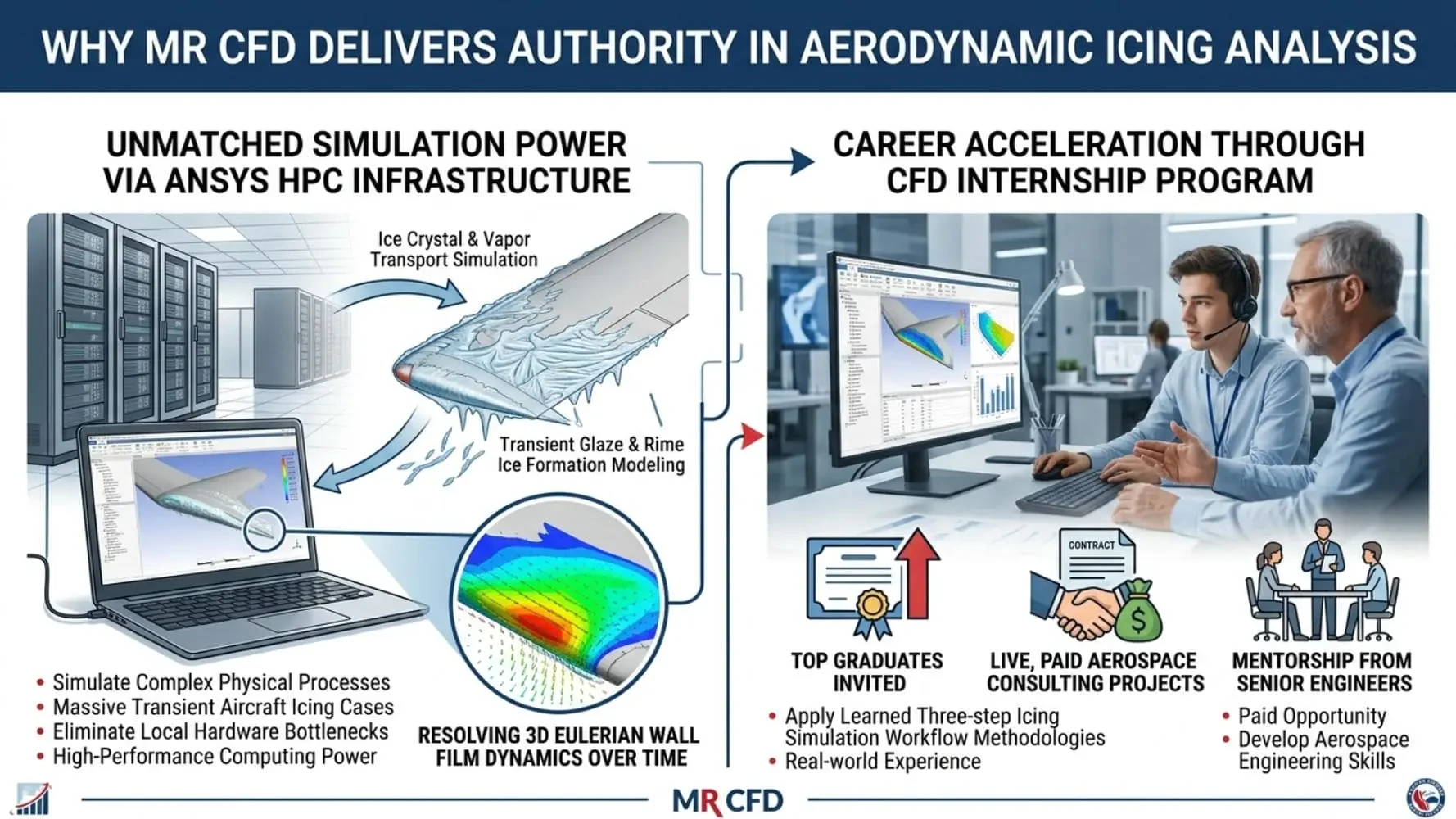
Simulating ice crystal and vapor transport simulation and transient glaze and rime ice formation modeling requires immense computational power, especially when resolving 3D Eulerian wall film dynamics over time. MR CFD eliminates local hardware bottlenecks by providing direct access to our ANSYS HPC Pack infrastructure, allowing you to run massive transient aircraft icing CFD simulation cases without latency. Furthermore, top-performing graduates are invited to join our CFD Internship program, where they apply these exact three-step icing simulation workflow methodologies to live, paid aerospace consulting projects under the mentorship of senior engineers.
Educational Progression from Fundamentals to Expert CFD
True mastery of aerodynamic icing analysis requires a structured ascent through fluid dynamics and thermodynamics. This specialized training assumes you have already conquered the foundational physics in the Ansys fluent beginner course and expanded your multiphase capabilities through the Ansys fluent intermediate course. While this program serves as a masterclass in ice accretion modeling and conjugate heat transfer icing, those seeking to master custom solver coding, extreme reacting flows, and advanced FSI should subsequently target the Ansys Fluent Expert Course to complete their certification pipeline.
Secure Your Enrollment in the ANSYS Fluent Icing Solver Course
Stop relying on simplified tutorials that fail to capture the thermodynamic complexity of supercooled atmospheric conditions. The Aircraft Icing CFD Course is your definitive gateway to mastering the ANSYS Fluent icing solver, droplet impingement simulation, and glaze and rime ice modeling. Enroll today to execute production-grade multiphase icing simulation, validate anti-icing and de-icing systems, and build a specialized portfolio that commands respect in the aerospace and UAV engineering sectors.
Icing is the process of formation a coating of ice on objects.
The icing phenomenon is caused by the impingement and freezing of supercooled droplets or ice crystals on in-flight objects in the cold airflow.
Icing analysis focuses specifically on air vehicles in flight; cases such as aircraft, flying equipment, and their components (like wings, nacelles, etc.)
We teach icing simulation in ANSYS Fluent, noting that we interrupt Fluent at the enterprise level using the icing solver.
Our icing simulation includes three principal steps, which correspond to three appropriate solvers: 1. Airflow, 2. Particles, 3. Ice Accretion.
This solver specifies the particle type used to model icing conditions; options include droplets, ice crystals, and vapor transport.
This solver defines the physical models to describe icing; options include glaze, rime, and water film.
This icing training course includes an introduction to icing concepts, along with training on two icing simulation projects involving an airfoil and an aircraft.