

Engineering Fields Online Courses
Here's every CFD online course related to Engineering Fields category.

Helical Blade Wind Turbine: 5 different RPMs
Beginner, Intermediate, Advanced
Price: $220
This project uses ANSYS Fluent to numerically simulate a helical-blade vertical axis wind turbine. The project investigates the tip speed ratio (TSR) across different blade rotational speeds. The 3D model is built in Design Modeler. The model is meshed in ANSYS Meshing, with a polyhedral element count of 507,457. The simulation is run as unsteady (transient). The Mesh Motion method is used to define the rotational motion in a distinct zone around the blades.
Vertical Axis Wind Turbine (VAWT): Paper Numerical Validation
Beginner, Intermediate, Advanced
Price: $320
This project uses ANSYS Fluent to numerically simulate a vertical axis wind turbine (VAWT). The project is validated against a reference article. The 3D model is built in SpaceClaim. The model is meshed in ANSYS Meshing, with an element count of 1,650,940. The simulation is run as unsteady (transient). The Mesh Motion method is used to define the rotational motion.
Darrieus Wind Turbine
Beginner, Intermediate, Advanced
Price: $42
This project uses ANSYS Fluent to numerically simulate a Darrieus wind turbine. The 3D model is built in Design Modeler. The model is meshed in ANSYS Meshing, with an element count of 2,289,621. The simulation is run as unsteady (transient). The Mesh Motion method is used to define a rotating zone.
Serrated Vs. Plain Airfoil: Darrieus VAWT
Beginner, Intermediate, Advanced
Price: $72
This project uses ANSYS Fluent to numerically simulate and compare a serrated-airfoil and a plain-airfoil turbine. The 3D model is built in Design Modeler. The model is meshed in ANSYS Meshing, with an element count of 1,186,185. The simulation is run as unsteady (transient). The rotating motion of the turbine blades is defined using the Mesh Motion option.

Urban Planning: All Levels CFD Training Package
Beginner, Intermediate, Advanced
Price: $29
Urban Planning: All Levels CFD Training Package is a six-project introduction to urban airflow and air-quality simulation in ANSYS Fluent. Starting from wind flow around individual buildings and building through street-canyon pollutant dispersion to district-scale air quality and the urban heat island effect, it gives learners a hands-on, application-driven foundation in the CFD techniques behind modern urban planning and sustainable city design — one real engineering case at a time.

Price: $29
Rotary Equipment: Beginner CFD Training Package is a ten-project introduction to rotating-machinery simulation in ANSYS Fluent. Starting from single-rotor blowers and fans and building through compressors, propellers, and pumps to a side-by-side comparison of the MRF, SRF, and mesh-motion methods, it gives newcomers a hands-on, application-driven foundation in the CFD techniques behind modern turbomachinery and rotating-equipment design — one real engineering case at a time.

Price: $29
Renewable Energy: Beginner CFD Training Package is a ten-project introduction to renewable-energy simulation in ANSYS Fluent. Starting from passive solar chimneys and building through solar-thermal collectors, thermal storage, dry cooling, geothermal, and wind energy, it gives newcomers a hands-on, application-driven foundation in the CFD techniques behind modern clean-energy engineering — one real engineering case at a time.

Marine Engineering: Beginner CFD Training Package
Beginner, Intermediate
Price: $59
Marine Engineering: Beginner CFD Training Package is a ten-project introduction to marine and hydrodynamic simulation in ANSYS Fluent. Starting from ship-system internal airflow and progressing through hydrodynamic loading, free-surface waves, moving-body dynamic-mesh problems, and cavitating flows, it gives newcomers a hands-on, application-driven foundation in the CFD techniques behind modern marine, offshore, and ocean-energy engineering — one real engineering case at a time.
Price: $29
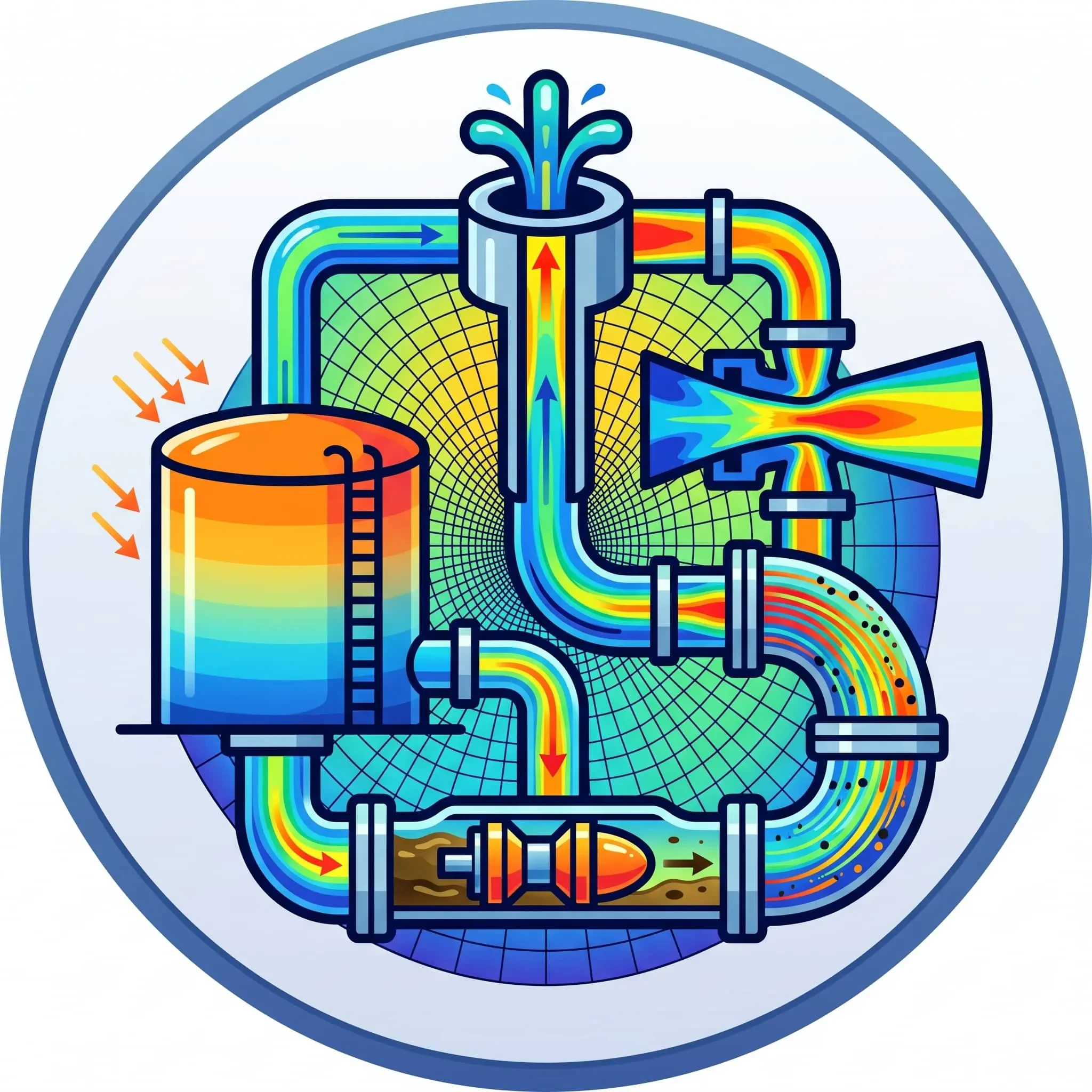
The Gas & Petrochemical: Beginner CFD Training Package contains 10 practical ANSYS Fluent projects covering the essential flow phenomena of the oil, gas, and petrochemical industries. Starting from laminar and turbulent pipe flow, you'll progress through borehole flow, tank charging and discharging, solar heating of fuel storage, steam and two-phase ejectors, gas sweetening hydrodynamics, elbow erosion, and pipeline pigging — building the core CFD skills every process and petroleum engineer needs.